In an era where artificial intelligence is rapidly reshaping consumer behavior, businesses are facing a critical shift in how potential customers initiate their search for products and services. A growing segment of buyers is now bypassing traditional search engines, opting instead for conversational AI interfaces like ChatGPT, Gemini, and Perplexity, or engaging with AI Overviews directly on search result pages without clicking through to websites. This paradigm shift presents a significant challenge and opportunity for companies to adapt their digital marketing strategies. Recognizing this evolving landscape, HubSpot embarked on an ambitious initiative to measure and optimize its presence within this new "answer engine" ecosystem, a journey that has yielded significant insights and actionable strategies for AI Engine Optimization (AEO).
The genesis of HubSpot’s AEO strategy can be traced back to the marketing team’s observation that a substantial portion of their audience was no longer relying solely on traditional search results. Buyers were increasingly turning to AI-powered platforms to compare products, seek solutions to complex problems, and gain immediate answers to their queries. However, the existing tools and metrics available to HubSpot were ill-equipped to quantify their visibility within these nascent AI environments. Without a reliable method to track AI performance, the team faced a crucial blind spot: they could not ascertain whether their efforts to engage with this new wave of search behavior were effective. This lack of visibility posed a direct threat to their ability to influence potential customers early in their decision-making process.
To address this critical gap, in June 2025, the HubSpot Marketing team partnered with XFunnel, a specialized AEO tool designed to provide granular insights into AI visibility across various platforms, including ChatGPT, Gemini, and Perplexity. This collaboration marked the formal commencement of HubSpot’s proactive approach to AEO, aiming to not only measure but also actively optimize their presence within these AI-driven answer engines. The initiative was designed to be comprehensive, covering a wide array of product lines and buyer personas.
Building a Robust AI Engine Optimization Measurement System
The foundational step in HubSpot’s AEO journey involved meticulously defining the buyer’s journey as it unfolds across these new answer engines. The primary question guiding this effort was: "When a potential customer poses a question related to a problem that HubSpot’s products address, does HubSpot appear as a relevant answer?" To answer this, the team architected a detailed measurement system, categorizing their efforts under "Product-Led AEO."
The architecture for this measurement system was built by establishing dedicated XFunnel containers for each of HubSpot’s distinct product lines. This granular approach allowed for specialized tracking and analysis, ensuring that AEO performance could be evaluated at a product-specific level while simultaneously contributing to an overarching view of the company’s AI strategy. The measurement framework incorporated several key components:
- Prompt Definition: Identifying and categorizing the specific queries and questions that potential buyers would likely ask AI engines related to HubSpot’s offerings. This involved extensive keyword research, analysis of existing search queries, and an understanding of common pain points addressed by HubSpot’s software.
- Answer Engine Tracking: Implementing XFunnel’s capabilities to monitor HubSpot’s visibility and mentions across major AI platforms. This included tracking direct citations, overall brand mentions, and the context in which HubSpot appeared.
- Citation Analysis: Deeply analyzing the instances where AI engines referenced HubSpot’s content. This went beyond mere mention tracking to understand why HubSpot was being cited, the quality of the citation, and its impact on the AI-generated answer.
- Performance Benchmarking: Establishing baseline metrics for AI visibility and setting clear Key Performance Indicators (KPIs) to measure progress. This allowed for objective evaluation of the effectiveness of optimization efforts.
This structured approach empowered sub-teams responsible for individual product lines to conduct experiments, track improvements in their specific AEO performance, and implement targeted optimizations. Crucially, it also provided HubSpot’s leadership with a holistic, bird’s-eye view of the entire AEO strategy, enabling strategic adjustments and resource allocation.
![How HubSpot became the #1 CRM in AI search [A case study]](https://53.fs1.hubspotusercontent-na1.net/hubfs/53/How-HubSpot-became-the-%231-CRM-in-AI-search.png)
The core AEO KPIs that HubSpot began to measure after defining their prompt sets were instrumental in guiding their optimization efforts. These included:
- AI Visibility Score: A comprehensive metric indicating how often HubSpot content appeared in AI-generated answers for relevant prompts.
- Citation Share: The percentage of times HubSpot content was directly cited by an AI engine compared to competitors or other sources.
- Mention Volume: The overall frequency of HubSpot’s brand name appearing within AI-generated responses, regardless of direct citation.
- Average Ranking Position: For prompts where HubSpot content was cited, the average position it occupied within the AI’s answer or the associated search results.
The Three-Pillar AI Engine Optimization Strategy
Following a thorough analysis of the initial data gathered through XFunnel, HubSpot identified three fundamental pillars that formed the bedrock of a successful AEO strategy: on-site content optimization, off-site amplification, and forum growth. This strategic framework was meticulously designed to address the unique characteristics of AI-driven information retrieval and influence.
Pillar 1: On-Site Content Optimization for AI Comprehension
Initial AI visibility scores for HubSpot were encouraging, but XFunnel data revealed a significant weakness: citation scores were consistently low. This indicated that while HubSpot’s brand might be appearing in AI outputs, the AI engines were not frequently referencing the company’s own website as a definitive source. This presented a critical challenge, as being cited directly increases the likelihood of influencing the AI’s answer and driving valuable direct traffic.
The Growth team’s analysis pointed to a clear need for more ultra-specific content that could directly address the hyper-personalized answers AI engines provide. When AI encountered buying questions or industry fit assessments, it often struggled to find HubSpot content deemed authoritative enough for citation. The key realization was the imperative to create content tailored precisely to HubSpot’s key buyer personas, enabling the AI to confidently answer the fundamental question: "Will HubSpot work for my business?"
To achieve this, HubSpot implemented several targeted on-site content optimization tactics:
Industry-Specific Content at Scale: Recognizing that prospects are keen to understand solution suitability for their particular industry, HubSpot developed industry solutions pages. Leveraging an AI content system, they generated content from HubSpot’s extensive library of case studies. This AI-generated content underwent rigorous human review before publication. The strategy incorporated structured data, specifically Breadcrumb and FAQ schema, to enhance AI engines’ ability to understand and categorize the pages. This initiative proved highly successful, with 92% of these industry-specific pages being cited by AI engines, resulting in a remarkable 49% uplift in AI visibility.
Furthermore, HubSpot began publishing software comparison articles tailored for specific industries, such as "5 best CRMs for construction businesses." These articles demonstrated a dramatic impact, leading to a 642% increase in citations for those posts and a 58% surge in overall mentions within AI outputs.
![How HubSpot became the #1 CRM in AI search [A case study]](https://53.fs1.hubspotusercontent-na1.net/hubfs/53/CRM-in-AI-search-1-20260414-7418567.webp)
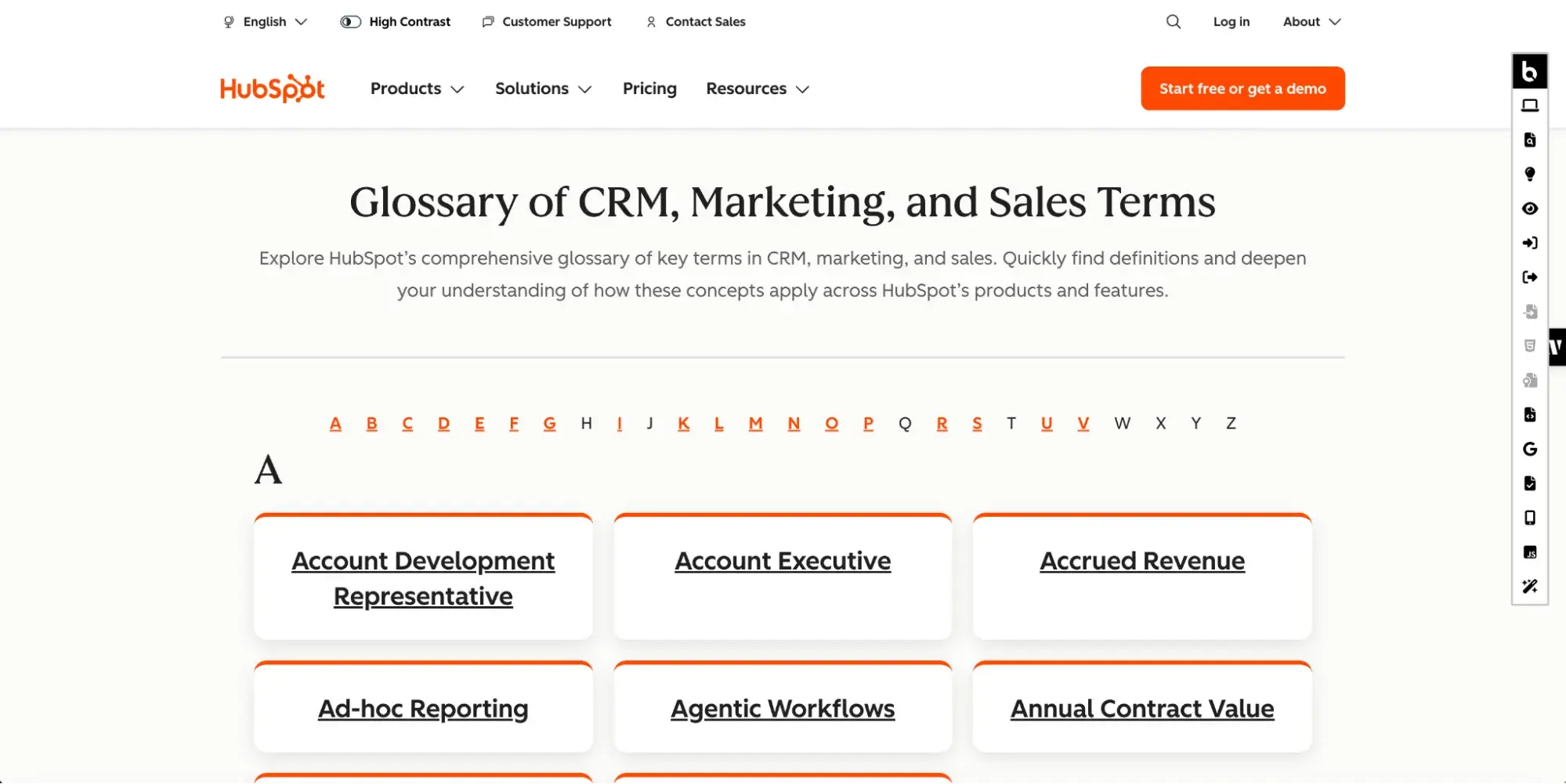
FAQ Glossary for Foundational Terms: The team also identified a gap in HubSpot’s presence during the "Problem Exploration" stage of the buyer’s journey. To address this, they launched an extensive FAQ glossary covering top-of-funnel terms like "what is marketing automation?" and "how does lead scoring work?" Each glossary page features a concise definition, answers to common related questions, and direct links to relevant HubSpot features. The strategy was based on the understanding that AI engines frequently extract information from definitions, and by owning these foundational terms, HubSpot could become the initial source of information for prospects. This led to a significant +60% increase in citation share for related prompts and a +35 percentage point rise in brand visibility for awareness-stage prompts when the glossary was cited.
Optimizing Product Pages for AI Comprehension: HubSpot systematically updated its product feature pages to better align with how AI engines process information. This involved incorporating FAQs, rewriting headlines to directly address common buyer questions, and improving formatting with tables and lists. The addition of structured data was crucial for making these pages more easily readable and categorizable by AI. These optimizations resulted in a 56% increase in citations from AI answer engines and an improvement in the average ranking position from 1.5 to 1, solidifying HubSpot’s authority on its own product offerings.
Pillar 2: Off-Site Amplification for Broader AI Influence
HubSpot’s AEO benchmarks revealed a crucial insight: third-party content significantly shaped AI answers related to HubSpot’s products. This underscored the necessity of actively building HubSpot’s presence within the broader third-party content ecosystem.
The partnership team, armed with XFunnel data, identified publishers who were already achieving strong citations for relevant topics but were not yet mentioning HubSpot. HubSpot then equipped these partners with AEO recommendations and content templates specifically designed for AI-engine-friendly content creation. This collaborative approach enabled partners to generate content that was more likely to be cited by AI, thereby extending HubSpot’s reach and influence.
The program was scaled rapidly, resulting in partnerships with hundreds of websites globally by the end of 2025. This collaboration yielded nearly a thousand new content pieces, contributing to hundreds of thousands of new AI citations where HubSpot was prominently mentioned. This off-site amplification strategy proved highly effective in embedding HubSpot’s brand and solutions within the wider digital conversation that AI engines were drawing from.
Pillar 3: Forum Growth for Community-Driven Insights
XFunnel benchmarks consistently highlighted Reddit as one of the most frequently cited sources for HubSpot-related prompts. This demonstrated the significant influence of online communities in shaping AI-generated answers.
To capitalize on this, HubSpot integrated continuous Reddit citation monitoring into their reporting using XFunnel. This allowed them to identify high-impact subreddits and track any gaps in HubSpot’s mentions on a weekly basis. Subsequently, HubSpot engaged its community advocates, tasking them with posting content that directly addressed the top buyer questions identified through this monitoring.
![How HubSpot became the #1 CRM in AI search [A case study]](https://53.fs1.hubspotusercontent-na1.net/hubfs/53/CRM-in-AI-search-2-20260414-1844703.webp)
A notable success story emerged from this pillar when XFunnel benchmarks indicated substantial Reddit citation growth in the German (DE) and French (FR) markets, yet a complete absence of HubSpot mentions. In response, localized campaigns were launched. Within a single month, HubSpot’s mention rate on Reddit in France surged from 0% to an impressive 33.5%, while in Germany, it rose to 17.1%. Overall, Reddit-driven citations experienced exponential growth, increasing from 178 in May 2025 to a staggering 146,000 by December 2025, illustrating the power of community engagement in AI optimization.
Implications and Future of AI Engine Optimization
The comprehensive AEO strategy implemented by HubSpot underscores a fundamental shift in digital marketing: the necessity of understanding and actively participating in the AI-driven information landscape. The journey began with a simple yet profound question: "When buyers asked AI, was HubSpot an answer?" The answer to this question necessitated a deep dive into measurement, followed by strategic action.
The success of HubSpot’s AEO initiative has paved the way for the integration of these advanced capabilities directly into their platform. HubSpot’s new AEO tools are designed to provide businesses with real-time visibility into their brand’s presence across answer engines like ChatGPT, Gemini, and Perplexity. This offers a critical advantage by enabling marketers to understand which prompts matter, where their brand appears, who is being cited, and where the significant opportunities and gaps lie.
The insights generated by these AEO tools power prioritized recommendations, drawing directly from the successful tactics piloted by HubSpot’s marketing team. This ensures that businesses know precisely what to improve and can act on these insights immediately. Furthermore, for users of Marketing Hub Pro or Enterprise, the integration of CRM-powered prompt suggestions ensures that AEO tracking is informed by existing business context from day one, eliminating the need to build tracking frameworks from scratch.
This evolution signifies a maturing of the digital marketing landscape, where understanding and optimizing for AI-driven information discovery is no longer a niche concern but a core competency for businesses aiming to connect with modern consumers. The HubSpot case study serves as a compelling testament to the proactive strategies and data-driven approaches required to thrive in the age of AI-powered search.
About the Author