The digital landscape is witnessing a significant paradigm shift as LimeWire, a brand once synonymous with the early era of peer-to-peer file sharing, undergoes a comprehensive transformation into a high-tech generative artificial intelligence (AI) and content publishing platform. This strategic pivot marks a departure from its historical roots, positioning the brand at the intersection of AI-driven creativity and Web3 blockchain technology. The newly launched LimeWire AI Studio represents a sophisticated ecosystem where creators can generate, share, and monetize digital assets, leveraging advanced machine learning models and decentralized finance protocols to redefine the relationship between artists and their audiences.
The Historical Evolution: From Peer-to-Peer to AI-Powered Publishing
To understand the significance of the current LimeWire platform, it is essential to examine its historical trajectory. Originally launched in 2000, LimeWire was a dominant force in the Gnutella network, facilitating the sharing of music and video files among millions of users globally. However, the platform’s original iteration faced severe legal challenges from the Recording Industry Association of America (RIAA), leading to a permanent injunction and its eventual shutdown in October 2010.
The brand remained dormant for over a decade until its intellectual property was acquired by entrepreneurs Paul and Julian Zehetmayr. In 2022, the brothers announced a vision to revive LimeWire not as a file-sharing utility, but as a creator-centric marketplace. This transition began with a focus on non-fungible tokens (NFTs) and has since evolved into a full-scale AI content creation studio. By leveraging the recognizable brand name, the new management aims to bridge the gap between mainstream users and the complex worlds of AI and blockchain.
Technical Framework of the LimeWire AI Studio
At the core of LimeWire’s current offering is the AI Studio, a multi-modal platform designed to democratize access to high-end generative tools. Currently, the platform specializes in image generation, providing a user-friendly interface that masks the underlying technical complexities of modern neural networks.
The studio integrates several industry-leading AI models, allowing users to select the specific engine that best suits their creative requirements. These include:
- Stable Diffusion 2.1 and XL: Known for their open-source versatility and high-resolution output capabilities.
- DALL-E 2: Developed by OpenAI, this model is celebrated for its ability to interpret complex natural language prompts with high semantic accuracy.
- Proprietary LimeWire Models: The platform is actively developing its own specialized AI models to provide unique aesthetic outputs and faster processing speeds.
The platform provides a suite of advanced settings, including samplers, quality sliders, and prompt guidance tools. These features allow creators to experiment with diverse visual styles, ranging from photorealistic cinematic renders and digital art to niche formats like pixel art, anime, and analog film aesthetics. While the current focus is on static imagery, LimeWire has officially announced plans to expand its technical capabilities into AI-generated music and video, aiming to become a comprehensive multimedia production hub.
Integration of Blockchain and Automated NFT Minting
A defining feature of the LimeWire ecosystem is its seamless integration with blockchain technology. Unlike traditional content platforms where digital rights management is often opaque, LimeWire utilizes decentralized ledgers to establish clear ownership and provenance.
When a creator generates and publishes a piece of content within the LimeWire Studio, the platform offers an automated minting process. This system converts the digital file into an NFT on either the Polygon or Algorand blockchains. These networks were selected for their high throughput, low transaction costs (gas fees), and significantly lower environmental impact compared to proof-of-work systems.
This automated minting serves several functions:
- Proof of Ownership: Each creation is timestamped and linked to the creator’s digital wallet.
- Secondary Market Trading: Fans and collectors can purchase and trade these assets within the LimeWire marketplace.
- Programmable Royalties: The platform enforces a 2.5% royalty fee on all secondary market trades, ensuring that the original creator continues to benefit financially as their work increases in value and changes hands.
The Economic Model: Revenue Sharing and LMWR Tokens
LimeWire has introduced a multi-tiered monetization strategy designed to provide sustainable income for creators. This model is built on three primary pillars: ad revenue sharing, subscription services, and the LMWR cryptocurrency.
Ad Revenue Distribution
In a move that challenges the revenue models of major social media platforms, LimeWire offers a generous ad revenue share. Creators receive up to 70% of the revenue generated from advertisements viewed alongside their content. This provides a passive income stream for designers who may not wish to sell their work as exclusive NFTs but still want to monetize their viewership.
The LMWR Tokenomics
The ecosystem is powered by LMWR, LimeWire’s native ERC-20 utility token. LMWR serves as the primary medium of exchange within the platform.
- Payments: Creators receive their monthly earnings, including ad revenue and NFT sales, in LMWR.
- Utility: Users can use LMWR to purchase credits for generating AI content, boosting their posts, or subscribing to their favorite artists.
- Trading: The token is listed on several major cryptocurrency exchanges, including Kraken, ByBit, and UniSwap, allowing users to convert their earnings into other digital assets or fiat currency.
Subscription and Pricing Tiers
To accommodate a wide range of users, from hobbyists to professional design studios, LimeWire operates on a "freemium" model with several subscription tiers:
- Free Plan: Offers 10 daily credits for up to 20 image generations and a 50% ad revenue share.
- Basic ($9.99/mo): Provides 1,000 credits, early access to new models, and a 50% revenue share.
- Advanced ($29/mo): Increases capacity to 3,750 credits and a 60% revenue share.
- Pro ($49/mo): Offers 5,000 credits and a 70% revenue share.
- Pro Plus ($99/mo): The highest tier, providing 11,250 credits for approximately 22,500 images and a 70% revenue share.
All premium tiers include "Pro" profile badges, faster generation speeds, a full creation history, and an ad-free browsing experience.
Strategic Partnerships and Industry Reception
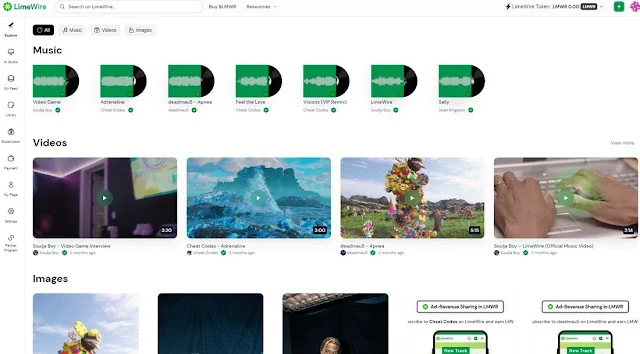
The platform’s transition has been bolstered by partnerships with high-profile figures in the entertainment industry. Musicians such as Deadmau5, Soulja Boy, and Sean Kingston have utilized LimeWire to release exclusive content and NFT collections. These collaborations serve as a proof-of-concept for how established artists can use AI and Web3 to engage with their fanbases in more direct, monetizable ways.
Industry analysts have noted that LimeWire’s approach addresses a critical gap in the generative AI market. While tools like Midjourney and ChatGPT offer powerful creation capabilities, they often lack a built-in distribution and monetization network. By combining the creation tool with a marketplace and a blockchain-based rights management system, LimeWire provides an end-to-end solution for the modern digital creator.
Broader Implications for the Creator Economy
The emergence of LimeWire as an AI powerhouse carries significant implications for the broader creator economy. By automating the minting of NFTs and providing a transparent revenue-sharing model, the platform is lowering the barrier to entry for artists who may be intimidated by the technical requirements of Web3.
Furthermore, the integration of AI models like Stable Diffusion and DALL-E into a social publishing environment suggests a future where content creation is highly collaborative between humans and machines. This shift raises important questions regarding copyright and the definition of "original" art, which LimeWire addresses by ensuring that every AI-generated asset is uniquely identified on the blockchain.
The platform also represents a significant case study in brand rehabilitation. By successfully pivoting from a legacy associated with copyright infringement to a platform dedicated to creator rights and monetization, LimeWire is attempting to set a new standard for how technology brands can evolve alongside shifting legal and technological landscapes.
Future Outlook: Music and Video Generation
As LimeWire continues to refine its image generation tools, the industry is closely watching its promised expansion into audio and video. The potential for AI-generated music, in particular, aligns with the brand’s original identity. If LimeWire can successfully implement tools that allow users to generate high-quality, royalty-free music tracks that are automatically minted as NFTs, it could disrupt the traditional music licensing industry.
The roadmap for the coming year includes the launch of these multi-modal tools, alongside further enhancements to the LMWR token utility. As AI technology continues to advance at an exponential rate, LimeWire’s ability to integrate the latest models into a cohesive, monetizable ecosystem will be the key to its long-term viability in the competitive landscape of digital content creation.
In conclusion, the new LimeWire is a multifaceted platform that leverages the power of generative AI and blockchain to empower a new generation of digital creators. By providing the tools for creation, the infrastructure for ownership, and the mechanisms for monetization, LimeWire has transitioned from a controversial relic of the past into a forward-looking architect of the future creator economy.
About the Author