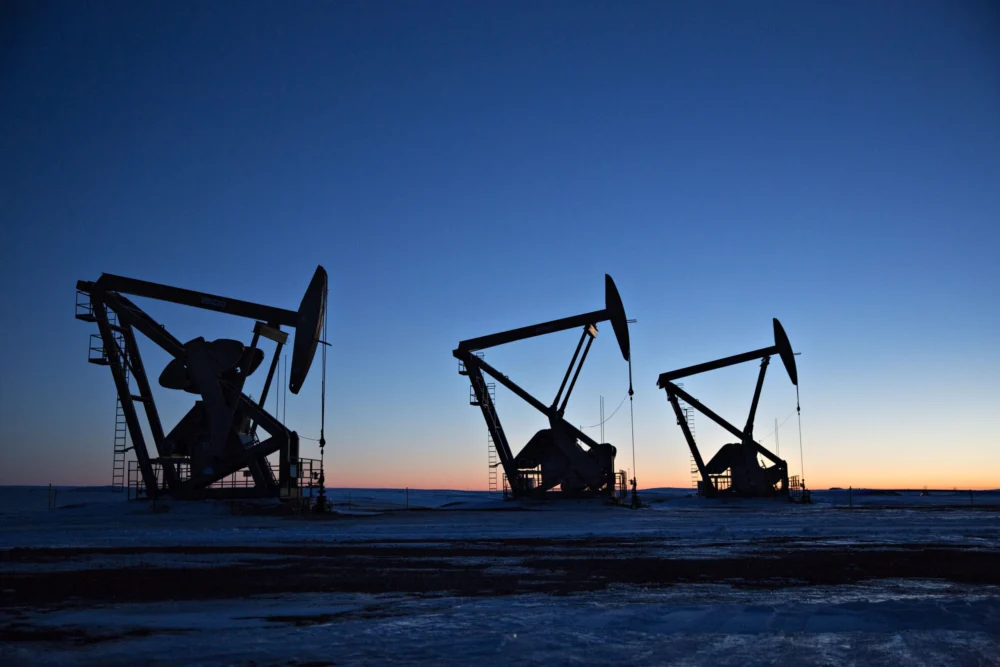
Global oil markets experienced a significant upheaval on Friday, with prices soaring to their highest levels in months, driven by intensifying military confrontations between Iran and Israel in the Middle East. The escalating conflict has severely disrupted critical shipping lanes and raised profound concerns over the stability of global energy supplies, sending ripples of anxiety through international financial markets. This latest surge marks a culmination of heightened geopolitical risks in a region vital to the world’s energy infrastructure.
Market Dynamics and Precipitous Price Increases
On Friday morning, the benchmark Brent crude futures surged by 4.5%, reaching $89.23 a barrel. This marked a fresh 52-week high and levels not witnessed in nearly two years, underscoring the severity of the market reaction. Simultaneously, U.S. West Texas Intermediate (WTI) crude futures climbed by an even more pronounced 6.3%, settling at $86.06 a barrel, its highest point since April 2024. These dramatic increases reflect an acute market fear premium, as traders price in the potential for widespread supply disruptions from the Middle East. The overnight session saw a brief dip in prices as investors digested initial reports and potential policy responses, but the broader upward trajectory remained firmly intact, culminating in what is projected to be the biggest weekly gain for crude prices since Russia’s full-scale invasion of Ukraine in early 2022.
The rapid escalation of the U.S.-Iran conflict across the Middle East has directly impacted energy production and, crucially, brought maritime traffic in the Strait of Hormuz to a near standstill. This strategic chokepoint, through which a significant portion of the world’s crude oil passes, is now at the epicenter of global energy security fears. The immediate reaction from commodity markets highlights the interconnectedness of geopolitics and global economic stability.
The Geopolitical Quagmire: U.S.-Iran Tensions and Regional Instability
The current crisis represents a dangerous intensification of long-standing animosities between the United States and Iran, exacerbated by regional proxy conflicts and the persistent shadow of the Israeli-Palestinian conflict. While the specific genesis of the "U.S.-Iran war" mentioned in market reports remains a complex and evolving narrative, it is understood to encompass a series of retaliatory strikes, maritime incidents, and cyber warfare that have spiraled into direct military engagements. For decades, the relationship has been fraught with tension, marked by the 1979 Iranian Revolution, the hostage crisis, Iran’s nuclear program, and the U.S. presence in the Persian Gulf. Each flare-up in this volatile dynamic sends tremors through global energy markets.
In the days leading up to the current price spike, reports indicated a steady increase in military activity. Initially, isolated incidents in the Red Sea and Gulf region, often attributed to Iranian-backed groups, escalated into more direct confrontations involving naval assets and air strikes. The rhetoric from both sides has hardened, with Washington reiterating its commitment to regional allies and freedom of navigation, while Tehran has asserted its right to defend its interests and territory. The exact chronology of the conflict’s latest phase, which entered its seventh day on Friday, suggests a rapid acceleration from localized skirmishes to broader military engagements, directly threatening oil production facilities and, more critically, the transit routes for energy exports.
The Strait of Hormuz: A Critical Chokepoint Under Threat
The Strait of Hormuz, a narrow waterway connecting the Persian Gulf with the Arabian Sea and the open ocean, is arguably the world’s most critical oil chokepoint. Approximately one-fifth of the world’s total petroleum liquids consumption and about one-third of the world’s liquefied natural gas (LNG) pass through this strait. It is bordered by Iran to the north and Oman to the south, making it highly susceptible to regional geopolitical tensions. Any significant disruption here, whether through military action, blockades, or even the perception of imminent threat, has immediate and profound global implications for energy supply and prices.
Reports of traffic coming to a "near standstill" are particularly alarming for energy-importing nations. Major oil producers like Saudi Arabia, Iraq, UAE, Kuwait, and Qatar rely heavily on the Strait for their exports. Should the passage become impassable or too risky for tankers, the ripple effects would be catastrophic, leading to severe supply shortages and exponential price increases globally. The fear of such a scenario is the primary driver behind the current market frenzy.
International Reactions and Dire Warnings
The gravity of the situation was underscored by stark warnings from regional energy leaders. On Friday morning, the Financial Times reported that Qatar’s energy minister, Saad al-Kaabi, cautioned that the escalating conflict could compel Gulf energy exporters to halt shipments within days. Al-Kaabi further projected a dire scenario where crude prices could skyrocket to $150 a barrel in the coming weeks if oil tankers are prevented from traversing the Strait of Hormuz. Such a price level would represent an unprecedented shock to the global economy, far surpassing previous peaks seen during the 2008 financial crisis or the early 2022 invasion of Ukraine.
From Washington, U.S. Defense Secretary Pete Hegseth delivered a resolute message during a press conference on Thursday, stating, "The U.S. had ‘only just begun to fight.’" Hegseth dismissed Iran’s perceived notion that the U.S. cannot sustain prolonged engagement, calling it a "really bad miscalculation." He emphasized the immense and increasing combat power at the disposal of the U.S. and its allies, particularly the Israeli Defense Forces, projecting that the capabilities "will be able to project over Iran is at multiples of what it currently is right now." These hawkish statements, while intended to deter, simultaneously fuel market anxieties about the potential for further escalation.

Other international bodies and nations are also closely monitoring the situation. The International Energy Agency (IEA) would likely be consulting with member states on emergency oil stock releases, a measure typically reserved for severe supply disruptions. Major oil-importing nations like China, India, and the European Union would be expressing deep concern over energy security, exploring alternative supply routes (though limited for Gulf oil), and potentially increasing diplomatic pressure for de-escalation. OPEC+, the alliance of oil producers, would face immense pressure to stabilize markets, though their capacity to offset a major Strait of Hormuz closure would be severely limited.
Policy Responses and Attempted Market Stabilisation
In an attempt to mitigate the economic fallout from soaring energy prices, the U.S. has initiated several policy maneuvers. Prices briefly dipped overnight after the U.S. issued a 30-day waiver to India – the world’s third-largest oil importer – allowing it to resume purchases of Russian oil. This move reversed earlier 25% "penalty" tariffs Washington had imposed on India for buying Russian crude, tariffs that were revoked just last month. The waiver aims to inject more supply into the global market and provide relief to a major consumer, indirectly easing pressure on Middle Eastern supplies.
Further underscoring the administration’s concern, news agency Reuters, citing an unnamed White House official, reported that the U.S. Treasury is actively planning to announce measures aimed at curbing energy price spikes. These potential interventions include actions in the oil futures market, which could involve strategic releases from the Strategic Petroleum Reserve (SPR) or other mechanisms designed to increase perceived supply and dampen speculative buying. While such interventions can offer temporary relief, their long-term effectiveness against a backdrop of fundamental supply disruption remains debatable.
Economic Fallout: Inflationary Pressures and Consumer Impact
The immediate and most tangible impact for ordinary citizens is the surge in gasoline prices. Data from the U.S. travel organization AAA revealed that the average price for a gallon of regular gasoline jumped nearly 27 cents in the week leading up to Thursday, reaching $3.25. This rapid increase directly erodes consumer purchasing power, as households allocate a larger portion of their budgets to fuel.
Economists are grappling with the broader inflationary implications. While higher energy prices mechanically push up headline Consumer Price Index (CPI) inflation, some analysts offer a nuanced perspective. Atakan Bakiskan, chief U.S. economist at Berenberg, posited a contrarian view on CNBC’s "Squawk Box Europe" on Friday, suggesting that "higher energy prices could actually be deflationary for the U.S." He reasoned that while gasoline costs increase, this simultaneously reduces consumer purchasing power and dampens sentiment. To offset higher fuel expenses, consumers are likely to cut demand for other goods and services. Bakiskan argued that this reduction in broader demand could, in turn, reduce core inflation, a dynamic he claims is also indicated by the Fed’s own macro models.
However, the consensus largely leans towards an inflationary scenario, at least in the short to medium term. Central banks, particularly the U.S. Federal Reserve, are keenly watching these developments. A sustained rise in energy prices could complicate their efforts to bring inflation back to target levels, potentially delaying interest rate cuts or even prompting further tightening if the situation deteriorates significantly.
Broader Geopolitical and Economic Implications
Beyond immediate market and consumer impacts, the escalating conflict carries profound broader implications. Regionally, it risks drawing in other actors, potentially destabilizing the entire Middle East. Global trade routes, particularly maritime shipping, would face increased costs and risks, impacting supply chains worldwide. Diplomatic efforts, led by the UN and various international powers, would intensify to de-escalate the conflict, but their effectiveness against determined adversaries is often limited.
Long-term energy security strategies would likely undergo renewed scrutiny. Nations heavily reliant on Middle Eastern oil might accelerate diversification efforts, investing further in renewable energy, domestic production, and strategic reserves. The current crisis also highlights the fragility of the globalized economy and its vulnerability to localized geopolitical events, especially when they occur in critical resource-rich regions. The specter of a prolonged conflict and sustained high oil prices could trigger a global economic slowdown or even a recession, as businesses face higher operational costs and consumer spending falters.
Outlook and Lingering Uncertainty
The immediate outlook for oil markets and the global economy remains highly uncertain. The trajectory of oil prices will be inextricably linked to the ebb and flow of military actions and diplomatic endeavors in the Middle East. Any signs of de-escalation could see prices retreat, while further intensification of hostilities, particularly any direct impact on major oil production facilities or a sustained closure of the Strait of Hormuz, would undoubtedly propel prices to new, unprecedented highs. The world watches with bated breath as the conflict unfolds, its repercussions set to reverberate across every facet of the global economy.
About the Author