For the past year, business leaders have been engaged in a widespread discussion about Artificial Intelligence (AI). A consistent theme emerges from these hundreds of conversations: a surplus of AI tools and a clear ambition to leverage them, yet a significant struggle with identifying where to begin and how to extract tangible value. This widespread adoption pressure, while intense, often lacks strategic direction, leading to experimental AI initiatives that fail to gain traction, tools that remain underutilized, and an increasingly skeptical workforce. The root cause, according to industry observers, is the disconnect between AI output and demonstrable business outcomes.
The prevailing wisdom among teams that have successfully integrated AI is counterintuitive to the market’s current focus. These organizations do not commence their AI journey by exploring the technology itself. Instead, they identify specific, pressing problems within their operations – tasks that are particularly time-consuming, inefficient, or costly – and then strategically seek out the most appropriate AI use cases to address these challenges. This problem-centric approach fosters confidence as initial results are achieved, paving the way for further exploration of AI capabilities, always tethered to clear, measurable objectives.
This article aims to provide a practical framework for marketing, sales, and service teams to navigate the complex AI landscape, focusing on actionable strategies for immediate value realization. The use cases are categorized based on the current maturity of the underlying technology, offering a roadmap for businesses at various stages of AI adoption.
Navigating the AI Landscape: A Structured Approach to Value
The pressure to integrate AI into business operations has never been greater. A recent survey by [Industry Research Firm, e.g., Gartner, Forrester] indicated that over 70% of organizations are currently exploring or implementing AI solutions, with a significant portion expecting to see measurable ROI within the next 18-24 months. However, the path to achieving this ROI is often fraught with challenges. Many companies find themselves overwhelmed by the sheer volume of available AI tools and platforms, leading to a "shiny object syndrome" where technology acquisition precedes a clear understanding of its application and impact.
The core of successful AI integration lies not in the technology itself, but in its strategic application to solve existing business pain points. This principle is particularly evident across marketing, sales, and customer service departments, which are increasingly reliant on data-driven insights and automation to meet evolving customer expectations and competitive pressures.
Marketing: Amplifying Reach and Engagement with AI
Marketing teams, in particular, are under immense pressure to achieve more with less. The demand for multi-channel campaigns, hyper-personalized content, and sophisticated audience segmentation continues to grow, often without a corresponding increase in headcount or budget. AI is emerging as a transformative force, enabling marketers to reimagine their workflows and achieve unprecedented levels of efficiency and effectiveness.
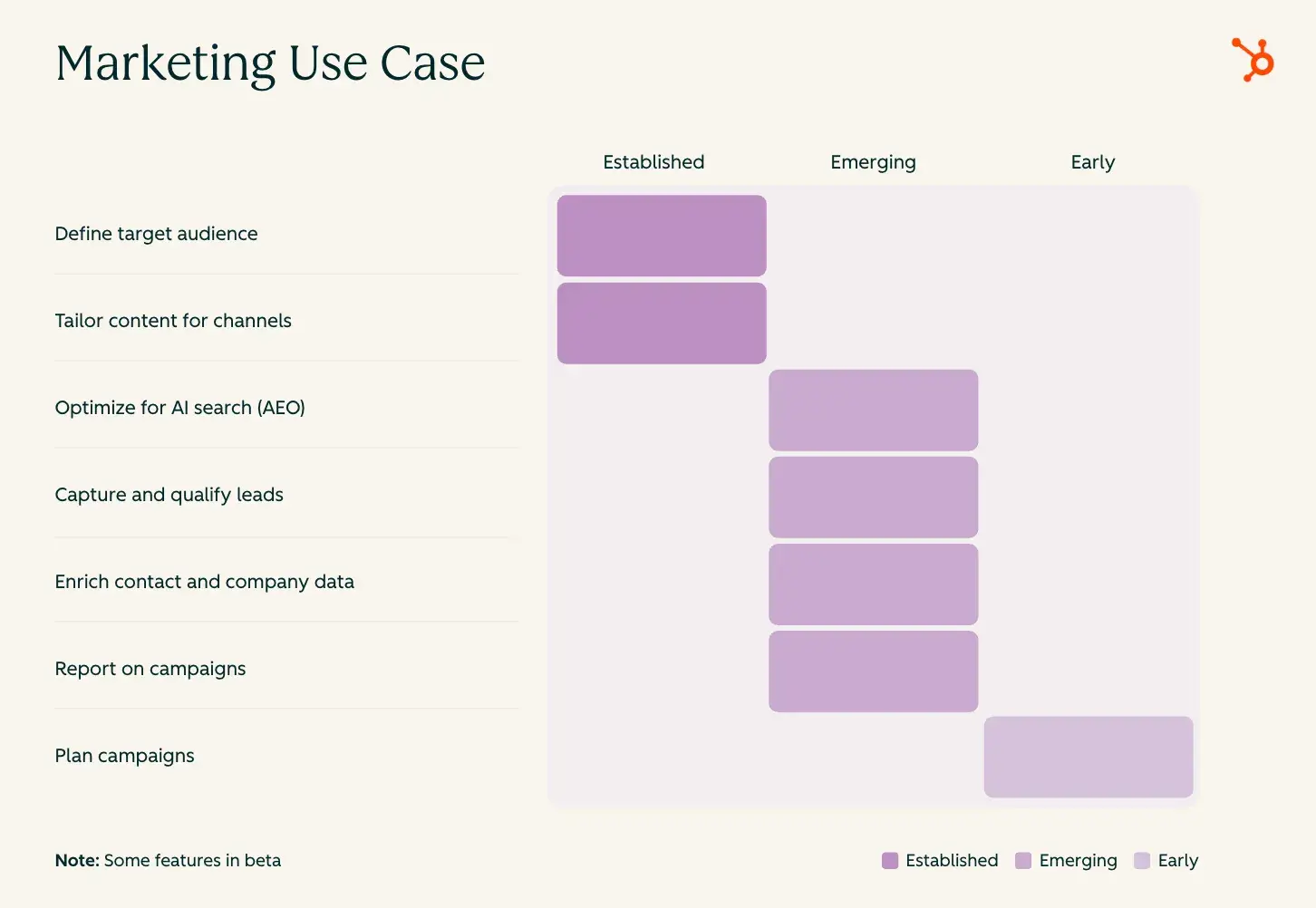
Established AI Use Cases for Marketing
Defining Target Audiences with Precision: Traditional audience segmentation, often based on broad demographics like job titles and company size, frequently falls short of identifying individuals who are genuinely inclined to purchase. AI offers a sophisticated solution by analyzing vast datasets to pinpoint high-fit prospects with a higher propensity to convert. For instance, HubSpot customers utilizing tools like Breeze Assistant can gain deeper insights into customer behavior, optimize customer journeys, and significantly improve lead quality. This has been demonstrated to reduce wasted marketing spend by an average of 15-20% by focusing efforts on the most receptive segments.
Tailoring Content Across Channels: The laborious process of adapting a single piece of content into multiple formats for different channels – from blog posts to emails, social media updates, and advertisements – consumes significant marketing resources. AI-powered solutions can automate this transformation, repurposing core content for various platforms while maintaining brand voice and consistency. Tools like HubSpot’s Content Remix and Breeze Assistant allow marketing teams to generate channel-specific variations of content in minutes, saving an estimated 5-10 hours per week on content adaptation tasks.
Emerging AI Use Cases for Marketing
Optimizing for AI-Powered Search: The landscape of online discovery is rapidly shifting as users increasingly turn to conversational AI models and answer engines like ChatGPT, Claude, and Perplexity, rather than traditional search engine results pages. This necessitates a strategic pivot towards Answer Engine Optimization (AEO). HubSpot is actively developing AEO features designed to help marketers understand their brand’s visibility within AI-generated answers and provide actionable recommendations for improvement. This area represents a significant investment and is expected to evolve rapidly, potentially impacting organic search visibility by as much as 30-40% in the coming years.
Automating Lead Capture and Qualification: Websites are 24/7 storefronts, but human teams operate on fixed schedules. AI-powered chatbots and virtual agents can engage website visitors in real-time, answer their queries, assess their fit for products or services, and even schedule meetings with sales representatives. This capability allows businesses to capture and qualify a greater volume of leads without increasing headcount. HubSpot’s Breeze Customer Agent, for example, has been shown to increase lead conversion rates by up to 25% by ensuring no visitor interaction is missed.
Early-Stage AI Use Cases for Marketing
AI-Assisted Campaign Planning: The ability to provide an AI with a campaign brief and receive a comprehensive strategic plan, including content recommendations and channel selection, can dramatically accelerate the marketing planning process. This allows marketing teams to shift their focus from administrative tasks to execution and optimization, enabling faster campaign launches and more agile responses to market dynamics.
Sales: Enhancing Efficiency and Effectiveness in the Sales Cycle
Sales representatives historically spend a disproportionately small amount of their day actively selling. The majority of their time is dedicated to administrative tasks such as research, data entry, follow-ups, and preparation for client interactions. AI is poised to revolutionize this by automating these time-consuming activities, empowering sales teams to concentrate on building relationships and closing deals.
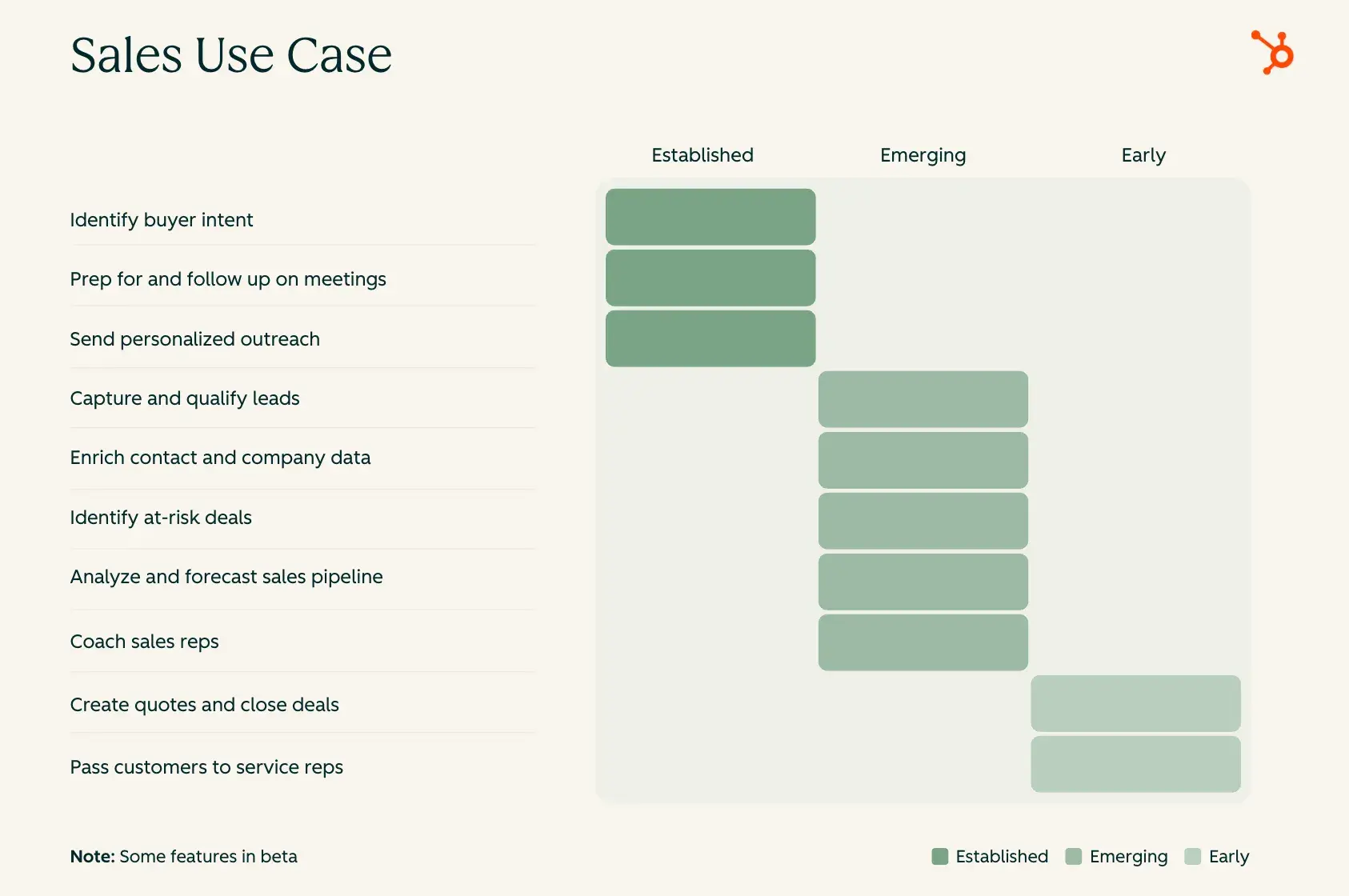
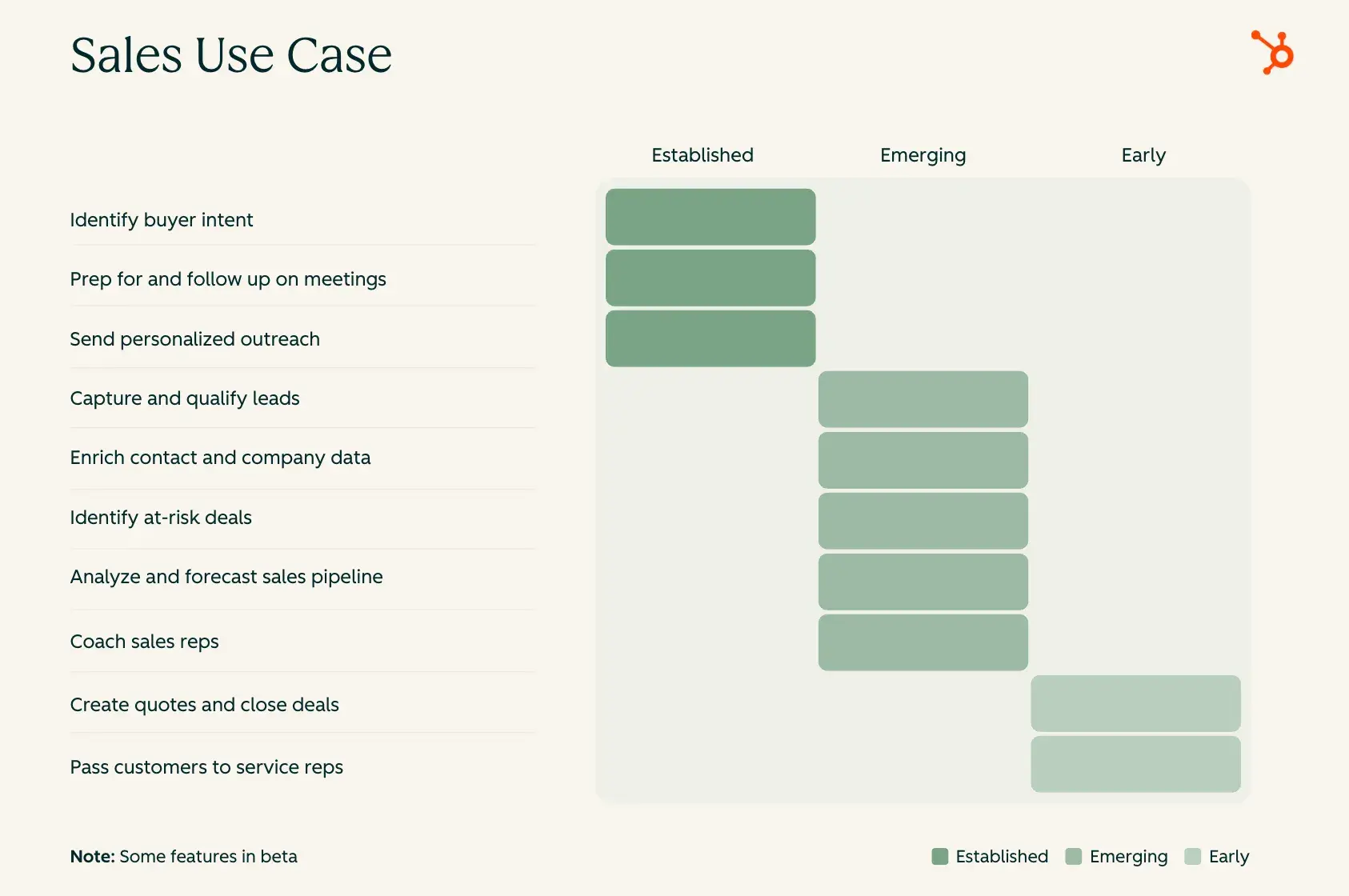
Established AI Use Cases for Sales
Identifying Buyer Intent Signals: Sales teams often dedicate valuable time to accounts that are not yet ready to engage. AI solutions can monitor target accounts for crucial signals of buying intent, such as funding announcements, new executive hires, or increased website traffic. These alerts enable sales representatives to engage with prospects at the opportune moment, leading to more productive conversations and a reduction in time spent pursuing cold leads. Early adopters of buyer intent tracking have reported an average increase of 20% in qualified opportunities.
Streamlining Meeting Preparation and Follow-Up: AI can significantly reduce the administrative burden associated with sales meetings. Before a call, AI can surface relevant contact history, deal context, and recent interactions, ensuring the sales representative is well-prepared. Post-call, AI can automatically transcribe discussions, extract action items, and draft follow-up emails. This automation frees up an estimated 3-5 hours per week per sales representative, allowing them to focus on building rapport and advancing deals.
Personalizing Sales Outreach: The ability to deliver timely and relevant outreach is critical in sales. AI can track account-level activities and alert sales teams to significant changes, enabling them to craft personalized messages that resonate with prospects. HubSpot’s Breeze Prospecting Agent has demonstrated a doubling of response rates compared to traditional, generic outreach methods, highlighting the power of AI-driven personalization.
Emerging AI Use Cases for Sales
Enriching Contact and Company Data: Incomplete CRM records represent a persistent challenge for sales teams, hindering effective segmentation, scoring, and personalization. AI can automatically populate missing fields, such as job titles and company details, by drawing from extensive and continuously updated datasets. This ensures sales teams have accurate and current information, leading to more relevant communication and a significant reduction in manual data entry. For HubSpot customers, this means leveraging a dataset of over 200 million company and buyer profiles.
AI-Powered Sales Coaching: AI can analyze sales calls and deal activities to identify the behaviors and strategies employed by top-performing representatives. This intelligence can then be used to coach other team members, accelerating ramp-up time and improving overall team performance. This approach has the potential to reduce new hire ramp-up time by as much as 25%.
Early-Stage AI Use Cases for Sales
Automating Quote Generation and Deal Closing: The process of generating quotes and proposals can be a bottleneck in the sales cycle. AI has the potential to automate pricing inquiries, build proposals based on historical data, and draft accompanying emails. By handling these administrative aspects, AI allows sales representatives to dedicate more time to customer engagement and strategic deal progression, potentially shortening sales cycles by an average of 10-15%.
Customer Service: Elevating Support and Retention with AI
Customer service teams often face the challenge of meeting rising customer expectations for speed and quality of support without a commensurate increase in staffing. The key to success for many of these teams lies in strategically leveraging AI to handle routine inquiries, thereby freeing up human agents to address complex issues that require empathy and critical thinking.
Established AI Use Cases for Customer Service
Automated Support Ticket Resolution: For common customer questions, AI can provide instant answers by accessing and utilizing internal knowledge bases. This immediate resolution for simple queries allows human agents to focus on more complex and nuanced issues. For example, HubSpot’s Breeze Customer Agent has been reported to resolve up to 65% of support tickets automatically, significantly improving customer satisfaction and reducing wait times.
Intelligent Ticket Review and Routing: When support tickets are not properly categorized, urgent issues can be overlooked, leading to inefficiencies. AI can analyze, prioritize, and route tickets to the appropriate representative quickly and accurately. This streamlines the support process and improves overall team efficiency. HubSpot’s Customer Agent, when integrated with help desk systems, has been shown to boost ticket resolution rates by 25%.
Personalized Communication for Service Teams: Similar to sales, AI can assist service teams in crafting personalized communications for at-risk customers or in preparing for renewal conversations. The same AI capabilities that inform sales outreach can ensure service teams are informed and responsive, fostering stronger customer relationships.
Emerging AI Use Cases for Customer Service
Proactive Identification of At-Risk Customers: By the time a customer expresses dissatisfaction, it may be too late to retain them. AI can analyze customer engagement patterns, ticket volume, and communication sentiment to detect early warning signs of churn. This proactive identification allows service teams to intervene and address potential issues before they escalate, leading to improved customer retention rates.
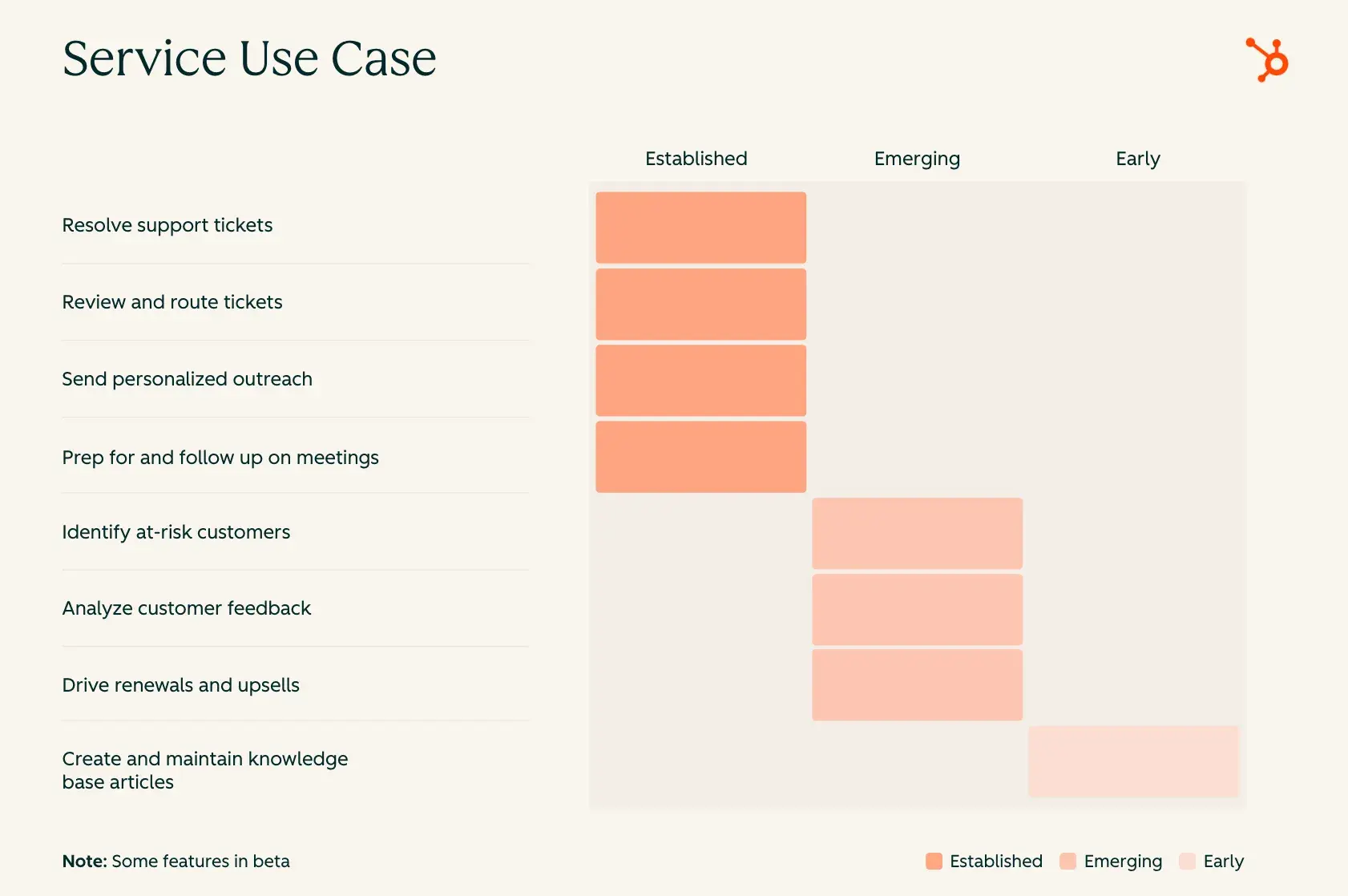
Analyzing Customer Feedback at Scale: Sifting through vast amounts of customer feedback from surveys and call transcripts is a monumental task. AI can efficiently scan this data to identify recurring themes and sentiment trends, providing actionable insights for product and service improvements. This data-driven approach allows businesses to respond to customer needs more effectively.
Early-Stage AI Use Cases for Customer Service
AI-Driven Knowledge Base Management: Maintaining an up-to-date knowledge base is crucial for effective self-service support. AI can assist in drafting new help articles based on common support ticket resolutions and automatically update existing content when changes occur. This creates a dynamic and self-sustaining knowledge base, ensuring customers receive accurate and timely answers while reducing the documentation burden on support teams.
The Path Forward: Problem-Centric AI Adoption
The overarching lesson learned from extensive engagement with businesses on AI implementation is clear: AI itself does not generate momentum. It is the strategic resolution of genuine business problems that drives progress. The organizations experiencing the most significant benefits did not begin with broad, transformative AI strategies. Instead, they identified a single, critical bottleneck – a workflow that was inefficient, a process consuming excessive time, or a clear area where performance needed improvement. They then deployed AI to address that specific challenge.
The results of this problem-focused approach are compelling. Marketing teams are achieving greater precision in reaching target audiences and converting visitors into qualified leads. Sales teams are reporting doubled response rates on outreach efforts. Customer service departments are resolving over half of their tickets without direct human intervention. These seemingly small, targeted applications of AI are accumulating to create substantial, measurable business outcomes.
Artificial Intelligence is no longer a speculative future investment; it is a present-day tool capable of driving tangible results for everyday business objectives. It is making work faster, smarter, and more effective across the enterprise. The crucial question for every organization is not whether AI can assist their team, but rather, where will they choose to begin their AI journey? The answer to this question will undoubtedly shape their competitive landscape in the years to come.
About the Author