As businesses experience periods of rapid expansion, the strategic scaling of marketing departments often becomes an overlooked, yet critical, imperative. The agile, lean teams that successfully launch a company may not possess the structure or capacity to drive sustained growth. This oversight can lead to significant operational challenges, impacting team morale, campaign effectiveness, and ultimately, revenue targets. Addressing this requires a proactive, structured approach to team development, moving beyond ad-hoc hiring to implement a framework that aligns with evolving business objectives and revenue milestones.
The Imperative of a Scalable Marketing Structure
The foundational principle for successful scaling lies in recognizing that marketing team structure is not static; it must evolve in tandem with company growth. A recent McKinsey report highlighted that a staggering 67% of organizations grapple with excessive complexity and inefficiency, often stemming from poorly defined roles and organizational designs. This complexity directly translates to slower decision-making, redundant efforts, and a tangible reduction in operational velocity. For marketing departments, this means ambitious goals can become unattainable due to an overwhelmed team struggling with an ever-increasing workload.
The correlation between company revenue, growth objectives, and marketing team capacity is direct and undeniable. For instance, a strategic decision to significantly increase content output necessitates a commensurate increase in content creators and strategists. Similarly, a new product launch demands the expertise of a dedicated product marketing manager. Simply assigning more tasks to an already overburdened team is a recipe for burnout and employee turnover, a reality often experienced firsthand by marketing leaders.
Mark Roberge, Co-founder of Stage 2 Capital and a former HubSpot executive, emphasizes the strategic importance of this alignment. He advocates for a comprehensive, five-year scaling plan that involves a bottom-up analysis of required inputs. This detailed assessment informs critical hiring decisions across all departments, including marketing, sales, engineering, and even facilities, underscoring that talent is a strategic resource directly tied to achieving business outcomes. However, this scaling must be intelligent and purposeful, avoiding the trap of simply increasing headcount without a clear organizational blueprint.
Common Pitfalls in Marketing Team Expansion
When marketing teams grow without a deliberate structural framework, several predictable issues arise, often undermining performance:

- Unclear Role Boundaries: A lack of defined responsibilities is a primary culprit. Gallup’s research indicates that a significant portion of employees lack clarity on their expectations, leading to tasks falling through the cracks or duplication of efforts. This ambiguity results in missed deadlines and confusion regarding accountability. Personal anecdotes from seasoned professionals often recall situations where overlapping expertise created stalemates, requiring a clear delineation of ownership to resolve.
- Leadership Bottlenecks: When decision-making power is concentrated in a single individual, especially in the absence of clear role definitions, efficiency plummets. Teams become reliant on constant approvals for routine tasks, leading to missed opportunities and delays in dependent projects.
- Disconnected Channels and Siloed Operations: As departments expand, inter-departmental communication can falter. If content, demand generation, and product marketing operate in silos, without robust cross-team coordination, messaging can become inconsistent and diluted, ultimately impacting the quality and impact of marketing campaigns.
- Meeting Fatigue: In an attempt to bridge communication gaps, companies often resort to an increased number of meetings. Flowtrace data suggests employees spend an average of 392 hours annually in meetings, equating to over 16 full workdays. This excessive time spent in meetings detracts from valuable execution time and can contribute to operational bottlenecks.
- Underutilized Talent: Hiring specialists before validating core marketing channels can be a costly mistake. This can lead to expensive talent remaining underutilized, with unclear deliverables and a suboptimal return on investment.
These compounding issues can be significantly mitigated or entirely avoided through a well-structured hiring and organizational plan.
A Phased Approach to Marketing Team Structuring for Growth
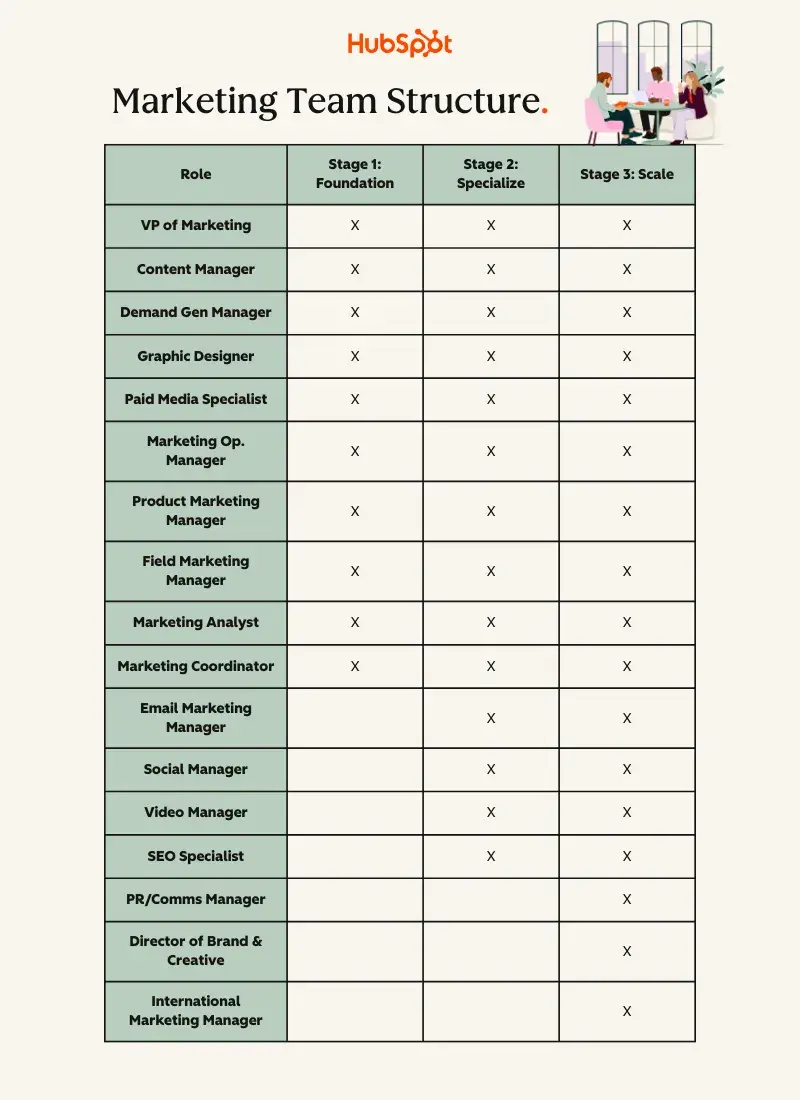
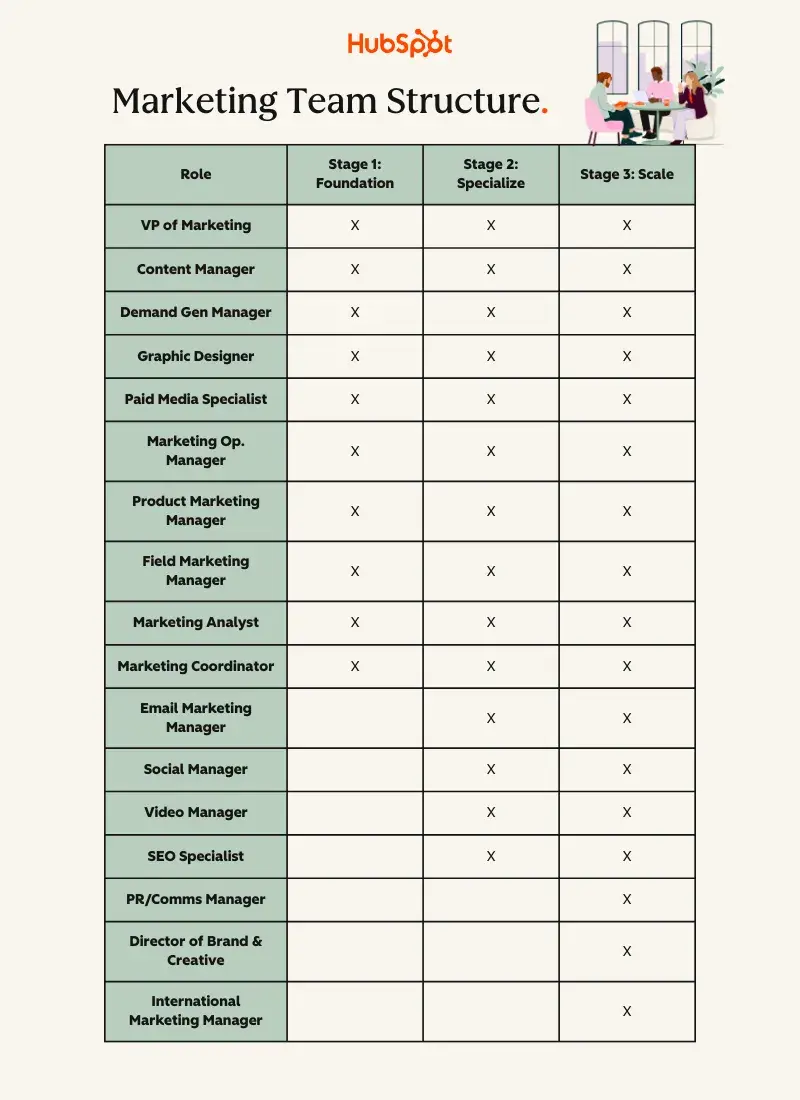
The journey of scaling a marketing team from a handful of individuals to a robust department of 25 can be effectively managed through a phased approach, often triggered by specific revenue milestones. This framework ensures that hiring priorities, role evolution, and structural recommendations align with the company’s current stage and future aspirations.
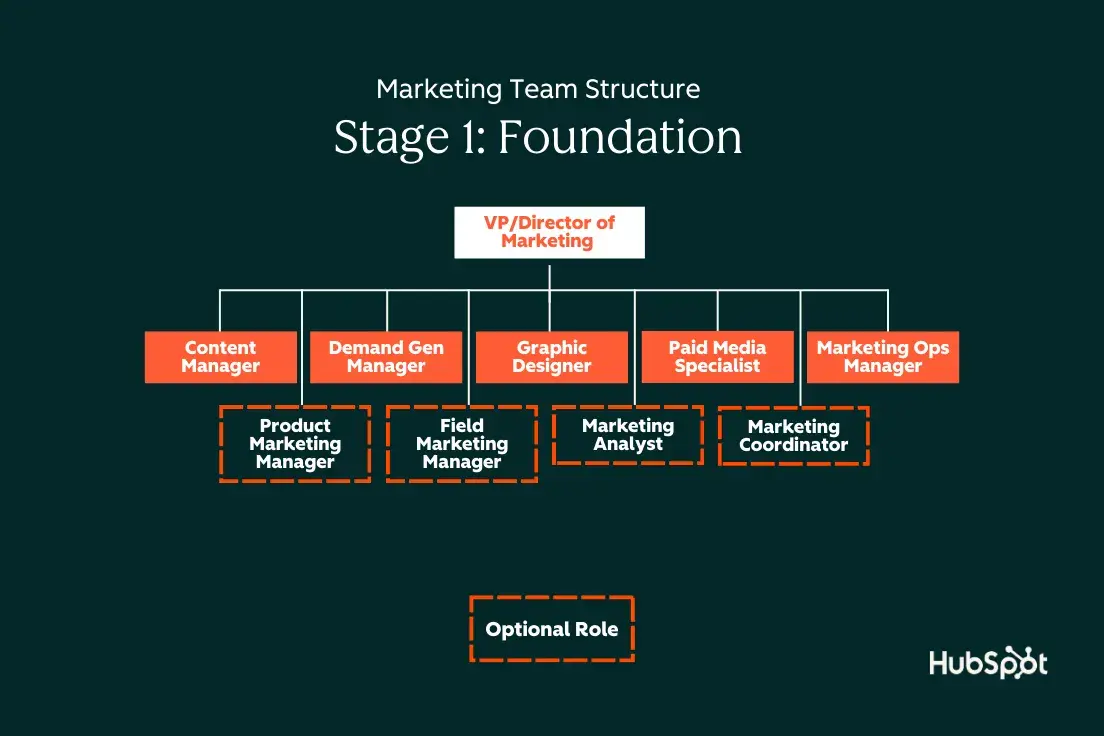
Phase 1: Foundation (5-10 People) – Establishing Core Competencies
This initial phase typically begins when a company achieves between $5 million and $15 million in Annual Recurring Revenue (ARR) and has acquired over 100 customers. The primary focus is on establishing essential marketing functions, setting up foundational tools, and implementing core processes. During this stage, hiring generalists with broad skill sets is paramount, as they can adapt to diverse needs and contribute across multiple functions.
Key Foundational Roles:
- VP or Director of Marketing: This individual is responsible for overall marketing strategy, team leadership, and alignment with business objectives. They are the primary decision-maker and accountable for achieving key marketing metrics.
- Efficiency Metrics: Return on Marketing Investment (ROMI), Customer Acquisition Cost (CAC), Marketing-Sourced Pipeline, Marketing Efficiency Ratio (MER).
- Content Marketing Manager: Oversees content creation, strategy, and Search Engine Optimization (SEO). This role may involve direct content production or managing external resources.
- Efficiency Metrics: Publishing Frequency, Organic Traffic Growth, Content-Attributed MQLs, First-30-Day Page Traffic.
- Demand Generation Manager: Focuses on lead acquisition and pipeline generation, ensuring a consistent flow of qualified leads to the sales team.
- Efficiency Metrics: Marketing Qualified Leads (MQLs), Sales Qualified Leads (SQLs), Cost Per Acquisition (CPA), Marketing-Sourced Pipeline, Payback Period.
- Graphic Designer: Responsible for creating visual assets across various platforms, including website materials, social media graphics, and premium content.
- Efficiency Metrics: Campaign Consistency Rate, Turnaround Time Per Asset, Engagement Uplift (CTR, Social Shares), Brand Adherence Audits.
- Paid Media Specialist: Manages advertising campaigns across various channels, including paid social and search engine marketing.
- Efficiency Metrics: Impressions, Click-Through Rate (CTR), Cost Per Click (CPC), CPA, Return on Ad Spend (ROAS).
- (Optional) Marketing Operations Manager: Manages marketing automation platforms and reporting systems, ensuring data accuracy and campaign efficiency.
- Efficiency Metrics: MER, Campaign Setup Time, Funnel Conversion Rates, Data Accuracy Score.
- (Optional) Product Marketing Manager: Focuses on product messaging, positioning, and go-to-market strategies.
- Efficiency Metrics: Sales Enablement Usage, Win Rate Uplift, Sales Cycle Reduction, Product-Qualified Leads (PQLs).
- (Optional) Event or Field Marketing Manager: Supports in-person events and marketing initiatives, particularly relevant for B2B organizations.
- Efficiency Metrics: Leads Generated Per Event, Cost Per Lead (CPL), Event Attendance Rate, Pipeline Sourced from Events.
- (Optional) Marketing Analyst: Monitors, measures, and reports on marketing performance, providing data-driven insights.
- Efficiency Metrics: Dashboard Refresh Cadence, Attribution Model Coverage, Forecast Accuracy, Data Insights Generated.
- (Optional) Marketing Coordinator: Provides administrative and executional support across various marketing activities.
- Efficiency Metrics: Task Completion Rate, Campaign Support Accuracy, Coordination Turnaround Time.
During this phase, a flat organizational structure with all team members reporting directly to the marketing leader is most effective. This streamlined hierarchy minimizes decision-making ambiguity and fosters direct collaboration. It is also recommended to prioritize local or in-office hires to navigate the complexities of remote work more effectively during this formative stage.

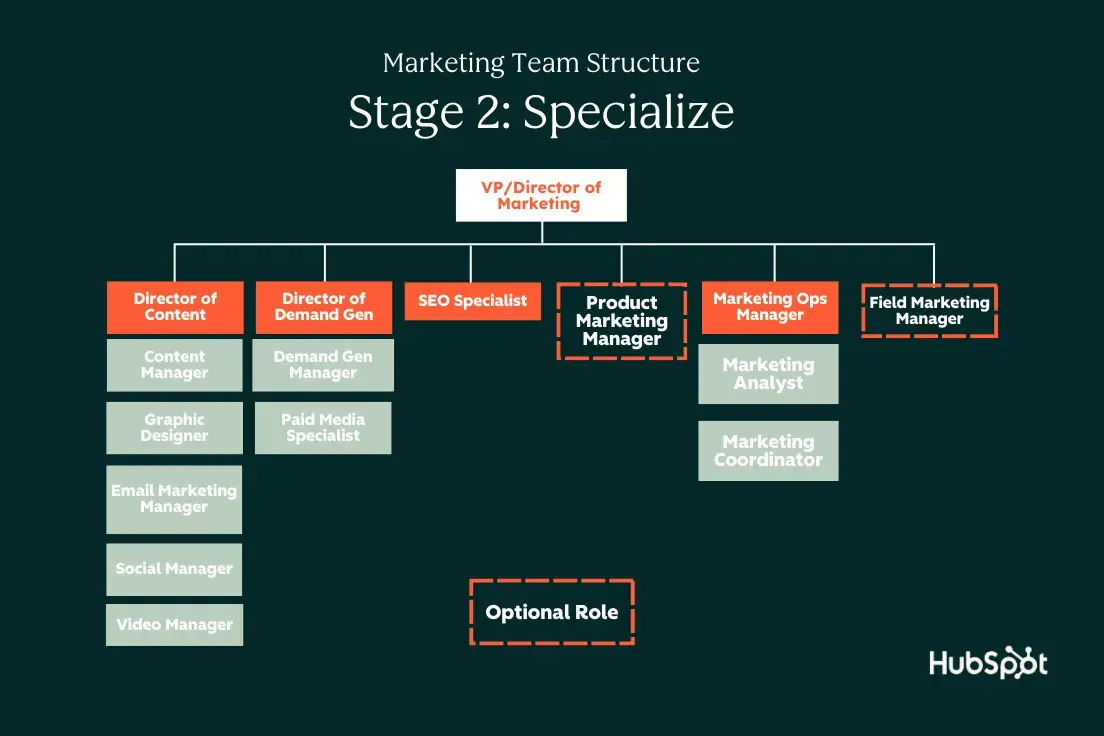
Phase 2: Specialization (11-17 People) – Deepening Expertise
As a company surpasses $15 million in ARR and serves over 500 customers, the marketing landscape becomes more competitive and requires increased sophistication. This phase is characterized by the introduction of specialization and a nascent management layer. Roles begin to delineate based on specific channels and functions, aiming to enhance performance tracking, foster focused expertise, and enable repeatable growth.
Key Specialized Roles:
- Director of Demand Generation: This role oversees both paid and inbound marketing efforts, with a focus on driving conversions and pipeline. They often manage the Demand Generation Manager from Phase 1.
- Efficiency Metrics: Leads Generated, Task Completion Rate, Campaign Support Accuracy, Coordination Turnaround Time.
- SEO Specialist: As website traffic and search engine visibility become more critical, a dedicated SEO specialist is needed to implement advanced strategies beyond the scope of a general content manager.
- Efficiency Metrics: Organic Traffic Growth, Keyword Ranking Improvements, Technical SEO Audit Completion, Site Speed Optimization.
- Email Marketing Manager: This role evolves from content management to focus specifically on lead nurturing, lifecycle campaigns, and customer retention through email communications.
- Efficiency Metrics: Number of Email Campaigns Launched, Email Open/Conversion Rates, Campaign Support Accuracy, Coordination Turnaround Time.
- Social Media Manager: Recognizing social media as a full-time strategic function, this role manages brand presence, engagement, and community building across platforms.
- Efficiency Metrics: Follower Growth Rate, Engagement Rate, Social Media Reach, Website Traffic from Social.
- Videographer or Video Marketing Manager: With the growing importance of video content, this phase is ideal for investing in talent capable of developing and scaling video marketing strategies.
- Efficiency Metrics: Number of Videos Completed, Video Engagement Metrics (watch time, completion rate), Campaign Support Accuracy, Coordination Turnaround Time.
At this stage, companies are often well-positioned to explore remote or hybrid work models, potentially even considering international team members. The foundational processes and tools established in Phase 1 should support this transition. Organizationally, functional teams with clear leaders begin to emerge, fostering specialization in areas like content, search, and demand generation.
Phase 3: Scale (18-25 People) – Enterprise Readiness
The final stage of this framework, triggered by reaching $40 million to $100 million in ARR and serving over 1,000 customers, focuses on structuring the marketing team for global operations and long-term, sustainable scale. This involves a fully layered marketing organization with both strategic and executional roles across various functions and geographic regions.
Key Roles for Scale:
- Director of Product Marketing: This role leads the go-to-market strategy, product positioning, and sales enablement, often managing a team of product marketers.
- Efficiency Metrics: Product Launch Success Rate, Sales Cycle Reduction, Market Share Growth for New Products, Sales Team Enablement Effectiveness.
- Director of Brand or Creative: This senior role is responsible for brand storytelling, visual identity, and managing creative resources, including graphic designers.
- Efficiency Metrics: Brand Awareness Metrics, Campaign Creative Effectiveness, Brand Guideline Compliance, Team Productivity.
- Account-Based Marketing (ABM) Manager: This role focuses marketing efforts on key target accounts or segments, fostering deeper alignment between sales and marketing.
- Efficiency Metrics: Pipeline Generated from Target Accounts, Conversion Rates within Target Accounts, Customer Lifetime Value of ABM-Acquired Customers.
- Conversion Rate Optimization (CRO) Manager: Dedicated to improving on-site and funnel conversion rates through data analysis and iterative testing.
- Efficiency Metrics: Website Conversion Rate, Funnel Stage Conversion Rates, A/B Test Win Rate, User Experience Improvements.
- Marketing Automation Specialist: Supports complex backend workflows, integrations, and advanced automation strategies across marketing, sales, and service.
- Efficiency Metrics: Workflow Automation Efficiency, Lead Scoring Accuracy, Campaign Automation Success Rate, Integration Reliability.
- Customer Marketing Manager: Focuses on customer engagement, retention, and loyalty through targeted marketing initiatives.
- Efficiency Metrics: Customer Retention Rate, Upsell/Cross-sell Revenue, Customer Satisfaction Scores, Net Promoter Score (NPS).
- PR/Communications Manager: Manages media relations, external messaging, and public perception, crucial for a growing global brand.
- Efficiency Metrics: Media Mentions, Share of Voice, Crisis Communication Effectiveness, Brand Reputation Scores.
- International Marketing Lead: Oversees localization efforts and regional expansion strategies for global markets.
- Efficiency Metrics: Regional Market Share Growth, Localization Effectiveness, Global Campaign Performance by Region, International Lead Generation.
At this mature stage, the organizational structure should feature at least two layers of leadership, with Directors overseeing Managers and clearly defined functional areas such as Brand, Demand Generation, Product Marketing, and Operations.
Strategies for Effective Scaling
Building a truly scalable marketing team requires more than just filling roles; it demands a strategic, phased approach:
- Identify Your Growth Phase: Accurately assess your company’s current stage based on ARR and customer count. This will dictate hiring priorities and structural needs for each phase (Foundation, Specialization, Scale). Use these milestones to set hiring checkpoints and avoid premature specialization or understaffing.
- Assess Current Marketing Capabilities: Map your existing team’s skills, bandwidth, and effectiveness. Identify gaps between current output and future goals. This assessment will inform where improvements or new roles are most needed.
- Prioritize Hiring Needs: Rank potential roles based on current skill gaps, underperforming channels, operational strain, and revenue goals. Prioritize roles that directly drive pipeline or alleviate significant friction points.
- Establish Clear Role Definitions, Metrics, and Expectations: Document responsibilities, success metrics, and reporting structures for each role. This clarity prevents overlap, confusion, and conflict. For scaling teams, establishing documented processes and guidelines is crucial for onboarding new members and maintaining consistency.
- Create a Regular Structure Review Cadence: Organizations experiencing hypergrowth often restructure every 6-9 months. Schedule at least quarterly reviews to assess if the current structure still aligns with evolving business goals. Be prepared to adjust reporting lines, combine functions, or split teams as complexity increases.
Prioritizing Roles During Scaling
When faced with resource constraints, prioritizing roles becomes essential. Consider these factors:
- Impact on Revenue: Roles directly contributing to pipeline generation or customer acquisition should often take precedence.
- Operational Efficiency: Positions that can automate processes, improve workflows, or reduce bottlenecks can provide significant returns.
- Strategic Alignment: Roles that support critical strategic initiatives, such as product launches or market expansion, are vital.
- Team Bandwidth: Hiring to alleviate immediate team overload and prevent burnout is a proactive measure for long-term success.
- Skill Gaps: Addressing critical skill deficiencies that hinder current performance or future growth is paramount.
In-House vs. Outsourcing Decisions
Not every role necessitates a full-time employee (FTE), especially in the early stages. Strategic decisions about insourcing versus outsourcing can optimize both budget and execution speed.
Insourcing (Hire Full-Time) for:
- Core Strategic Functions: Roles that define and drive long-term marketing strategy, such as demand generation, product marketing, or brand management.
- Roles Requiring Deep Company Knowledge: Positions that necessitate an intimate understanding of the company’s mission, values, and operational nuances.
- Continuous, High-Volume Work: Tasks that are consistently required and benefit from dedicated internal expertise and team integration.
- Building Internal Expertise and IP: Developing proprietary knowledge and capabilities within the organization.
- Roles Tied to Company Culture and Team Integration: Positions that are integral to team cohesion and company culture.
Outsourcing (Use Contractors/Agencies) for:
- Executional or Project-Based Needs: Tasks that are specific, time-bound, and do not require ongoing internal management, such as specialized graphic design for a particular campaign or video production.
- Niche or Specialized Skills: Accessing expertise that is not core to the business or required on a continuous basis, like advanced SEO audits or niche PR campaigns.
- Temporary Bandwidth Gaps: Addressing short-term surges in workload or covering for employee absences.
- Testing New Channels or Strategies: Experimenting with new marketing avenues without the commitment of a full-time hire.
- Cost-Effectiveness for Lower-Volume Needs: Utilizing external resources for tasks that are less frequent or can be efficiently managed by an agency.
Early-stage companies often leverage fractional CMOs, freelance writers, or design agencies to prove viability or secure budget before committing to full-time hires. As companies grow, the balance may shift towards insourcing core functions to build dedicated internal teams, while still utilizing outsourcing for specialized or project-based needs.
Essential Tools for Scaling Marketing Teams
The right technology stack is as crucial as the talent itself. The selection of marketing technology (martech) should evolve with the team’s growth phases.
Phase 1 (Foundation): Focus on core functionality that covers multiple needs.
- Essential Tools: CRM (e.g., HubSpot), Email Marketing Platform, Social Media Management Tool, Content Management System (CMS), Basic Analytics (e.g., Google Analytics).
- Budget Consideration: Aim for under $2,000/month, leveraging free tiers and integrated solutions.
Phase 2 (Specialization): Refine channels and deepen capabilities with specialized tools.
- Core Stack Upgrades: Advanced Analytics and Reporting tools, SEO Platforms, Marketing Automation Platforms, Project Management Software.
- Integration is Key: Prioritize tools with native integrations or utilize platforms like Zapier. Collaborative platforms (e.g., Google Workspace, Asana) and communication tools (e.g., Slack) become vital to prevent silos.
Phase 3 (Scale): Enterprise platforms are required for global operations and advanced capabilities.
- Enterprise Stack: Advanced CRM (e.g., Salesforce), Marketing Automation Platforms (e.g., Marketo, HubSpot Enterprise), Data Management Platforms (DMPs), ABM Platforms, Customer Data Platforms (CDPs), Advanced Analytics and BI tools.
- Pro Tip: At this stage, consolidating tools through enterprise-grade platforms can reduce complexity and improve data quality.
Tool Selection Best Practices:
- Scalability: Ensure tools can grow with your team and business needs.
- Integration: Prioritize platforms that seamlessly connect with your existing stack.
- Ease of Use: Select tools that are intuitive and require minimal training.
- ROI: Measure the tangible impact of tools on efficiency and revenue.
- Vendor Support: Choose vendors with robust customer support and clear roadmaps.
Frequently Asked Questions About Scaling Marketing Teams
- What is the ideal leader-to-individual contributor ratio?
- Phase 1: 1:5 or 1:6.
- Phase 2 & 3: Middle managers (Directors) should manage smaller groups of 3-7 individual contributors to ensure effective oversight and support.
- How can silos be prevented?
- Introduce management layers before teams become too large. Foster cross-functional meetings, establish shared metrics tied to revenue, and utilize collaborative tools.
- When should marketing specialists be hired?
- Avoid hiring too many specialists prematurely. Introduce specialist roles in Phase 2 (11-17 people, ~$15-20M ARR) when dedicated channel focus and deeper expertise are required.
- Should I hire full-time employees or contractors?
- Prioritize FTEs for strategic and core functions. Use contractors for executional, temporary, or niche needs. Avoid prioritizing creative hires without a strong strategic plan.
Building to Scale, Not Just to Survive
In essence, a marketing organization can either be a company’s primary growth engine or its most significant bottleneck. Structuring the team for scale is not merely a tactical decision; it’s a strategic imperative. As companies navigate periods of growth, guesswork becomes an expensive luxury. By adopting a structured framework, revisiting it regularly, investing in appropriate tools, and remaining adaptable to evolving strategies, marketing teams can transcend simply keeping pace with growth and instead, confidently lead the charge.
About the Author