In the dynamic landscape of business expansion, the deliberate scaling of marketing teams is not an afterthought but a critical strategic imperative. As companies transition from nascent stages to robust growth, the lean, agile marketing units that facilitated initial traction often become bottlenecks, hindering further advancement. This oversight, frequently driven by the immediate demands of scaling operations, can lead to significant detrimental effects, including diminished quality of work, team burnout, and ultimately, the failure to meet ambitious growth objectives.
The foundational marketing team, adept at navigating the early stages of a company’s lifecycle, is inherently unequipped to manage the escalating complexity and volume of tasks associated with sustained growth. This article delves into the structured approach necessary to evolve a marketing team, from a core group of five to a comprehensive unit of twenty-five, ensuring that speed, clarity, and impact are not only maintained but amplified. This framework is designed to align hiring priorities, role evolution, and structural recommendations with specific revenue milestones, offering a pragmatic roadmap for organizational development.
The Criticality of Marketing Team Structure in an Era of Growth
The axiom that growth necessitates scale is particularly pertinent to marketing departments. A recent comprehensive survey by McKinsey, analyzing nearly 67% of organizations, revealed a pervasive issue of excessive complexity and inefficiency. This organizational intricacy frequently stems from poorly defined roles and inadequate structures, resulting in protracted decision-making processes, duplicated efforts, and a significant reduction in operational velocity.
The direct correlation between team structure and productivity is undeniable. As ambitious growth targets are set, the volume and complexity of marketing tasks inevitably increase. Consequently, the size and composition of a marketing team must directly reflect the company’s revenue trajectory, growth aspirations, and the resultant operational demands. For instance, a decision to increase content output necessitates the addition of content creators and strategists. Similarly, a product launch requires the dedicated expertise of a product marketing manager.

The detrimental impact of overloading existing team members with an ever-increasing workload is manifold, invariably leading to burnout and increased employee turnover. This sentiment is echoed by Mark Roberge, Co-founder of Stage 2 Capital and a former HubSpot executive, who emphasizes the importance of long-term strategic planning. "We have a long conversation with our founders out of the gate about their five-year scale plan and do a bottom-up analysis to understand the realistic inputs," Roberge states. "That’s a critical strategic decision that determines everything – how many reps you’ll hire, how many support people, how many engineers, how much property." This highlights that talent is a finite resource, and its allocation must be meticulously planned to achieve organizational objectives. However, the expansion of headcount must be a deliberate and strategic process, not a reactive measure.
Common Pitfalls in Scaling Marketing Teams
When marketing teams expand without a clear, intentional structural framework, several predictable patterns emerge that undermine performance. These common missteps include:
- Unclear Role Boundaries: A significant percentage of employees, as reported by Gallup (46% in a recent survey, down from 56% in 2020), lack clarity regarding their job expectations. Ambiguity in ownership and responsibilities can lead to critical tasks being overlooked or duplicated efforts, resulting in missed deadlines and confusion. A personal anecdote illustrates this point: in a previous role where teams were intentionally kept flat, two colleagues with overlapping expertise found themselves in a stalemate due to undefined decision-making authority, necessitating the formalization of ownership lines.
- Leadership Bottlenecks: When all decisions converge on a single individual, efficiency is severely compromised. Teams often face delays waiting for routine approvals, causing opportunities to be missed and dependent projects to stall.
- Disconnected Channels: As teams grow, interdepartmental communication can suffer. When content, demand generation, and product marketing operate in silos without adequate cross-team coordination, messaging can become inconsistent and fragmented, impacting overall campaign quality.
- Meeting Fatigue: While intended to enhance communication, an over-reliance on meetings can be counterproductive. Flowtrace data indicates that employees spend an average of 392 hours annually in meetings, equating to over 16 workdays. Excessive, non-essential meetings detract from productive execution time and can contribute to bottlenecks.
- Underutilized Talent: Hiring specialists prematurely, before core channels have been validated, can lead to wasted budgets and roles without clear deliverables, resulting in expensive talent remaining idle.
These issues can compound rapidly. A well-defined hiring plan, grounded in a phased approach, is essential to mitigate and prevent these challenges.
Structuring Your Marketing Team for Sustainable Growth
Elad Gil, a prominent entrepreneur and advisor, posits that organizations can sustain threefold growth even as team complexity increases, provided they implement the correct organizational design. This principle is foundational to scaling a marketing organization. The following phased approach outlines the evolution of a marketing team toward a size of twenty-five individuals, detailing the roles, metrics, and structural considerations at each stage.

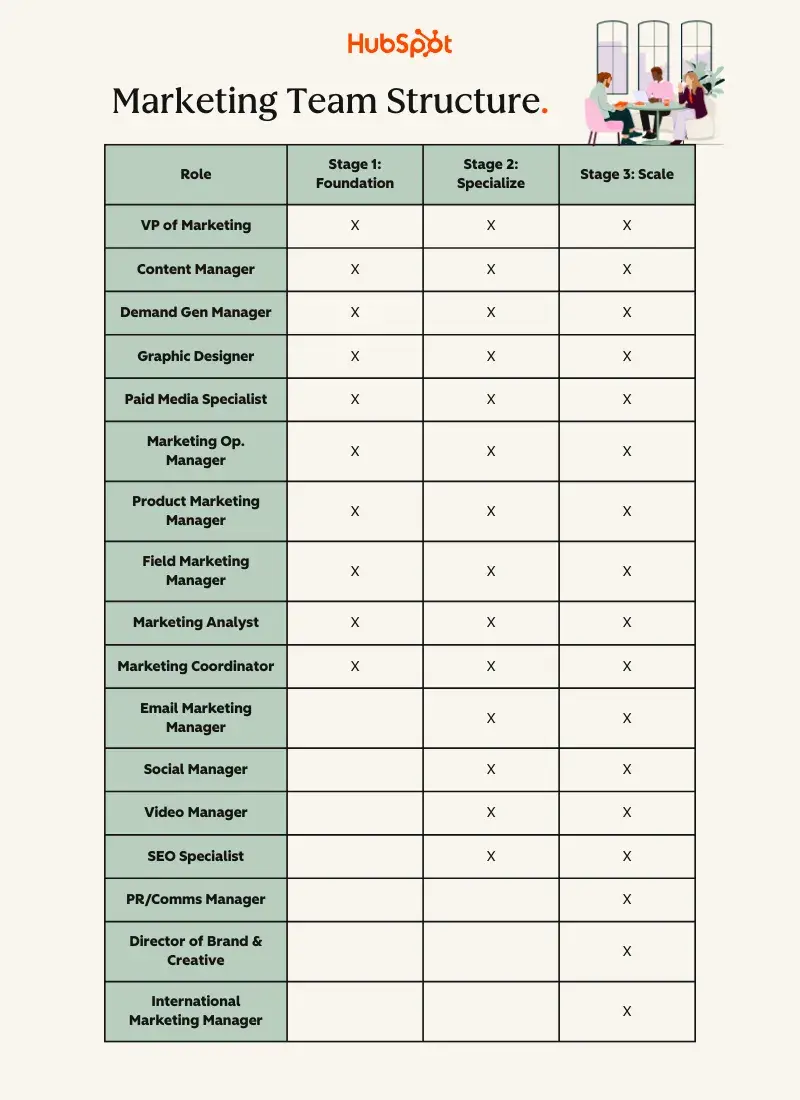
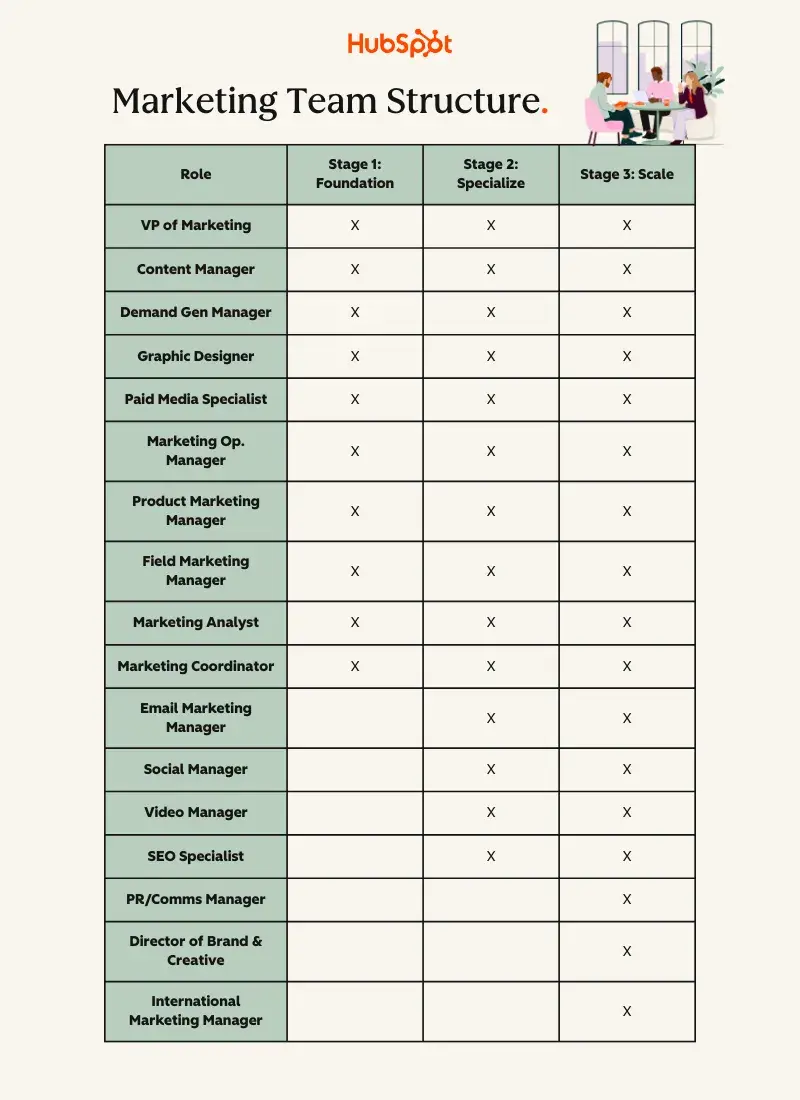
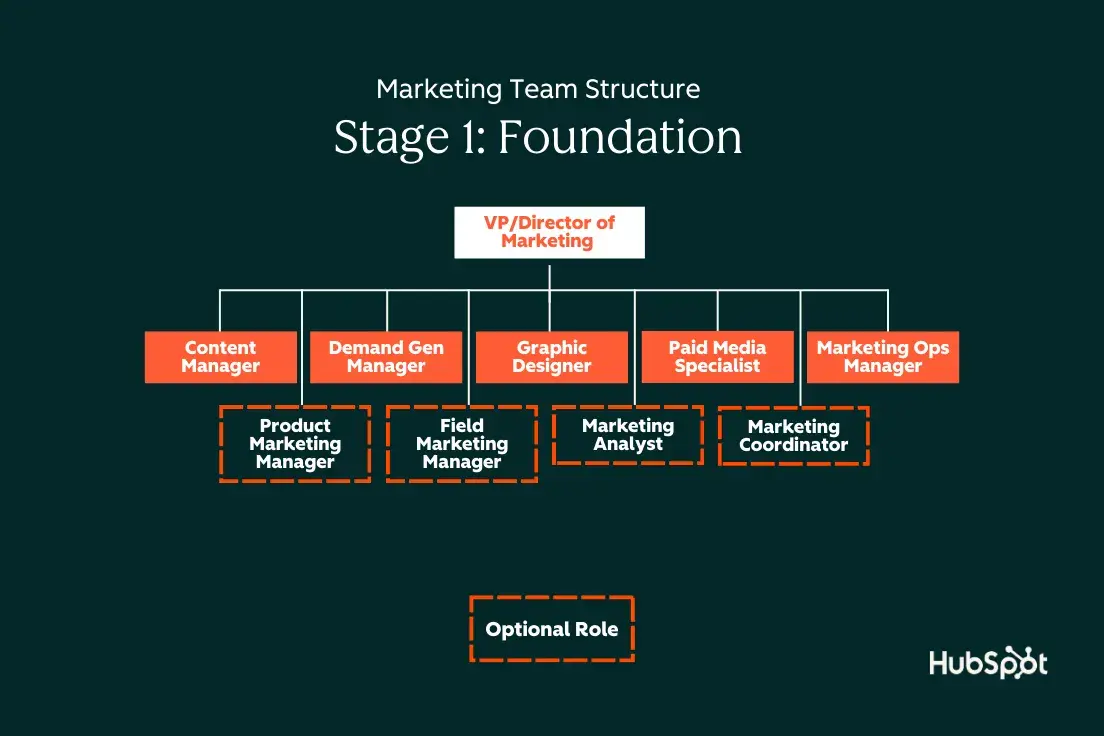
Phase 1: Foundation (5-10 People) – Establishing Core Competencies
This initial phase, typically triggered by reaching $5-15 million in Annual Recurring Revenue (ARR) and acquiring over 100 customers, is dedicated to establishing the fundamental marketing functions and implementing essential tools and processes. The emphasis at this stage is on hiring generalists with broad skill sets who can adapt to diverse responsibilities.
- Foundational Marketing Roles:
- VP or Director of Marketing: Responsible for overall strategy, team leadership, and alignment with business objectives. This role serves as the primary marketing decision-maker and is accountable for key metrics.
- Efficiency Metrics: Return on Marketing Investment (ROMI), Customer Acquisition Cost (CAC), Marketing-Sourced Pipeline, Marketing Efficiency Ratio (MER).
- Content Marketing Manager: Oversees content creation, SEO strategy, and production. This individual may create content directly or manage external resources.
- Efficiency Metrics: Publishing Frequency, Organic Traffic Growth, Content-Attributed Marketing Qualified Leads (MQLs), First-30-Day Page Traffic.
- Demand Generation Manager: Focuses on acquisition and pipeline generation, driving conversions and lead flow to sales.
- Efficiency Metrics: MQLs, Sales Qualified Leads (SQLs), Cost Per Acquisition (CPA), Marketing-Sourced Pipeline, Payback Period.
- Graphic Designer: Creates visual assets for websites, social media, and premium content, ensuring brand consistency.
- Efficiency Metrics: Campaign Consistency Rate, Turnaround Time per Asset, Engagement Uplift (CTR, Social Shares), Brand Adherence Audits.
- Paid Media Specialist: Manages advertising campaigns across various platforms, including paid social.
- Efficiency Metrics: Impressions, Click-Through Rate (CTR), Cost Per Click (CPC), CPA, Return on Ad Spend (ROAS).
- (Optional) Marketing Operations Manager: Manages automation and reporting systems, including CRM tools.
- Efficiency Metrics: MER, Campaign Setup Time, Funnel Conversion Rates, Data Accuracy Score.
- (Optional) Product Marketing Manager: Focuses on product messaging, positioning, and go-to-market strategies.
- Efficiency Metrics: Sales Enablement Usage, Win Rate Uplift, Sales Cycle Reduction, Product-Qualified Leads (PQLs).
- (Optional) Event or Field Marketing Manager: Supports in-person events, particularly relevant for B2B organizations.
- Efficiency Metrics: Leads Generated per Event, Cost Per Lead (CPL), Event Attendance Rate, Pipeline Sourced from Events.
- (Optional) Marketing Analyst: Monitors, measures, and reports on marketing performance.
- Efficiency Metrics: Dashboard Refresh Cadence, Attribution Model Coverage, Forecast Accuracy, Data Insights Generated.
- (Optional) Marketing Coordinator: Provides administrative and executional support across various marketing activities.
- Efficiency Metrics: Task Completion Rate, Campaign Support Accuracy, Coordination Turnaround Time.
- VP or Director of Marketing: Responsible for overall strategy, team leadership, and alignment with business objectives. This role serves as the primary marketing decision-maker and is accountable for key metrics.
In this phase, a flat organizational structure with all team members reporting directly to the marketing leader is most effective, minimizing confusion in decision-making and fostering collaboration. The principle of allocating functional areas based on available skills and bandwidth, as advocated by Elad Gil, allows for pragmatic initial assignments, with the understanding that roles can evolve. Generalists are crucial here, capable of adapting to shifting priorities and contributing across core channels, which is vital for agility during the scaling process. The expected impact is the establishment of a functional funnel, foundational processes, and initial pipeline traction.
Regarding the integration of AI, while AI tools can support certain roles, human oversight remains critical for refining and validating outputs, especially in content generation. For remote talent, it is advisable to prioritize local or in-office hires during this foundational phase to mitigate the complexities of remote work and maintain a cohesive team dynamic.
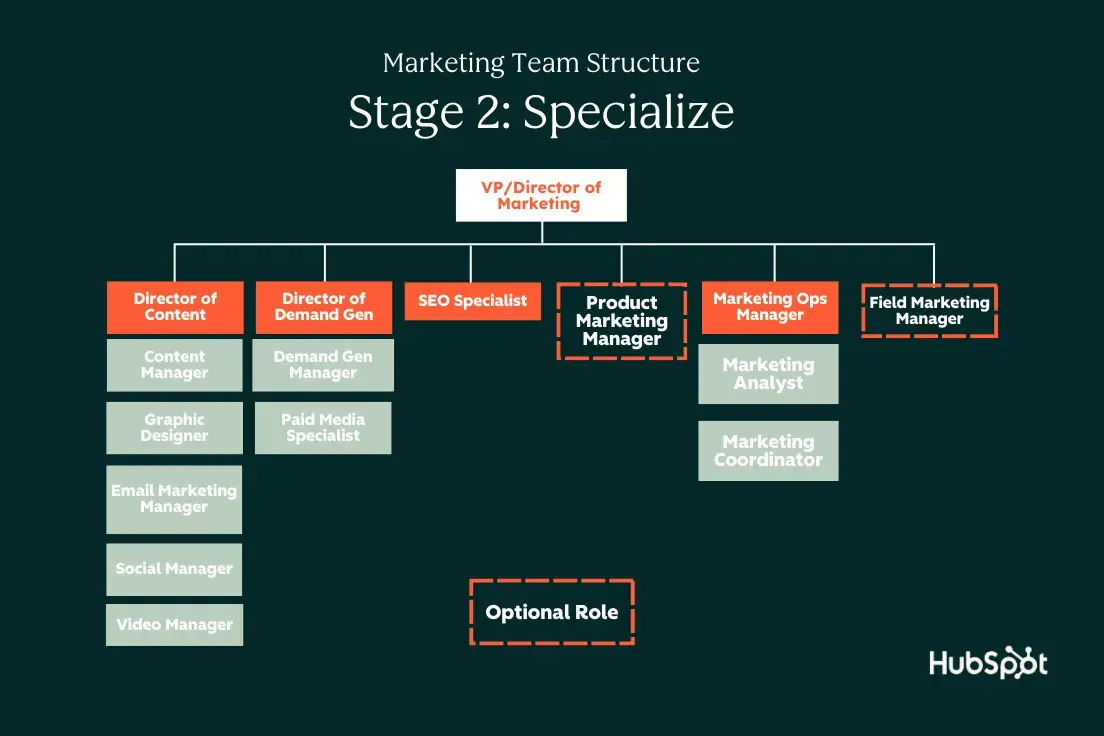
Phase 2: Specialization (11-17 People) – Deepening Expertise
Upon surpassing $15 million in ARR and serving over 500 customers, companies enter a more competitive market, necessitating a more sophisticated marketing approach. This phase introduces specialization, typically by channel, to enhance performance tracking, enable focused effort, and support repeatable growth, alongside an initial layer of management.
- Specialized Marketing Roles:
- Director of Demand Generation: Oversees both paid and inbound efforts, focusing on driving conversions and sales, and often managing the Demand Generation Manager.
- Efficiency Metrics: Leads Generated, Task Completion Rate, Campaign Support Accuracy, Coordination Turnaround Time.
- SEO Specialist: Takes over advanced SEO responsibilities from the Content Marketing Manager, driving improved search engine visibility and site performance.
- Efficiency Metrics: Task Completion Rate, Campaign Support Accuracy, Coordination Turnaround Time, Organic Traffic Growth.
- Email Marketing Manager: Focuses on lead nurturing, lifecycle campaigns, and customer retention through email communications, evolving from content marketing responsibilities.
- Efficiency Metrics: Number of Email Campaigns Launched, Email Open/Conversion Rate, Campaign Support Accuracy, Coordination Turnaround Time.
- Social Media Manager: Manages the brand’s presence and engagement across various social media platforms, a full-time endeavor in today’s digital landscape.
- Efficiency Metrics: Task Completion Rate, Campaign Support Accuracy, Coordination Turnaround Time.
- Videographer or Video Marketing Manager: Invests in talent to build and scale video marketing strategies, a crucial element in modern content consumption.
- Efficiency Metrics: Number of Videos Completed, Campaign Support Accuracy, Coordination Turnaround Time.
- Director of Demand Generation: Oversees both paid and inbound efforts, focusing on driving conversions and sales, and often managing the Demand Generation Manager.
At this juncture, additional content writers may be required to scale content output, or a campaign manager might be appointed to coordinate cross-channel initiatives tied to revenue. This phase also presents a suitable opportunity to explore remote or hybrid work structures, leveraging established processes and tools to support distributed teams. Organizationally, functional teams with clear leaders, acting as middle managers, begin to form. Channel-specific ownership enhances focus, and the analytics function should operate independently for objectivity. The expected impact is reliable, scalable performance across all channels and the implementation of efficient campaign processes.
Phase 3: Scale (18-25 People) – Global Reach and Enterprise Readiness
The final stage, typically initiated when a company reaches $40-100 million in ARR and exceeds 1,000 customers, involves structuring the marketing team to support global operations and long-term scalability. This requires a fully layered marketing organization with strategic and executional roles across functions and regions.
- Marketing Roles for Scale:
- Director of Product Marketing: Owns the go-to-market strategy and enablement, often managing product marketing teams.
- Efficiency Metrics: Task Completion Rate, Campaign Support Accuracy, Coordination Turnaround Time.
- Director of Brand or Creative: Leads brand storytelling and visual identity, typically managing graphic designers.
- Efficiency Metrics: Task Completion Rate, Campaign Support Accuracy, Coordination Turnaround Time.
- Account-Based Marketing (ABM) Manager: Focuses on marketing to key segments or specific accounts, bridging sales and marketing alignment.
- Efficiency Metrics: Task Completion Rate, Campaign Support Accuracy, Coordination Turnaround Time.
- Conversion Rate Optimization (CRO) Manager: Dedicated to improving on-site and funnel conversion rates.
- Efficiency Metrics: Conversion Rate, Task Completion Rate.
- Marketing Automation Specialist: Supports backend workflows and integrations across marketing, sales, and service operations.
- Efficiency Metrics: Workflows Launched, Task Completion Rate.
- Customer Marketing Manager: Drives customer engagement and retention, fostering loyalty.
- Efficiency Metrics: Task Completion Rate, Campaign Support Accuracy, Coordination Turnaround Time.
- PR/Communications Manager: Manages media relations and external messaging to shape public perception.
- Efficiency Metrics: Task Completion Rate, Campaign Support Accuracy, Coordination Turnaround Time.
- International Marketing Lead: Oversees localization and regional expansion for global markets.
- Efficiency Metrics: Task Completion Rate, Campaign Support Accuracy, Coordination Turnaround Time.
- Director of Product Marketing: Owns the go-to-market strategy and enablement, often managing product marketing teams.
At this scale, the organizational structure should feature at least two layers of leadership, with Directors overseeing Managers and clearly defined functional areas such as Brand, Demand Generation, Product Marketing, and Operations. The expected impact is an enterprise-ready team capable of driving both pipeline and brand awareness across diverse markets, requiring alignment on global strategy and localized execution.
Key Steps to Building a Scalable Marketing Team
- Identify Your Growth Phase: Determine your company’s current stage based on ARR and customer count. Each phase (Foundation, Specialization, Scale) has distinct hiring priorities and structural needs. Utilize these to assess your team, identify necessary roles, and set revenue milestones as hiring checkpoints.
- Assess Current Marketing Capabilities: Evaluate your existing team’s skills, bandwidth, and effectiveness. Identify any gaps between current output and future goals to determine areas for improvement or new initiatives.
- Prioritize Hiring Needs: Rank potential roles based on current skill gaps, underperforming channels, operational strain, and revenue goals. Prioritize roles that directly drive pipeline or alleviate friction for immediate impact.
- Establish Clear Role Definitions, Metrics, and Expectations: Document responsibilities, success metrics, and reporting structures for each role. Clear definitions prevent overlap, confusion, and conflict. For scaling teams, formalizing processes and guidelines ensures faster onboarding and consistent execution.
- Create a Regular Structure Review Cadence: As recommended by Stripe, ambitious teams typically restructure every 6-9 months. Schedule at least quarterly reviews to assess if the current structure aligns with evolving business goals. Be prepared to adjust reporting lines, combine functions, or split teams as complexity increases.
Prioritizing Roles During Scaling
When faced with resource constraints, prioritizing roles becomes essential. Consider these factors:
- Urgency: Which roles address immediate pain points or critical skill gaps?
- Impact: Which roles have the highest potential to drive revenue or improve key performance indicators?
- Scalability: Which roles are foundational for future growth and team expansion?
- Team Bandwidth: Which roles can alleviate immediate pressure on existing team members?
- Budget: Which roles offer the most cost-effective solution for achieving critical objectives?
In-house vs. Outsourcing Decisions
Not every role necessitates a full-time employee (FTE), especially in the early stages. Strategic decisions about insourcing versus outsourcing can optimize budget and execution speed.
- Insourcing (Full-Time Hire) is beneficial for:
- Core strategic functions critical to long-term growth.
- Roles requiring deep institutional knowledge and consistent presence.
- Areas where building internal expertise is a competitive advantage.
- Tasks that demand high levels of collaboration and integration with other internal teams.
- Outsourcing (Contractors/Agencies) is advantageous for:
- Executional or temporary needs (e.g., specific design projects, short-term campaigns).
- Specialized skills not required full-time.
- Testing new channels or strategies before committing to FTEs.
- Leveraging external expertise for efficiency and speed on specific tasks.
Tooling for Scalable Marketing Teams
The right technology stack is as crucial as the talent itself.
- Foundation (5-10 People): Focus on core, multi-functional tools. Essential tools include a CRM (e.g., HubSpot), email marketing platform, social media management tool, analytics platform (e.g., Google Analytics), and design software. Aim for a martech spend under $2,000/month, leveraging free tiers and bundled solutions.
- Specialization (11-17 People): Refine channels and invest in tools that deepen capabilities and improve attribution. Core stack upgrades may include marketing automation platforms, SEO tools, project management software, and content management systems. Integration between tools becomes paramount to prevent manual data transfer.
- Scale (18-25 People): Global scale demands enterprise platforms with advanced personalization, ABM capabilities, and multi-market support. Enterprise marketing stacks can range from $50,000-$200,000+ annually, offering comprehensive solutions that replace multiple point solutions, reducing complexity and improving data quality.
Tool Selection Best Practices: Prioritize integration, scalability, user-friendliness, and vendor support. Ensure tools align with team workflows and provide actionable insights.
Addressing FAQs on Scaling Marketing Teams
- Ideal Leader-to-Individual Contributor Ratio: Start with a 1:5 or 1:6 ratio. As complexity increases, Directors or middle managers should manage smaller groups of three to seven.
- Preventing Silos: Introduce a management layer early, foster cross-functional meetings, align on shared revenue-based metrics, and utilize collaborative tools like Slack and Google Docs.
- Hiring Marketing Specialists: Avoid specialists before validating core channels. Introduce them in Phase 2 (11-17 people, $15-20M ARR) when dedicated focus per channel and deeper expertise are required.
- Full-time Employees vs. Contractors: Prioritize FTEs for strategic and core functions. Contractors are suitable for executional or temporary needs. Avoid prioritizing creative hires without a strong strategic plan.
Building to Scale, Not Just to Survive
The marketing organization is either a company’s growth engine or its most significant bottleneck. Structuring it for scale is not merely an operational decision but a strategic imperative. By adopting a phased approach, prioritizing roles judiciously, making informed decisions about insourcing versus outsourcing, and investing in the right technology, companies can ensure their marketing teams not only keep pace with growth but actively lead it. Regular review and adaptation of this framework are essential, as sustained growth requires a marketing team built to adapt, innovate, and excel.
About the Author