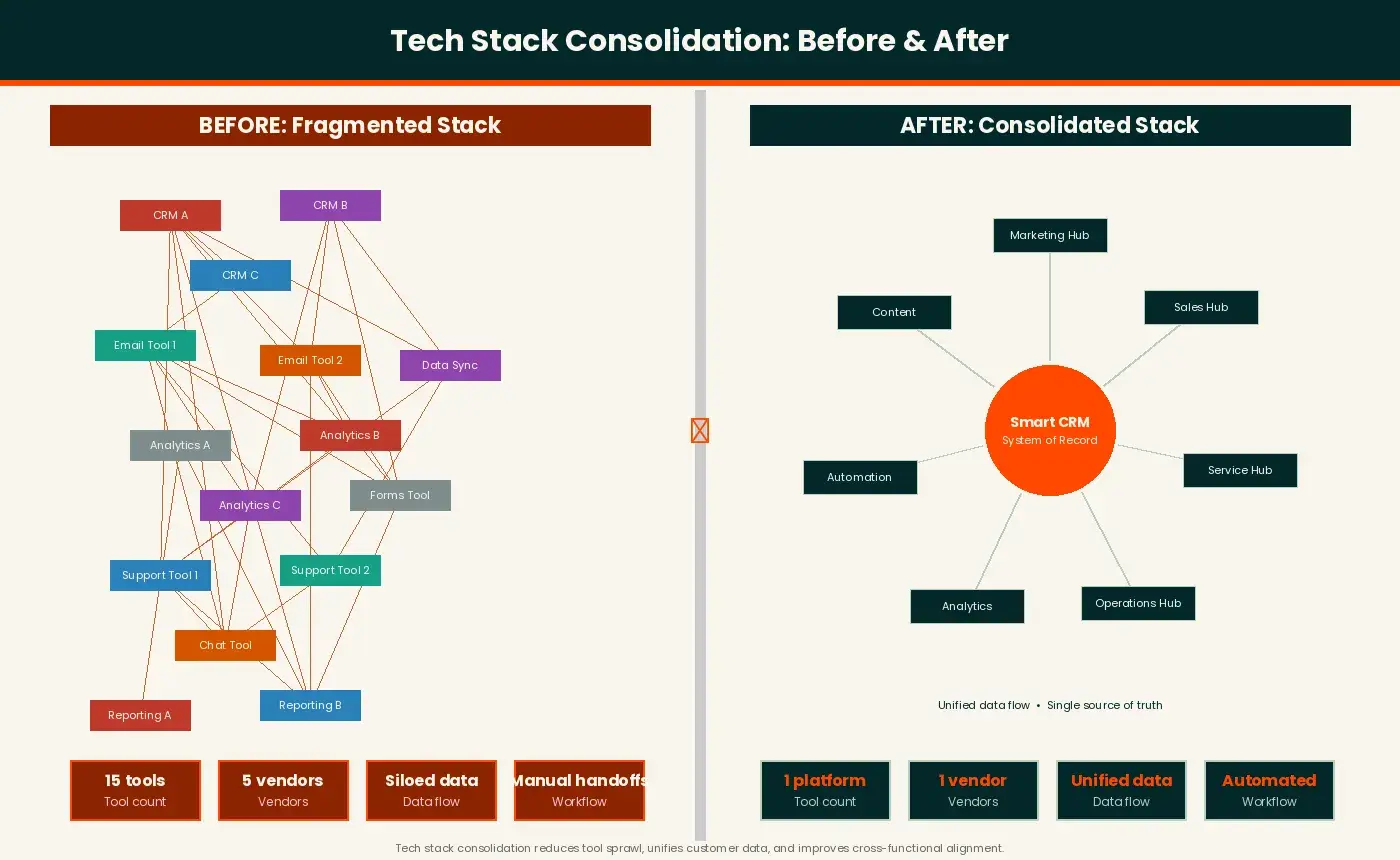
Tech stack consolidation is the strategic process of reducing the number of software tools an organization utilizes, standardizing operations on a more integrated and streamlined set of systems. This initiative extends far beyond mere cost-cutting, offering a fundamental shift in operational efficiency, data integrity, and customer engagement. By centralizing data within a unified platform, typically a Customer Relationship Management (CRM) system, organizations empower customer-facing teams to operate from a single source of truth. This eliminates data silos, streamlines workflows across the entire customer journey—from initial marketing touchpoints to sales engagement and post-sale service—and crucially, stops the repetitive and inefficient process of rebuilding customer context as individuals move between departments.
The foundational element of a successful tech stack consolidation strategy is the establishment of a robust CRM system as the "system of record." This centralized platform not only houses all customer data but also powers automated workflows and serves as the definitive source of truth for every team interacting with customers. This approach directly addresses the pervasive issue of "tool sprawl," where an accumulation of redundant or poorly integrated applications creates inefficiencies and hinders growth.
Understanding Tech Stack Consolidation and Its Significance
At its core, tech stack consolidation involves retiring redundant tools, standardizing on a core platform, and establishing cleaner, more efficient integrations between the remaining essential applications. This is a more profound undertaking than simply canceling a few software subscriptions. True consolidation requires a deliberate decision-making process to identify which tools serve as the definitive system of record, which ones extend its capabilities, and which have persisted due to inertia rather than necessity. By tackling "tool sprawl" at its root, organizations can move beyond the reactive management of individual contracts and achieve a more sustainable and efficient technological ecosystem.
The primary benefit derived from such consolidation is the unification of customer data. When a single CRM system captures every interaction, from a prospect’s first website visit through to their renewal or repeat purchase, departmental teams no longer face the challenge of reconciling conflicting definitions of "active customer" before critical business reviews. Reporting becomes faster and more accurate, automation can be effectively deployed across the entire customer lifecycle, and the overall customer experience is significantly enhanced as employees possess the comprehensive context needed to serve clients effectively.
While cost savings are a tangible outcome, they are often secondary to the operational gains. Research from Gartner indicates that software spending continues to rise even as organizations increase the number of tools they employ. The most significant returns on investment from tech stack consolidation emerge from reinvesting operational efficiencies—such as improved data accuracy, accelerated workflows, and the elimination of integration failures—directly into strategic execution and growth initiatives.
Identifying the Right Time for Tech Stack Consolidation
Several indicators suggest that an organization may be at a critical juncture for tech stack consolidation. These include:
- Excessive software spending: When the cost of managing and maintaining a multitude of disparate tools begins to outweigh their perceived benefits.
- Data silos and inconsistencies: When different departments or teams operate with conflicting or incomplete customer data, leading to miscommunication and inefficiencies.
- Manual workarounds and data re-entry: When employees spend significant time manually transferring data between systems or performing repetitive tasks due to a lack of integration.
- Poor cross-departmental collaboration: When the inability to share real-time, accurate customer information hinders collaboration between marketing, sales, and service teams.
- Difficulty in generating comprehensive reports: When generating unified reports on customer behavior, sales performance, or marketing ROI is a time-consuming and complex process.
- High integration maintenance costs: When IT resources are heavily dedicated to building and maintaining custom integrations between various software applications.
- User frustration and adoption challenges: When employees struggle to navigate multiple systems or find that the tools hinder rather than help their productivity.
If three or more of these conditions are present, tech stack consolidation becomes an essential operational fix rather than a mere optional improvement. The precise trigger for consolidation is not necessarily a specific number of tools, but rather the point at which the existing technology stack introduces more friction into daily operations than the tools themselves alleviate.
Cross-Functional Benefits of Tech Stack Consolidation
The impact of a consolidated tech stack reverberates across all functional areas of a business:
- Marketing: A unified marketing technology (martech) stack liberates marketing teams from the burden of data discrepancies, allowing them to focus more on campaign strategy and execution. Attribution models become more accurate as all customer touchpoints feed into a single platform. Automated workflows, such as lead nurturing, scoring, and lifecycle stage management, can operate seamlessly across the entire marketing funnel. This consolidation empowers marketers to build more effective, data-driven campaigns and achieve better ROI.
- Sales: Sales representatives operating from a single CRM can instantly access a prospect’s complete history—including past interactions, marketing engagement, and previous sales activities—without needing to toggle between multiple applications. Pipeline management, activity logging, sequence tracking, and note-taking are all centralized, leading to improved organization and efficiency. Furthermore, sales forecasting becomes more reliable due to the completeness and accuracy of the underlying data.
- Customer Service: Support teams gain a 360-degree view of the customer, including their purchase history, previous communications, and active deals, directly within their helpdesk interface. This eliminates the need for agents to ask customers to repeat information and allows for faster, more informed issue resolution. Seamless integration between service and sales/marketing data ensures a consistent and positive customer experience at every touchpoint.
- Operations, Finance, and IT: Vendor consolidation simplifies procurement processes, reduces the overall attack surface for cybersecurity threats, and enables finance teams to more accurately reconcile software spend against actual utilization. Operations teams can redirect valuable resources from maintaining complex custom integrations toward higher-value strategic initiatives, improving overall operational agility and efficiency.
A Step-by-Step Approach to Tech Stack Consolidation
Implementing a successful tech stack consolidation requires a structured and phased approach, often beginning with a thorough audit of the existing technological landscape.
Step 1: Audit Your Current Stack
The initial and perhaps most critical step is to conduct a comprehensive audit of every tool currently in use. This inventory should extend beyond centrally managed software to include "shadow IT" and departmental purchases made outside of central procurement. For each tool, detailed documentation should be gathered, including:
- Tool Name and Vendor: Clear identification of the software and its provider.
- Functionality: A precise description of the primary purpose and key features of the tool.
- Ownership: The department or individual responsible for the tool.
- Annual Cost: The direct financial outlay for licensing and subscriptions.
- Renewal Date: Critical for strategic planning and contract management.
- Utilization Metrics: Data on active users, frequency of use, and feature adoption.
- Data Flows: How data enters, leaves, and is processed by the tool, and its integration points with other systems.
- Integration Dependencies: Identification of other tools that rely on or feed into this application.
The key artifact from this phase is a master tool inventory that provides a clear overview of ownership, cost, renewal timelines, utilization patterns, and data flow for every piece of software within the organization.

Step 2: Prioritize Categories and Identify Quick Wins
Once the inventory is complete, the next step is to group tools by functional category (e.g., CRM, marketing automation, project management, HRIS). Within these categories, the organization should identify:
- Redundant tools: Applications that perform similar functions, allowing for the retirement of less effective or more costly options.
- Underutilized tools: Software that is paid for but not actively used, representing an immediate opportunity for cost savings.
- Essential tools: Applications that are critical to core business operations and should be prioritized for integration or retention.
- Quick wins: Opportunities to retire tools with minimal disruption and immediate cost savings, which can build momentum and secure buy-in for more complex phases.
Focusing on quick wins can build confidence among stakeholders and free up budget and resources for more challenging migrations.
Step 3: Define the System of Record and Data Standards
Before selecting or retiring any tool, it is imperative to clearly define where customer data will reside. Establishing a CRM as the definitive "system of record" means:
- Centralized Data Hub: All core customer information—contact details, company profiles, deal stages, and service interactions—is housed within the CRM.
- Single Source of Truth: Every department accesses and updates data from this central repository, ensuring consistency and eliminating discrepancies.
- Workflow Automation Engine: The CRM powers automated processes and triggers actions across different business functions based on unified data.
Crucially, data standards must be established. This includes defining field naming conventions, standardizing lifecycle stage definitions, and implementing robust deduplication rules. These standards ensure predictable integrations and prevent data quality degradation during and after the migration process.
Step 4: Select What to Keep and Justify Retention
Each tool remaining in the stack should be evaluated against a consistent set of criteria, such as:
- Strategic Alignment: Does the tool support the organization’s overall business objectives?
- Functional Fit: Does it perform a unique and critical function that cannot be easily replicated elsewhere?
- Integration Capabilities: How well does it integrate with the defined system of record and other essential tools?
- User Adoption and Satisfaction: Is the tool widely used and positively received by its users?
- Cost-Effectiveness: Does the value derived from the tool justify its cost?
- Vendor Viability and Support: Is the vendor reputable, financially stable, and does it offer adequate support?
Tools that do not earn their place based on these criteria should be retired. The evaluation should focus on demonstrable outcomes and business value.
Step 5: Plan Migrations Without Causing Disruption
Before retiring any tool, a detailed migration plan is essential to ensure business continuity. This involves:
- Data Migration Strategy: Defining how data will be extracted from the old system, cleansed, transformed, and imported into the new system.
- Integration Planning: Ensuring that new or retained tools integrate seamlessly with the system of record.
- User Training and Enablement: Developing comprehensive training programs to equip users with the skills needed to operate the new or consolidated systems.
- Phased Rollout: Implementing changes in phases, perhaps by department or use case, to identify and address issues early in the process.
This meticulous planning minimizes the risk of operational disruptions and ensures a smoother transition for all stakeholders.
Step 6: Enable Teams and Measure Adoption
Successful consolidation hinges on effective team enablement and continuous monitoring of adoption. For each migrated function, organizations must:
- Provide Comprehensive Training: Offer ongoing training and support to ensure users are proficient with the new tools and workflows.
- Establish Feedback Channels: Create mechanisms for users to provide feedback and report any issues or challenges.
- Monitor Adoption Metrics: Track key performance indicators (KPIs) related to tool usage, feature adoption, and workflow completion rates.
Adoption should be measured not just by login counts but by tangible improvements in business outcomes, such as increased data completeness, higher automation trigger rates, and more efficient workflow completion.
Step 7: Govern and Prevent Re-Sprawl
Without ongoing governance, the problem of tool sprawl can resurface within 12 to 18 months. To prevent this, organizations should establish:
- Clear Procurement Policies: Guidelines for acquiring new software, ensuring that all requests are vetted against existing tools and strategic objectives.
- Regular Stack Reviews: Periodic assessments of the technology stack to identify redundancies or emerging inefficiencies.
- Category Ownership: Assigning responsibility for specific tool categories to individuals or teams who oversee their utilization and renewal.
- Documentation of Standards: Maintaining accessible documentation of data standards, integration requirements, and approved vendor lists.
These governance measures create a framework for sustained efficiency and prevent the uncontrolled proliferation of software tools.

Navigating Common Challenges in Tech Stack Consolidation
The path to tech stack consolidation is not without its obstacles. Organizations frequently encounter:
- Stakeholder Resistance: Employees may resist losing tools they have become accustomed to, especially if they have built established workflows around them. Addressing this requires clear communication about the benefits, involving stakeholders in the decision-making process, and providing adequate training and support for new systems.
- Legacy Edge Cases: Certain tools may cover highly specific, critical workflows that are not easily replicated by other systems. In such instances, it may be necessary to retain these tools as exceptions, provided they integrate cleanly with the core system and their necessity is well-documented.
- Integration Gaps: Assumed integrations between systems may prove to be more complex or require custom development than initially anticipated. Thorough technical due diligence and pilot testing are crucial to identify and mitigate these issues.
- Contractual Timing: Organizations may identify a tool for retirement but find themselves mid-contract, necessitating careful negotiation or strategic planning for the contract’s expiration.
- "Dirty" Data: Migrating poor-quality data into a new, clean system merely perpetuates the problem. Data cleansing and validation must be a priority before, during, and after migration.
- Lack of Alignment with Procurement, Security, and Finance: Decisions made without the input of these critical departments can lead to downstream problems related to budget, security compliance, and vendor management.
Strategies for Preventing SaaS Sprawl Post-Consolidation
To ensure that the benefits of consolidation are long-lasting, organizations must implement proactive strategies to prevent the re-emergence of SaaS sprawl:
- Streamlined Intake Process: All new software requests, including free trials, should be routed through a standardized intake form. This form should capture the business case, anticipated costs, integration requirements, and whether similar functionality already exists within the current stack. This serves as a crucial gatekeeping mechanism.
- Defined Category Ownership: Assigning a dedicated owner to each technology category ensures accountability for renewals, utilization reviews, and the evaluation of new requests within that domain. This eliminates the "nobody’s job" gap that often leads to unchecked tool accumulation.
- Renewal-Based Review Cadence: Quarterly reviews anchored to major contract renewal cycles are essential. These reviews should scrutinize utilization against licensed seats and flag any tools with low adoption that are approaching renewal.
- Accessible Documented Standards: Data standards, integration requirements, and an approved vendor list must be readily accessible to relevant personnel, not buried in forgotten shared drives. These should be integrated into the onboarding process for new operations, IT, and marketing hires.
- Living Tool Inventory: The master tool inventory established in Step 1 should be a dynamic document, updated with every renewal and new purchase. This serves as the ongoing governance record and the baseline for future consolidation efforts.
Common Tech Stack Consolidation Pitfalls to Avoid
Several mistakes can derail consolidation efforts:
- Focusing solely on cost reduction: Overlooking the significant operational and strategic benefits can lead to suboptimal decisions.
- Skipping the audit phase: Jumping directly into tool selection without understanding the current landscape is a recipe for failure.
- Underestimating change management: Failing to adequately prepare and support users through the transition can lead to low adoption and resistance.
- Ignoring data quality: Migrating bad data into a new system will not resolve underlying issues and can create new ones.
- Lack of executive sponsorship: Without strong leadership support, consolidation initiatives often lack the necessary resources and authority to succeed.
- Not establishing clear governance: Failing to implement ongoing processes for managing the tech stack will inevitably lead to the return of sprawl.
A 90-Day Tech Stack Consolidation Plan
A structured 90-day plan can provide a roadmap for initiating a tech stack consolidation effort. The scope can be adjusted based on the size of the organization’s tool count and team capacity.
Days 1-30: Audit and Align
- Week 1: Initiate the collection of the master tool inventory by gathering data from finance, IT, and department heads.
- Weeks 1-2: Annotate the inventory with critical details such as utilization, renewal dates, data flows, and designated owners.
- Weeks 2-3: Map out data flows and identify integration dependencies between various tools.
- Week 3: Present initial findings to leadership and align on overarching consolidation goals.
- Week 4: Define candidate systems for the "system of record" and establish initial data standards.
The primary artifact from this phase is a comprehensive findings deck and an annotated inventory.
Days 31-60: Prioritize and Plan
- Week 5: Score all identified tools against pre-defined "keep" or "retire" criteria and pinpoint immediate "quick win" opportunities.
- Week 6: Finalize the selection of the system of record and validate critical integrations required for its functionality.
- Week 7: Develop a detailed migration plan, including a runbook, for the identified quick-win tools.
- Week 8: Communicate the consolidation plan to all affected teams, clearly outlining timelines and go-live dates.
Key outputs include a scored tool list, an integration map, and a migration runbook.
Days 61-90: Execute Pilot and Govern
- Week 9: Conduct a pilot migration for the first identified quick-win tool to test the migration process and gather feedback.
- Week 10: Deliver comprehensive training to affected teams on the new workflows and replacement tools.
- Week 11: Officially retire the first tool and begin tracking user adoption and initial business outcome metrics.
- Week 12: Establish the foundational governance structures, including the intake form, category owner assignments, and the review cadence.
This phase culminates in the establishment of an adoption dashboard and governance documentation. Post-Day 90, consolidation transitions into ongoing quarterly review cycles to maintain efficiency and prevent the recurrence of sprawl.
Frequently Asked Questions About Tech Stack Consolidation
How long does tech stack consolidation typically take?
Consolidation efforts can range from three to twelve months, depending on the complexity of the stack, the number of tools involved, and the extent of data migration required. The initial 90-day plan covers the foundational audit and pilot phases. Full CRM migrations might take a full quarter, while larger organizations may undertake consolidation in waves over 12-18 months.
How can organizations avoid vendor lock-in during consolidation?
Prioritizing platforms with open APIs and a robust partner ecosystem is crucial. Avoiding proprietary data formats and negotiating data portability terms into enterprise contracts are also key strategies. Maintaining a lightweight integration layer between the system of record and category-specific tools ensures that individual components remain replaceable.
Can smaller teams benefit from consolidation?
Yes, smaller teams often experience more immediate and direct benefits. A small team managing numerous tools faces proportionally higher overhead than larger enterprises. For them, the primary advantages are significant time savings and cleaner data. Opting for platforms that natively integrate multiple functions can entirely remove the burden of complex integrations.
What metrics should be tracked to confirm consolidation is successful?
Success should be measured across four key areas:
- Cost: Total software spend and cost per user.
- Data Quality: Record completeness, duplicate counts, and field standardization.
- Adoption: Active users and feature utilization rates.
- Business Outcomes: Conversion rates, sales cycle velocity, and customer satisfaction scores. Baselines should be established before migration and tracked at 30, 60, and 90 days post-implementation.
How should edge-case tools be handled during consolidation?
Edge-case tools should be retained if they cover a genuine, critical workflow, demonstrate consistent utilization, and integrate cleanly with the system of record. These exceptions should be clearly documented. If an "edge case" represents low utilization with a narrow use case, it is often more efficient to invest in a workaround within the core platform rather than maintaining a separate vendor relationship.
About the Author