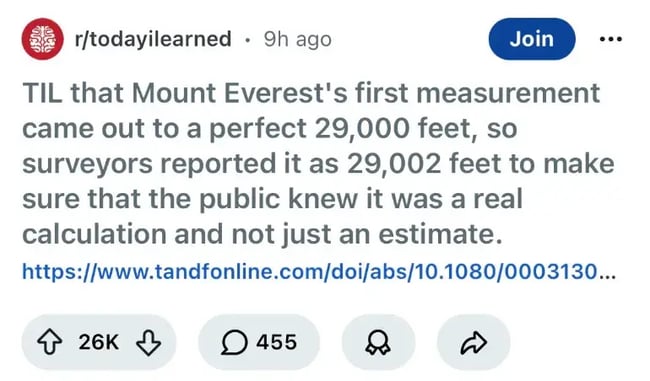
The seemingly innocuous decision by the British Royal Geographical Society in the mid-19th century to declare Mount Everest’s elevation as 29,002 feet, rather than a round 29,000 feet, offers a compelling glimpse into a fundamental aspect of human psychology: our inherent trust in specificity. This historical detail, initially unearthed through a Reddit post and corroborated by various sources, reveals a deliberate, albeit subtle, manipulation of perception that resonates even today, influencing everything from charitable giving to high-stakes negotiations. The story of Everest’s measurement is not merely an anecdote; it’s a foundational example of the "pique technique" and the broader psychological phenomenon that precise numbers, no matter how seemingly insignificant, often carry more weight and inspire greater confidence than their rounded counterparts.
The Genesis of a Precise Measurement: Charting the Roof of the World
The first comprehensive survey of Mount Everest, then known as "Peak XV," was a monumental undertaking that began in the 1840s as part of the Great Trigonometrical Survey of India. Spearheaded by the British, this ambitious project aimed to map the Indian subcontinent with unparalleled accuracy. The task of measuring the world’s highest peak was fraught with immense logistical challenges, involving traversing treacherous terrain, enduring extreme altitudes, and employing sophisticated, yet rudimentary by today’s standards, surveying equipment.
The survey, which spanned decades, involved teams of surveyors working under arduous conditions. Measurements were taken from distant points, utilizing triangulation methods to calculate heights. The initial raw data for Peak XV suggested an elevation very close to 29,000 feet. However, when the findings were compiled and presented by the British Royal Geographical Society, the official figure was announced as 29,002 feet. This precise number was not arbitrary. It was a conscious choice rooted in an understanding, perhaps intuitive at the time, that a rounded figure might be perceived as an approximation or even a guess, thereby diminishing its perceived accuracy and authority.
The Pique Technique: Disrupting "Mindless Refusal" with Specificity
The underlying principle that explains why a seemingly arbitrary addition of two feet to Mount Everest’s height lends it an air of authenticity has been explored and validated through numerous psychological studies. One of the most significant contributions to this understanding comes from the "pique technique," a persuasion strategy that posits that unusual or specific requests are more likely to elicit compliance by disrupting automatic, or "mindless," refusal patterns.

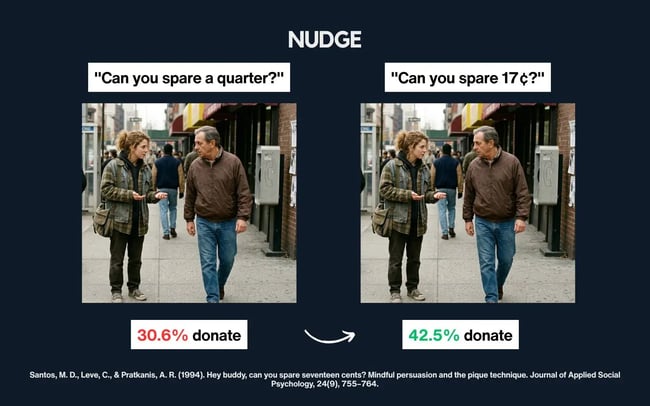
A seminal study in 1994, published in the Journal of Applied Social Psychology by researchers Michael D. Santos, Craig Leve, and Anthony R. Pratkanis from the University of California, Santa Cruz, provided compelling evidence for this technique. The researchers employed three female actors to approach 289 adults, asking for change. In one condition, the actors asked, "Can you spare 17¢ (or 37¢)?" In the other condition, they used a more general request: "Can you spare a quarter (or any change)?"
The results were striking. Participants who were asked for a specific, non-round amount were significantly more likely to donate change than those who received a general request. This demonstrated that the unusual specificity of "17 cents" or "37 cents" served to momentarily break the recipient’s habitual response to such solicitations, prompting them to engage with the request more thoughtfully and, consequently, be more amenable to complying. The implication was clear: precise numbers, by their very nature, signal a level of deliberation and accuracy that vague, rounded figures often lack.
Extending the Principle: Specificity Beyond Monetary Requests
The impact of specific numbers is not confined to monetary transactions. Researchers have explored whether this phenomenon extends to other forms of requests, particularly those involving time or effort. A 2015 study by Nicolas Guéguen, a professor of behavioral sciences at the University of Southern Brittany in France, revisited the pique technique, applying it to a non-monetary solicitation.
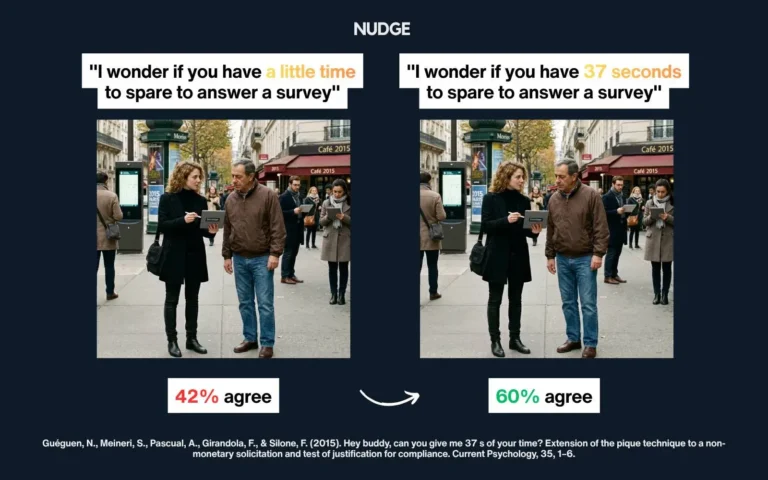
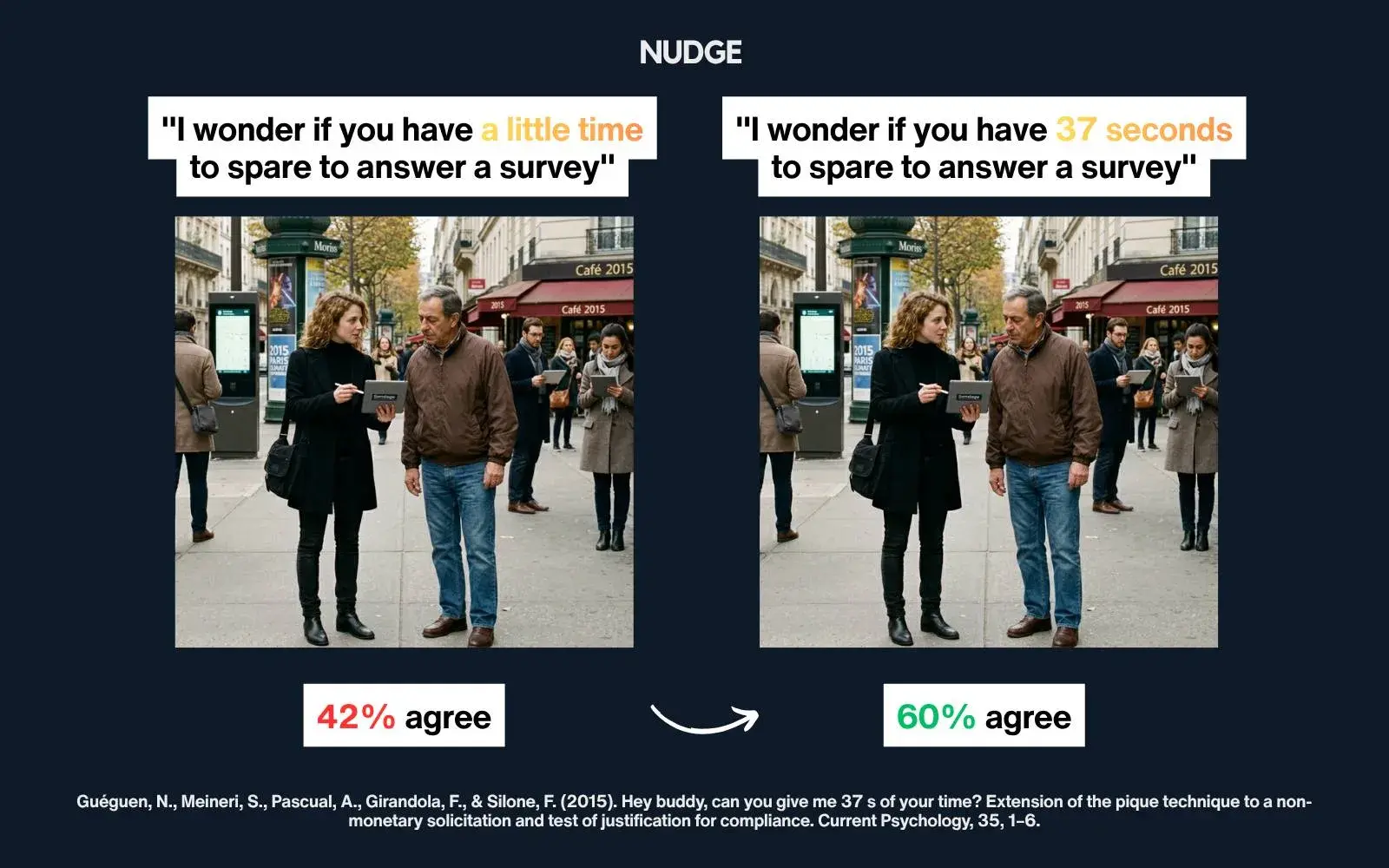
In this experiment, four female actors, uniformly dressed, approached 300 passersby to ask them to complete a survey. Half of the individuals were asked, "I wonder if you have a little time to spare to answer a survey." The other half were presented with a more precise request: "I wonder if you have 37 seconds to spare to answer a survey."
The findings mirrored those of the earlier monetary study. While 63 out of 150 individuals agreed to answer the survey when asked for "a little time," a significantly higher number, 90 out of 150, agreed when asked for "37 seconds." This represented a 42.9% increase in compliance. This extension of the pique technique indicated that the power of specificity transcended mere financial exchanges, influencing individuals’ willingness to commit their time as well. The unusual precision of "37 seconds" effectively disrupted the automatic "no" and prompted a more considered, positive response.

The Psychology of Round Numbers: Perceived Vagueness and Lack of Credibility
The consistent observation across these studies points to a fundamental human cognitive bias: we tend to associate rounded numbers with approximations, estimations, or even arbitrary choices. The absence of granular detail can lead us to question the rigor behind the figure. In contrast, precise numbers, with their trailing digits, suggest a process of careful measurement, calculation, and validation. They imply that someone took the time to be exact, thereby imbuing the claim with a greater sense of credibility.
This psychological principle has profound implications in various fields, including marketing, sales, and negotiation. In marketing, while rounded numbers might be favored for their simplicity and memorability (e.g., "$10" instead of "$9.97"), research suggests that precision can be a more effective tool for building trust and influencing consumer behavior. When a product is priced at "$19.97," it often signals a deliberate pricing strategy, implying a more careful consideration of value and cost, which can, in turn, enhance its perceived authenticity.
Precision in Negotiation: The $2,135 Advantage
The influence of precise numbers extends to high-stakes environments like negotiations. A 2013 study published in the Journal of Experimental Social Psychology investigated the impact of precise offers on negotiation outcomes. In one of the studies summarized, hundreds of participants were tasked with negotiating the hypothetical sale of a used car. Buyers were instructed to initiate the negotiation with either a rounded price of $2,000 or a precise price point of either $1,865 or $2,135.
The researchers observed a significant difference in the sellers’ counter-offers. When buyers began with a precise asking price, sellers tended to make smaller adjustments in their counter-offers compared to when the initial offer was a round $2,000. The use of specific figures, such as $1,865 or $2,135, lent an air of justification and reasonableness to the offer. This perceived accuracy made the price appear more considered and less arbitrary, leading to a more favorable final selling price for the buyer, as the seller was less inclined to push for a significantly different figure.
This phenomenon suggests that precise numbers in negotiations can anchor the discussion more effectively and create a perception of expertise and thoroughness on the part of the party presenting the precise figure. It signals that the number is not a guess but a result of careful deliberation, which can influence the perceived fairness and value of the offer.
Broader Implications: Trust, Credibility, and Persuasion
The consistent findings across these diverse studies highlight a powerful, yet often overlooked, aspect of human psychology: our inherent belief in the accuracy of precise figures. This principle, exemplified by the initial measurement of Mount Everest, has far-reaching implications for how we communicate and persuade.
In marketing and sales, embracing specificity can foster greater customer trust. Instead of opting for broad claims, marketers can leverage precise data points to substantiate their assertions. For instance, stating that a product improves efficiency by "42.9%" (as seen in one of the study’s findings) is likely to be perceived as more credible than saying "almost half." This precision suggests that the claim is backed by empirical evidence and rigorous testing, not just marketing hyperbole.
Furthermore, this understanding can inform how organizations solicit support, whether for charitable causes or research initiatives. A specific request for "17 cents" or "37 seconds" is more likely to capture attention and prompt a positive response than a vague appeal for "some change" or "a moment of your time."
The implications extend to everyday interactions, from personal requests to professional presentations. By incorporating precise numbers where appropriate, individuals can enhance the perceived credibility and authenticity of their statements, making them more persuasive and trustworthy. This doesn’t imply that all rounded numbers are inherently untrustworthy, but rather that in situations where accuracy and credibility are paramount, specificity often holds a distinct advantage.
Conclusion: The Enduring Legacy of Precision
The story of Mount Everest’s 29,002-foot elevation serves as a potent reminder of the subtle yet significant ways in which numerical precision influences our perceptions. The surveyors’ deliberate choice to add two feet, a seemingly minor detail, was a strategic move rooted in an understanding of human psychology that has been repeatedly validated by modern research. The pique technique, demonstrated through studies on monetary and temporal solicitations, and the anchoring effect observed in negotiation scenarios, all underscore the power of specificity.
In a world saturated with information, where discerning truth from falsehood is increasingly challenging, the principle of precise numbers offers a valuable heuristic for establishing credibility. When presented with specific figures, we are more inclined to believe that the claim is grounded in reality, meticulously measured, and therefore trustworthy. This psychological tendency, though seemingly simple, has profound implications for communication, persuasion, and the very foundation of trust in our interactions. As marketers, communicators, and individuals navigate the complexities of influencing others, embracing the subtle power of precision, much like the surveyors of Everest, can be a key to unlocking greater credibility and achieving desired outcomes. The enduring legacy of those extra two feet on the world’s highest peak continues to inform our understanding of how specific numbers shape our reality and our willingness to believe.
About the Author