
The smartphone industry is abuzz with artificial intelligence, with manufacturers vying to integrate AI-powered features to capture the mainstream consumer. Yet, UK-founded luxury phone maker Vertu is charting a distinct course. Eschewing benchmark scores and camera megapixels, Vertu, renowned for its hand-finished devices commanding prices in the tens of thousands, sells not just specifications but status. Its latest offering, the Alphafold, a foldable device, targets the ultra-affluent, particularly chief executives. This premium device marries opulent materials with an AI agent engineered to streamline an executive’s demanding professional life.
To assess this ambitious proposition, a departure from conventional smartphone reviews was undertaken. Instead of focusing on the usual metrics, the review period was dedicated to using the Alphafold as Vertu envisions its clientele would: managing complex documents, dissecting spreadsheets and contracts, orchestrating business travel, automating routine tasks, and relying on its integrated AI agent as a constant digital companion throughout the workday. The central question was not whether the Alphafold is a capable smartphone, but rather, if it succeeds as an executive smartphone.
At the core of the Vertu Alphafold lies the Hermes Agent, a pre-installed artificial intelligence designed to operate on the open-source Hermes project. Vertu asserts that this agent possesses the capability to analyze files, orchestrate task automation across various applications, retain conversational context, and, when necessary, seamlessly transfer requests to a human concierge. Unlike many prevalent smartphone AI assistants that primarily respond to direct commands, Hermes is architected to execute multi-step workflows autonomously on behalf of the user. This sophisticated AI is positioned by Vertu as the Alphafold’s primary draw, overshadowing the foldable hardware itself.
Physically, the Alphafold, with a starting price of $6,880, unequivocally embodies luxury. The review unit featured genuine calfskin leather upholstery accented with titanium, presenting a stark contrast to the glass and synthetic finishes prevalent in mainstream foldables. This design choice clearly caters to a demographic that views their mobile device as both a sophisticated tool and a potent status symbol.

In comparison to the Samsung Galaxy Z Fold 7, used as a benchmark throughout this evaluation, the 264-gram Alphafold feels noticeably heavier than Samsung’s 215-gram foldable. While this added heft is discernible during extended usage, it never becomes unwieldy. The Alphafold’s curved frame also facilitates a smoother unfolding experience compared to the flatter edges of the Galaxy Z Fold 7. However, Samsung’s design ultimately presents a sleeker profile and a more comfortable in-hand feel when folded, allowing for easier one-handed operation.
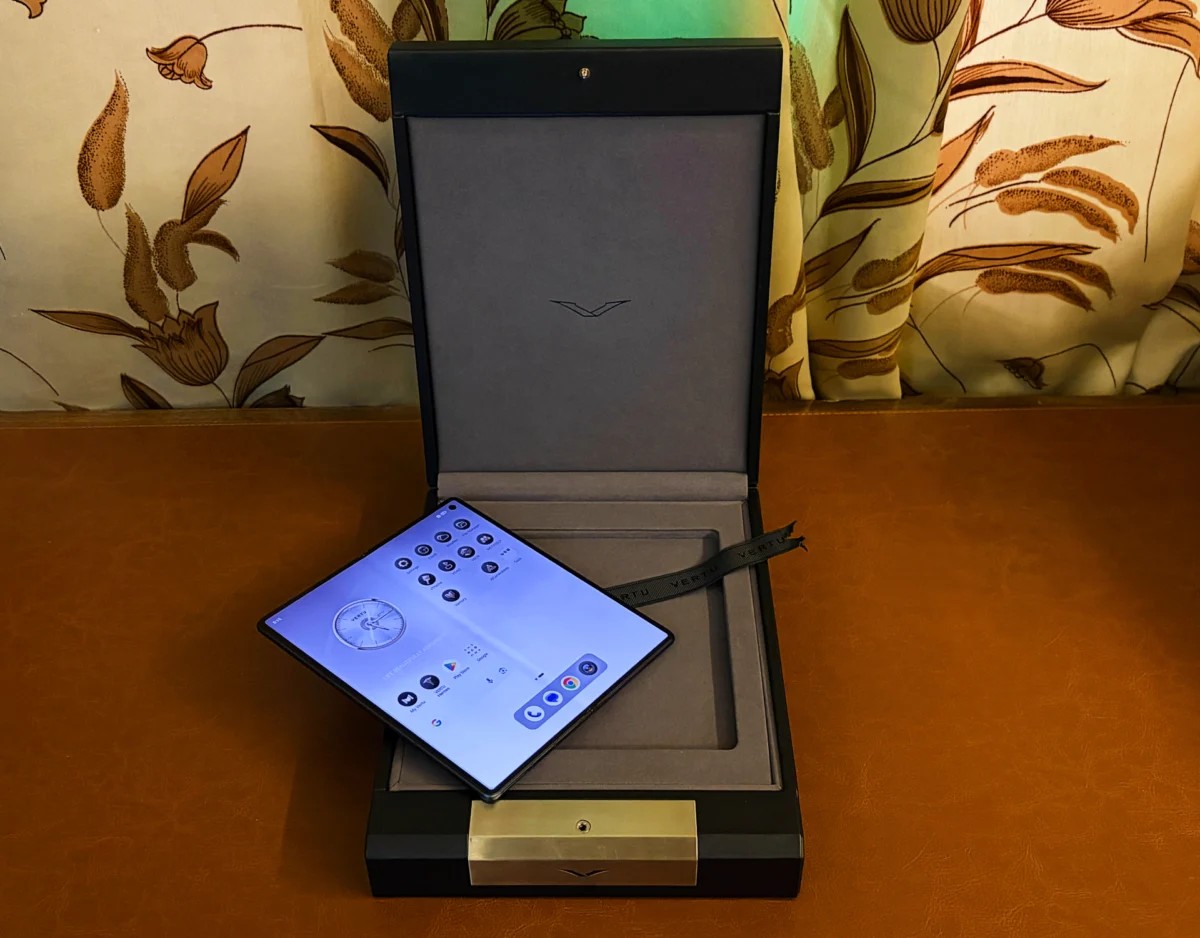
The Alphafold’s unboxing experience further reinforces its luxury positioning, eschewing typical smartphone packaging for something more akin to a high-end jewelry presentation case. The oversized box unfolds to reveal meticulously organized drawers containing bundled accessories, including a bespoke leather sleeve and charging cables, underscoring Vertu’s strategy of selling an encompassing luxury experience rather than merely a handset.
Beneath the veneer of premium materials, however, a more complex narrative emerges. During the review, striking similarities were observed between the Alphafold and the ZTE Nubia Fold, a device priced at approximately $1,100. These parallels extended from the hinge design and overall dimensions to the precise placement of speakers, microphones, and the fingerprint reader. The most evident distinction remains Vertu’s signature leather-clad rear panel. Furthermore, system information logs revealed the presence of ZTE identifiers within parts of the device’s software.
In response to these observations, Vertu confirmed to TechCrunch that the Alphafold was developed through a specialized supply-chain partnership that leveraged ZTE/Nubia’s established hardware platform, component integration expertise, and production engineering capabilities. Vertu stated that its own responsibilities encompassed the selection and integration of luxury materials, the curation of the software experience, rigorous quality control measures, and the provision of after-sales service. ZTE did not respond to a request for comment.
This reliance on existing hardware platforms is not unprecedented for Vertu. A 2023 review of the MetaVertu by Wired noted that the device appeared to be based on a ZTE Nubia handset, citing hardware similarities and information from Counterpoint Research suggesting Vertu’s practice of adapting existing ZTE models with premium materials and customized software.

However, focusing solely on hardware underpinnings risks overlooking the fundamental premise of the Alphafold. Vertu’s core gamble lies not in engineering a novel foldable design, but in determining whether discerning executives will invest a significant premium for an AI agent capable of enhancing their daily productivity.
The AI Assistant: Hermes Agent in Practice
Over several days, the Alphafold was employed as the primary mobile device, replacing routine interactions with sophisticated executive-level workflows. Tasks included analyzing spreadsheets and contracts, planning intricate business trips, managing complex schedules, and automating actions across multiple applications. This hands-on experience was then benchmarked against the Samsung Galaxy Z Fold 7, running Google’s Gemini AI.
The testing process evolved organically. Initial software builds exhibited challenges with file uploads, image analysis, and connectivity to Vertu’s concierge service. Following the reporting of these issues to Vertu, server-side fixes were implemented, restoring the necessary functionality and enabling the completion of subsequent testing phases.
The evaluation revealed a more nuanced performance profile than initially suggested by Vertu’s marketing. The Hermes Agent demonstrated impressive capabilities in analyzing local files and spreadsheets, an area where Gemini on Samsung’s foldable still necessitated manual document uploads during testing. Hermes also exhibited a greater propensity for automating cross-application tasks and executing multi-step workflows. However, this increased autonomy was accompanied by trade-offs, raising pertinent questions about the appropriate balance between AI independence and the need for user clarification.

Can Vertu’s Hermes Agent Replace an Executive Assistant?
A simulated executive scenario was designed to test the agent’s capabilities. The task involved preparing for departure to the airport: messaging a contact about a 20-minute delay, initiating navigation to the airport, activating the phone’s Do Not Disturb mode, and setting a reminder to call the hotel in 15 minutes. The Hermes Agent successfully dispatched the message and enabled Do Not Disturb. It also opened Google Maps with airport directions. However, it failed to automatically commence navigation and, critically, set the reminder for 9:08 p.m., despite the request being made at 2:32 a.m. for a reminder to be issued 15 minutes later.
In contrast, the same request executed on Samsung’s Galaxy Z Fold 7 yielded a different outcome. Rather than attempting all actions immediately, Gemini engaged in a series of clarifying questions, inquiring about the specific airport destination and the preferred application for the reminder (Google Tasks or Samsung Reminder). Upon receiving these selections, it accurately scheduled the reminder for the correct time.
This comparison highlighted a fundamental difference in approach: Hermes demonstrated a greater willingness to act autonomously, while Gemini prioritized explicit confirmation before proceeding. Consequently, while Hermes managed to complete a larger portion of the requested workflow, Gemini ultimately delivered a more accurate and reliable result.
Planning a Business Trip
A second, more open-ended task focused on business trip planning. The prompt instructed Vertu’s Hermes Agent to arrange a business trip from Mumbai to Pune, including a morning flight, a hotel recommendation, and adding the itinerary to the user’s calendar. The agent responded by stating no direct morning flights were available for the requested journey and offered a "Contact Butler" option to escalate the task to Vertu’s concierge service. Furthermore, it created a calendar entry for the incorrect dates, scheduling the trip for July 7th instead of the intended July 18th-19th, leaving the workflow incomplete.
The Gemini AI on Samsung’s Galaxy Z Fold 7 adopted a different strategy. Upon identifying the unavailability of suitable direct morning flights, it proceeded to plan the trip by suggesting alternative travel options rather than deferring the task.

Working with Business Documents
The analysis of business documents presented a similarly mixed performance. Both Hermes Agent and Gemini were tasked with analyzing a locally saved financial spreadsheet, summarizing quarterly results, and identifying the inclusion of third-quarter sales figures.
During initial testing, Hermes successfully analyzed an uploaded sales spreadsheet and accurately summarized the second-quarter figures. However, upon revisiting the same conversation days later, the agent no longer recognized the previously shared document, responding, "I cannot access files stored directly on your local device. Please upload or attach the Sales spreadsheet here in the chat, and I will gladly analyze the Q2 data for you."
Gemini, while also requiring the spreadsheet to be uploaded initially, maintained the conversational context. Days later, it could still respond to follow-up questions about the document, correctly identifying the North region as the highest sales generator without requiring the file to be re-uploaded.
Collectively, the testing indicated that Hermes Agent represents an ambitious yet unfinished AI assistant. Its inclination towards autonomous action often made it feel more akin to a dedicated agent than Gemini on Samsung’s device. However, this proactive approach occasionally resulted in incomplete workflows, inaccurate outputs, and inconsistent behavior. The rapid pace of software updates during the review period suggested that Vertu is actively refining the platform, implying that the current user experience may evolve significantly in the coming months.
Beyond general assistance, Vertu has developed Hermes around a suite of specialized AI agents tailored for affluent professionals. These include agents focused on legal advice and investment insights, complemented by the option to escalate specific requests to a human concierge. The overarching objective is to position the Alphafold not merely as a premium smartphone, but as a comprehensive digital assistant for executives.

In practice, these specialist agents should be viewed as initial resources rather than definitive authorities. While they can furnish valuable summaries and recommendations, their responses are AI-generated and necessitate independent verification before being relied upon for critical legal, financial, or other high-stakes decisions. The provision of a human concierge service underscores the current limitations of AI agents, reinforcing the enduring importance of human expertise.
Vertu is also marketing the Alphafold as a business platform, transcending its identity as a mere smartphone. The company showcased an integrated enterprise resource planning (ERP) system designed to grant executives access to business data and workflows directly from the device. However, the testing was confined to a demonstration environment, making it challenging to ascertain the feature’s real-world performance or its integration capabilities with existing enterprise systems.
The Security Imperative
For Vertu’s target demographic, security is likely to be as paramount as AI functionality. Executives are unlikely to utilize an assistant that analyzes sensitive contracts, financial reports, and business plans if they lack confidence in the data processing and storage protocols.
Vertu asserts that conversations with the Hermes Agent are encrypted and are not utilized for training public AI models. The company further states that users have the flexibility to choose their data processing location, with enterprise deployments supporting private infrastructure for organizations requiring enhanced control over sensitive information.

These claims are substantiated by a dedicated "A5" security chip, which Vertu states provides hardware-level protection for sensitive data, encrypted communications, and digital credentials. While these assertions could not be independently verified during the testing period, they form a critical component of Vertu’s value proposition to executives and enterprises.
Living with the Alphafold: Beyond the AI
Beyond its AI capabilities, the Alphafold functions much like any contemporary flagship foldable device. The battery comfortably sustained over a day of usage during testing. However, the absence of wireless charging is a notable omission at this price point, particularly when considering that Samsung’s Galaxy Z Fold 7 offers convenient Qi charging alongside wired USB-C charging.
The camera application includes a document scanning mode, accessible under a "Smart AI" setting, which can recognize paperwork and apply enhancements, proving useful for digitizing contracts, receipts, and other business documents. Samsung offers a comparable scanning experience through its native camera software, suggesting this feature functions more as a parity offering than a significant differentiator.
Verdict

The Vertu Alphafold represents an ambitious endeavor to create an AI-first luxury smartphone, but its execution falls short of its considerable price tag. Despite its premium materials and exclusive services, the core hardware offers little that cannot be found in significantly less expensive foldables. The Hermes Agent, while promising, remains an evolving platform rather than a compelling reason to justify the substantial price increase.
Ultimately, Vertu is requesting a significant premium from buyers for branding, craftsmanship, and an ecosystem of AI and concierge services built upon an established smartphone foundation. Based on the conducted testing, this premium is challenging to justify, especially when considering that Samsung’s Galaxy Z Fold 7 provides a more mature foldable experience with comparable day-to-day functionality at a fraction of the cost. With Samsung’s next-generation Galaxy Z Fold 8 anticipated imminently, the Alphafold’s value proposition faces even greater scrutiny.
About the Author





