The digital search ecosystem is undergoing a profound transformation, shifting away from a traditional list of blue links towards direct, synthesized answers provided by AI-driven tools. This paradigm shift, driven by the increasing prevalence of AI Overviews, ChatGPT, and Perplexity, necessitates a fundamental rethinking of content strategy for marketers. The focus is no longer solely on achieving high rankings in traditional search results but on understanding and implementing "Answer Engine Optimization" (AEO) to ensure content is discoverable and citable by these emerging AI platforms.
According to HubSpot’s 2026 State of AEO Report, a significant 58% of marketers are actively optimizing their content for answer engines, underscoring the rapid ascent of AEO from a nascent concept to a mainstream marketing priority. This report highlights that the key to earning citations from AI search lies not in complex algorithms but in the fundamental structure of the content itself. This article delves into the structural elements that elevate content’s visibility and citation rates within AI-powered search environments.
The Fundamental Shift: From Links to Synthesized Answers
Historically, search engine optimization (SEO) revolved around presenting a website prominently within a list of search results. Users would click through to individual pages to find the information they sought. However, AI-driven search engines are fundamentally altering this user experience. Instead of presenting a multitude of links, these platforms are designed to directly answer queries by extracting and synthesizing information from various sources. This means that a website’s success in the AI search era hinges on its ability to provide clear, concise, and easily extractable answers that AI engines can confidently attribute.
Google’s AI Overviews, for instance, aim to provide immediate, comprehensive answers at the top of the search results page, often pulling snippets of information directly from authoritative web pages. Similarly, conversational AI models like ChatGPT and specialized answer engines like Perplexity are trained to understand natural language queries and generate direct responses. This transition means that visibility is no longer solely determined by ranking among the top ten blue links but by whether an AI engine can confidently extract a self-contained passage from a webpage and attribute it to the originating brand.
Why Content Structure is Paramount for AI Citations
The architecture of a webpage is the primary mechanism through which AI engines can effectively extract and attribute information. A well-structured page provides a clear roadmap for AI crawlers, enabling them to identify, understand, and isolate relevant information. This is a departure from traditional SEO, where keyword density and backlink profiles often played a more dominant role.
The core principle of AEO is that AI engines are not just ranking pages; they are reading them. Before a citation appears in an AI Overview or a Perplexity answer, the engine typically performs a series of steps:
- Crawling: The AI accesses and reads the content of the webpage.
- Parsing: It breaks down the content into manageable segments or passages.
- Scoring: Each passage is evaluated against the user’s query for relevance and accuracy.
- Extraction and Synthesis: The most relevant and well-structured passages are identified for potential inclusion in the AI-generated answer.
- Citation: The AI attributes the extracted information to its original source.
Understanding this "parse-then-cite" pipeline is crucial for content creators. It highlights that the ease with which an AI can extract and attribute information directly correlates with the likelihood of a citation.
Structural Themes Driving Citation Rates
The content most likely to be cited by AI answer engines shares several recognizable traits, primarily centered around its organizational structure. These themes are not merely stylistic choices but strategic approaches to making content digestible for AI.
Theme 1: Question-Led Headings and Direct-Answer Summaries
The efficacy of question-led headings and direct-answer summaries in AEO cannot be overstated. Sequential heading structures, according to the 2026 State of AI Search Report by AirOps, can increase citation odds by an impressive 2.8 times. This is because these formats directly map a user’s query to a specific answer, providing AI engines with readily extractable information.

- Question-Led Headings: These headings mirror the exact phrasing of a user’s query. For example, instead of a generic heading like "Benefits of SEO," a question-led heading would be "What are the benefits of SEO for businesses?" This direct correlation helps AI engines quickly identify relevant content sections.
- Direct-Answer Summaries (TL;DR): Placing a concise, one-to-two-sentence answer at the beginning of a section, before any detailed explanation, is highly effective. This "Too Long; Didn’t Read" format provides an immediate answer that AI engines can easily lift.
When paired effectively in Q&A blocks, explicit questions with tight, upfront answers create one of the most citable structures on a page. To maximize this potential, the format should clearly present the question, followed immediately by the direct answer, ensuring the answer is self-contained and requires no further context to be understood.
Theme 2: Semantic Schema and Entity Modeling
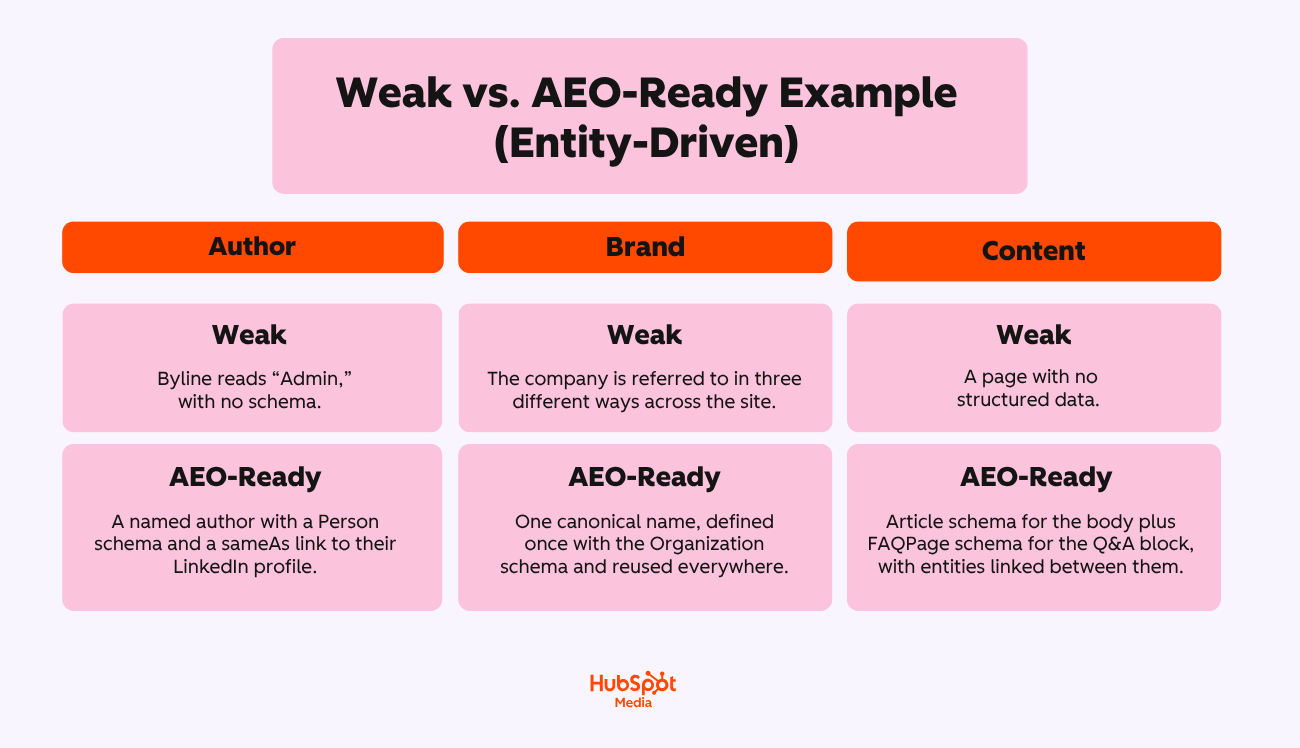
Schema markup and entity modeling provide the machine-readable layer essential for AEO. Structured data labels specific elements of a webpage, explicitly informing AI engines about the content’s nature, its author, and the brand behind it. This structured data helps bridge the "weak-schema" gap that can prevent otherwise strong content from being cited.
-
Schema Types: Key schema types that describe content and its context include:
- Article Schema: Identifies the content as an article, providing metadata like author, publication date, and headline.
- Author Schema: Details information about the author, establishing credibility and expertise.
- Organization Schema: Provides information about the brand or company publishing the content, reinforcing brand identity.
- FAQ Schema: Specifically marks up question-and-answer pairs, making them highly accessible for AI extraction.
-
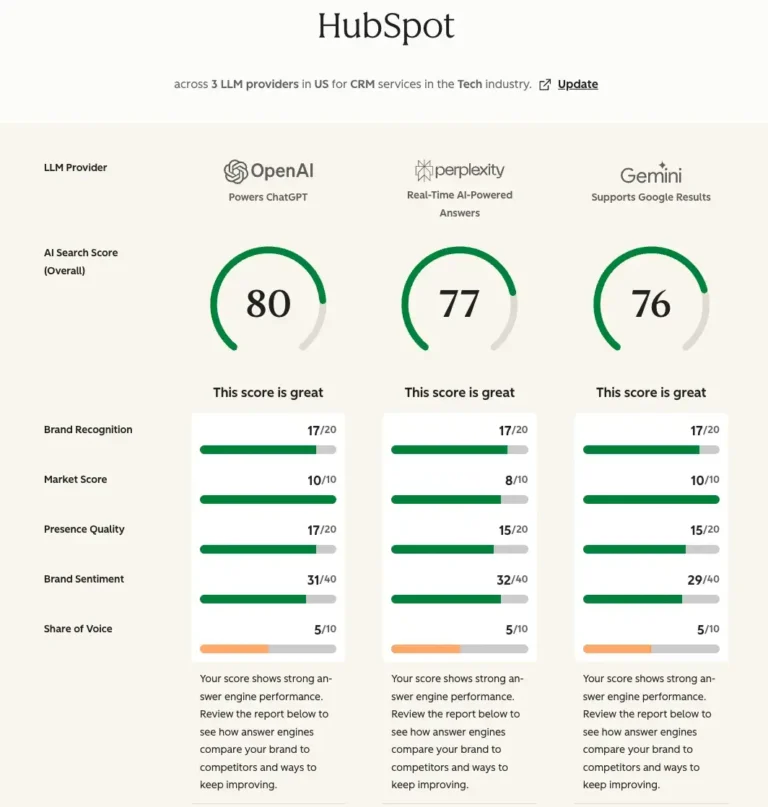
Entity Modeling: This involves defining people, brands, and products as consistent, interconnected entities rather than isolated keywords. By ensuring consistency in how these entities are represented across a website and the broader web, AI engines build confidence in the source. This consistency strengthens brand, product, and author relationships, making attribution more reliable. Tools like HubSpot’s AEO Grader can help benchmark how AI engines currently represent a brand and identify areas for improvement in entity signaling.
Theme 3: Authoritative Signals and Trust Markers
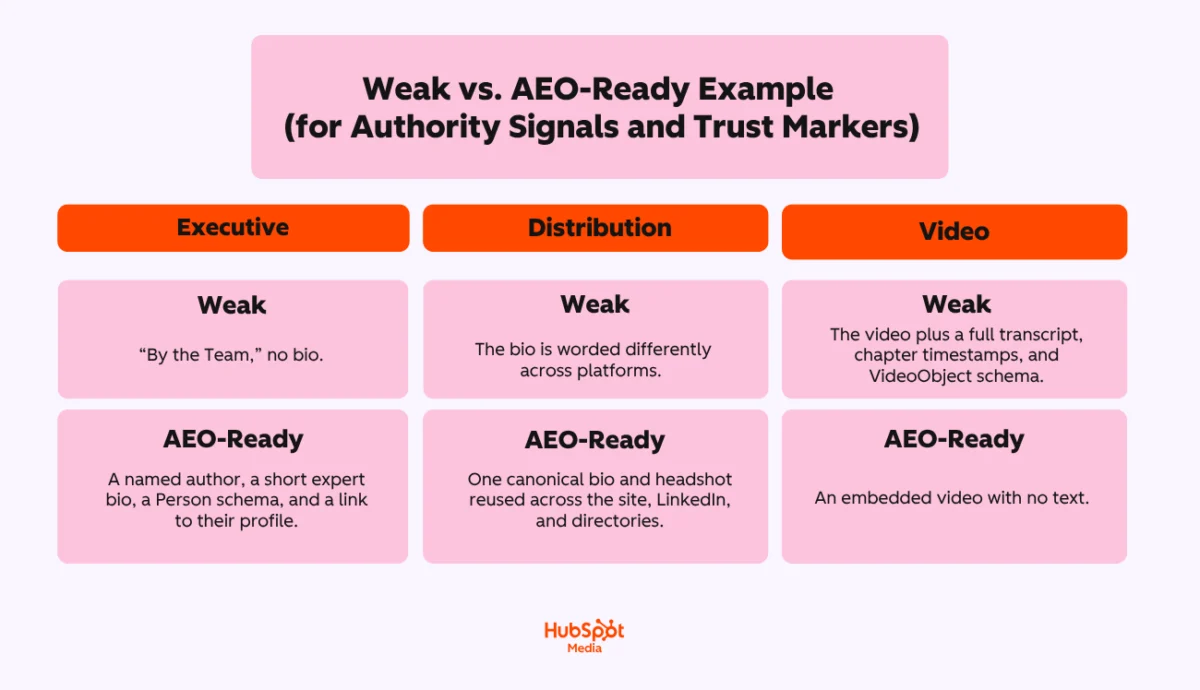
AI engines prioritize trustworthiness when selecting sources for citations. Two pages might provide equally accurate answers, but the AI will favor the source it can verify and trust. These signals of trustworthiness, known as authority signals, directly influence the quality and likelihood of a mention.
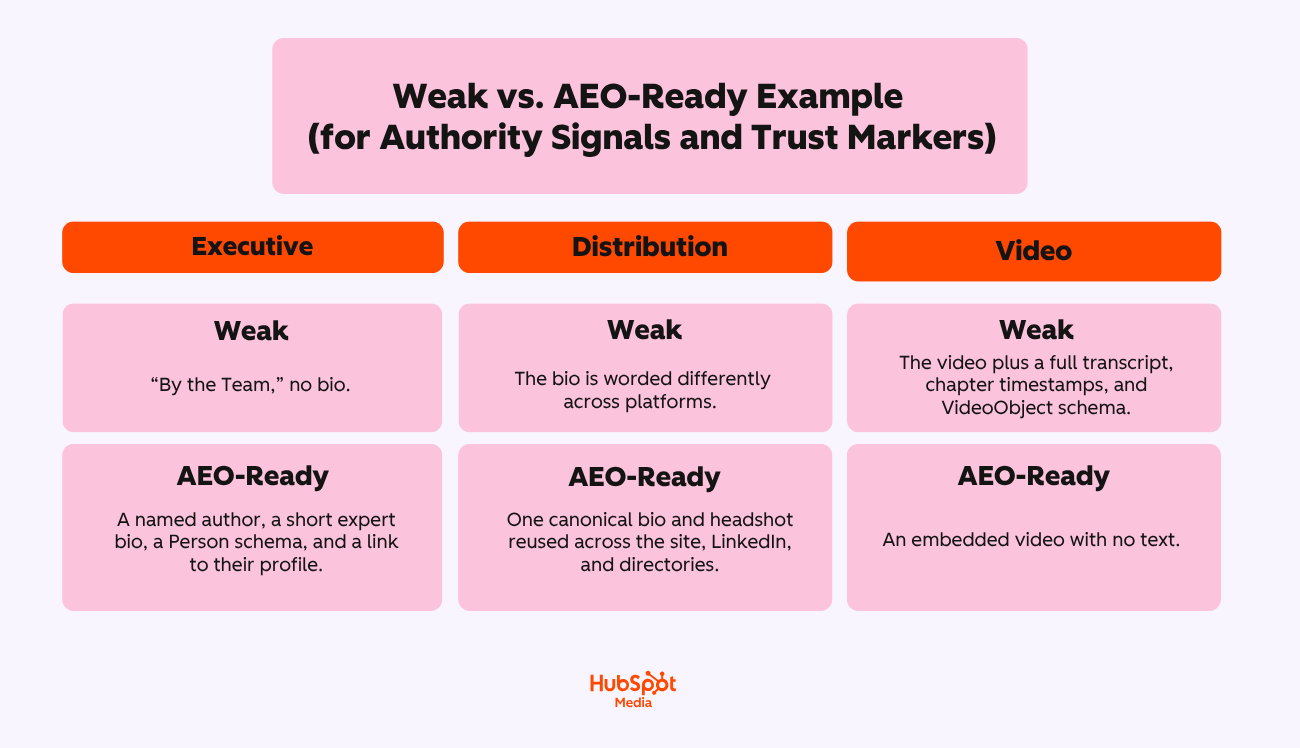
- Authoritative Brand, Executive, and Product Profiles: A well-defined profile acts as a stable, recognizable entity that AI engines can trust. Explicitly detailing who or what a profile represents is crucial. This includes having clear author biographies, detailed company profiles, and comprehensive product descriptions.
- Distribution Across Trusted Ecosystems: The presence of content and entities across reputable external sources serves as a powerful trust signal. Corroboration from established platforms lends credibility to the originating source.
- Video Transcripts, Timestamps, and VideoObject Schema: Video content, while engaging, is inherently difficult for AI engines to parse. Making video content text-readable through transcripts, incorporating timestamps, and utilizing the
VideoObjectschema can significantly enhance its discoverability and citability by AI.
By consistently implementing these trust markers, content transitions from merely answering a question to becoming a source that an AI is willing to name and attribute.
Theme 4: Strategic Internal Linking Architecture
Internal linking forms the site-level expression of content structure and is a critical factor in AI citation success. A well-designed internal linking strategy helps AI engines efficiently crawl, group, and trust related content. Conversely, weak or random linking can leave valuable answers isolated and disconnected from their topical context.
- Hub-and-Spoke Model, Glossary Pages, and Sibling Links: A hub-and-spoke model organizes content around a central, authoritative page that links to more focused supporting pages. Glossary pages define key terms, and sibling links connect related pieces of content within a topic cluster. This hierarchical structure provides a clear organizational framework for AI.
- Clear Anchor Text and Early Link Placement: The text used for internal links (anchor text) and their placement on the page signal their importance and relevance to search engines. Clear, descriptive anchor text helps AI understand the topic of the linked page.
- Internal Link to Topic Clusters: A topic cluster comprises a group of interconnected pages that comprehensively cover a specific subject. Linking within these clusters strengthens topical authority and allows AI engines to understand the breadth and depth of a website’s expertise on a given subject.
Theme 5: Passage-Level Optimization for Extraction
Passage-level optimization is the practice of writing each segment of content so that it can stand alone and be cited without relying on its surrounding context. The goal is to make each paragraph, list item, or table row a self-contained unit of information.
- Stand-Alone Paragraphs: Each paragraph should aim to answer a single, specific question and be understandable independently. This involves opening with the answer, followed by supporting details, and avoiding pronouns that refer back to previous text.
- Lists, Tables, and Definition Boxes: Structured formats like lists, tables, and definition boxes are highly snippet-friendly. They present information in a clear, organized manner that AI engines can easily extract and reproduce.
- Concise, Extractable Sentences: The length and clarity of sentences directly impact how cleanly an AI can quote them. Shorter, more direct sentences are generally easier for AI to parse and attribute accurately.
Aligning Structural Themes with Quality Guidelines
It is imperative to remember that structural optimization for AI citations must be grounded in genuine value. Google’s quality guidelines, which prioritize "people-first" content, remain paramount. Attempting to "game the system" by applying structural techniques to low-quality content is unlikely to yield sustainable results and may even backfire.
- Accuracy, Quality, Relevance, and User Context: These are fundamental prerequisites for any AEO strategy. Before optimizing structure, ensure the content itself is accurate, high-quality, relevant to the user’s intent, and provides a comprehensive answer.
- Disclosure When Automation Assists: Transparency is key. When AI assists in content creation, it’s important to disclose this to maintain reader trust. An editor’s note indicating review and fact-checking by a human contributor signals accountability.
- Do/Do-Not Guardrails: Establishing clear guidelines for content creation ensures consistency. This includes doing things like unifying brand and expert perspectives and ensuring honest attribution, while avoiding practices that prioritize search engines over users.
Measuring Citation Performance and Structural Impact
A significant challenge in AEO is proving its effectiveness. While implementing structural changes is achievable, demonstrating a direct correlation between these changes and an increase in citations requires robust measurement.
-
Key Performance Indicators (KPIs): Tracking specific metrics is essential:
- Citation Rate: The percentage of AI Overviews or generated answers that cite your content.
- Mention Quality: The prominence and context of the citation within the AI-generated answer.
- Traffic from AI Overviews: The amount of referral traffic originating from AI-powered search features.
-
The Measurement Loop: A cyclical approach of diagnosing performance, testing hypotheses, measuring results, and iterating on strategy is crucial. This data-driven process allows for continuous improvement and refinement of AEO tactics.
Operationalizing High-Citation Content Themes
To achieve consistent success in the AI search era, AEO strategies must be systematized and operationalized across content teams. This involves establishing clear roles and responsibilities and leveraging reusable templates.
- Role-Based Checklists: Assigning specific AEO tasks to designated team members (e.g., content strategists, writers, editors) ensures accountability and prevents crucial steps from being overlooked.
- Templates in Content Hubs: Developing reusable content templates that incorporate best practices for AEO can standardize citation-ready structures. These templates can be integrated into content management systems, making it easier for writers to consistently apply these principles. Tools like HubSpot’s AI can assist in generating initial drafts for Q&A and TL;DR blocks, which human editors then refine to meet quality standards.
Conclusion: Embracing the Future of Search
The transition to AI-driven search presents both challenges and opportunities for marketers. By understanding and implementing the principles of Answer Engine Optimization, content creators can ensure their valuable information is discoverable, citable, and influential in this evolving digital landscape. The core of AEO lies in structure: making content clear, direct, and easily extractable for AI engines. By focusing on question-led headings, direct answers, semantic schema, authoritative signals, strategic internal linking, and passage-level optimization, businesses can position themselves for success in the AI search era, transforming their content into a trusted source for the next generation of search.
About the Author