Wholesale businesses require more than a generic customer relationship management (CRM) system to thrive in the competitive B2B landscape of 2026. A CRM tailored for wholesalers must adeptly handle account-specific pricing, manage extensive product catalogs, facilitate repeat orders, and seamlessly integrate with inventory and fulfillment systems. When these crucial processes operate in silos, the consequences are tangible: quoting cycles lengthen, the incidence of errors escalates, and valuable revenue opportunities become increasingly elusive. The digital transformation across industries has underscored the need for specialized tools, and wholesale distribution is no exception. As of 2026, the market is increasingly recognizing that off-the-shelf CRM solutions often fall short of the intricate demands of B2B sales environments.
The optimal CRM for wholesale distributors acts as a central nervous system, connecting disparate customer data with sophisticated pricing logic, streamlined order workflows, and real-time inventory visibility. This integrated approach empowers sales teams to transition from generating a quote to finalizing an order without the disruptive need to switch between multiple platforms. Simultaneously, it furnishes operations leaders with precise pipeline insights, enabling more informed inventory management and strategic planning. Furthermore, it equips field representatives with the critical information they need to operate efficiently from mobile devices, a necessity in today’s on-the-go sales culture. This guide meticulously compares the leading CRM software solutions for wholesalers in 2026, evaluating each platform against essential wholesale-specific criteria such as enterprise resource planning (ERP) and inventory integration capabilities, robust mobile field sales functionalities, flexible pricing structures, and the total cost of ownership.
What is a CRM for Wholesalers?
A CRM specifically designed for wholesalers is a customer relationship management system engineered to support the unique B2B distribution workflows. This includes the granular management of account-specific pricing, the complexities of bulk ordering, and sales processes that are intrinsically linked to inventory and fulfillment systems. Its primary function is to help wholesale teams effectively manage their accounts, generate highly accurate quotes, and efficiently move orders through the sales cycle without the inefficiencies of relying on disconnected tools.
Wholesale CRM software excels at supporting customer-specific pricing and tiered price lists. This allows distributors to accurately apply contract pricing, volume-based discounts, and negotiated terms at an individual account level. Crucially, it integrates sales workflows with real-time inventory and order status data, often achieved through robust integrations with ERP systems. In a typical setup, the CRM system manages customer accounts, contacts, ongoing deals, and sales activities, while the ERP system handles the core operational aspects of inventory management, purchasing, and order fulfillment. This clear division of labor ensures that wholesale teams maintain accurate operational data while providing sales teams with the essential context needed to quote and sell with precision and speed. Many of these requirements bear a strong resemblance to those found in manufacturing environments, where CRM systems also play a vital role in connecting sales activities with production schedules and fulfillment processes.
Wholesaler CRM vs. Standard CRM: A Crucial Distinction
The wholesale distribution sector introduces a unique set of requirements that standard, out-of-the-box CRMs often fail to fully address without significant customization or the implementation of additional integrations. These divergences profoundly impact how sales teams price products, execute sales, and manage order fulfillment.
For instance, standard CRMs typically operate on a single, universal pricing structure. In contrast, wholesale businesses frequently deal with multiple price lists, customer-specific contracts, volume discounts, and negotiated rates. A generic CRM would struggle to accommodate this level of pricing complexity, leading to manual calculations, increased errors, and potential disputes with clients. Similarly, while standard CRMs track sales opportunities, they often lack the deep integration with inventory management systems necessary for wholesalers. This means sales representatives might be quoting products that are out of stock or on backorder, leading to customer dissatisfaction and lost sales. Repeat order functionality, a cornerstone of wholesale business, is also often underdeveloped in standard CRMs, requiring manual tracking and follow-up for recurring purchases.
Best CRMs for Wholesalers at a Glance
The landscape of CRM solutions for wholesalers is diverse, with platforms offering varying strengths. While wholesale CRM requirements share some common ground with adjacent industries like retail, they diverge significantly in terms of pricing models, typical order volumes, and the intricate structure of account management. For those in retail environments, a separate comparison of customer-focused sales solutions may be more relevant.
Best CRM Software for Wholesalers in 2026
The right CRM platform can be a transformative asset for wholesale teams, enabling them to drastically reduce quoting delays, synchronize sales activities with critical inventory data, and provide sales representatives with enhanced account visibility. The six CRM platforms detailed below are selected to address a spectrum of wholesale needs, ranging from specialized field sales enablement and stock-aware quoting to comprehensive enterprise forecasting and seamless ERP connectivity.
- HubSpot Smart CRM
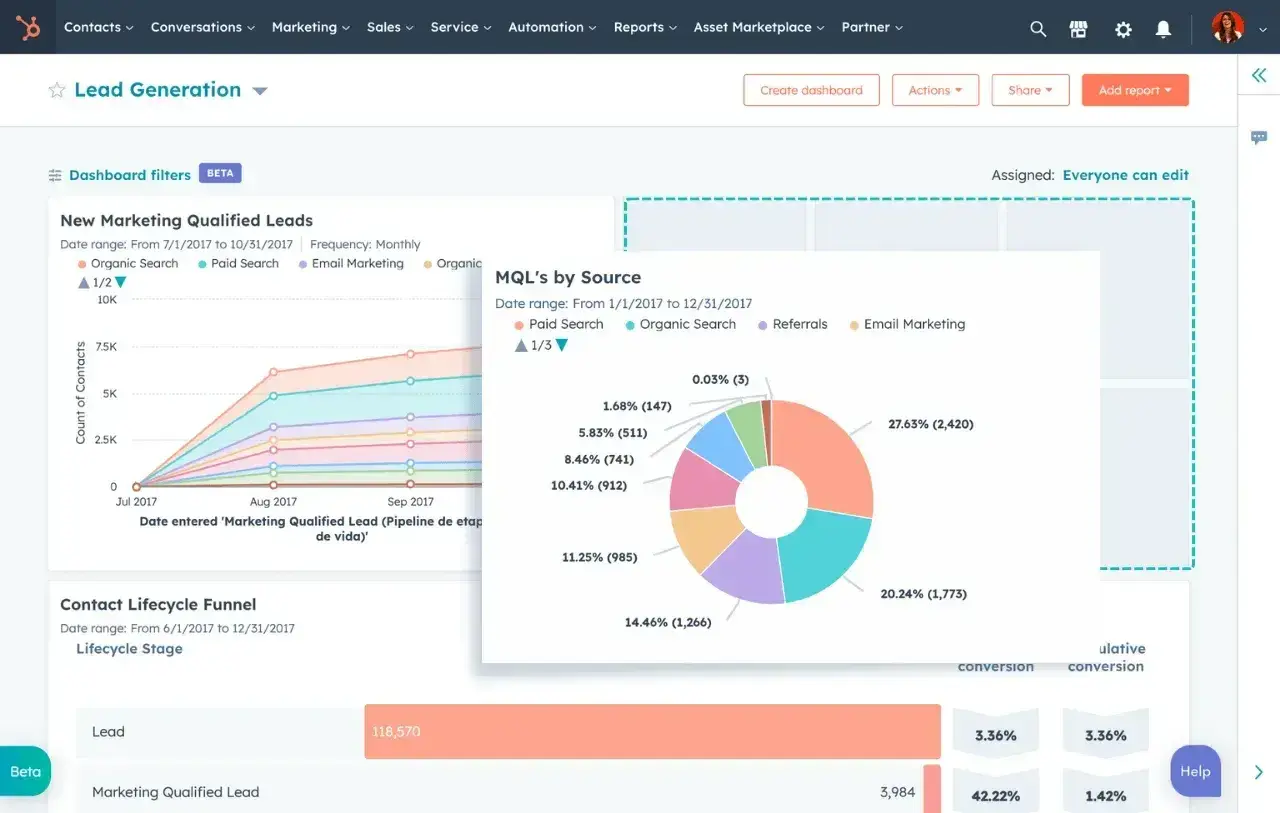
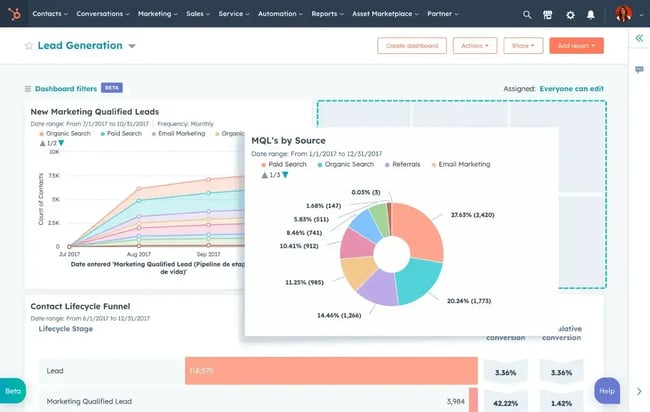
HubSpot Smart CRM represents HubSpot’s advanced, AI-powered system of record for all account, contact, deal, and activity data. For wholesale distributors, it offers robust capabilities to support quote-to-order workflows through its integrated product libraries, quoting tools, workflow automation, comprehensive reporting, and extensive integrations with ERP, inventory, and order management systems. HubSpot further enhances its offering by connecting Smart CRM with Commerce Hub, creating a unified environment where wholesale teams can manage customer data, quoting processes, billing, payments, automation, and reporting from a single, consolidated customer record. This holistic approach minimizes data silos and streamlines complex B2B transactions.
Key Features:
- Unified customer database across sales, marketing, and service.
- AI-powered insights and automation for sales processes.
- Extensive app marketplace for ERP and inventory system integrations.
- Robust reporting and analytics for pipeline and performance tracking.
- Mobile application for field sales productivity.
- Scalable pricing plans from free to enterprise-level.
Pricing: Tiered pricing available, starting with free CRM tools and expanding through Starter, Professional, and Enterprise plans for Sales Hub, which encompasses CRM functionalities. Specific pricing for Sales Hub Starter is $20/month/seat, Sales Hub Professional is $100/month/seat (with annual discounts), and Sales Hub Enterprise is $150/month/seat.
Best for: Wholesalers seeking a unified platform to manage sales, service, and marketing efforts, with a strong emphasis on connecting CRM data with ERP and inventory systems for end-to-end visibility.
What we like: The platform’s ability to combine a comprehensive, unified customer database with powerful automation and AI capabilities simplifies the management of complex B2B relationships without imposing undue operational overhead.
- Pepperi
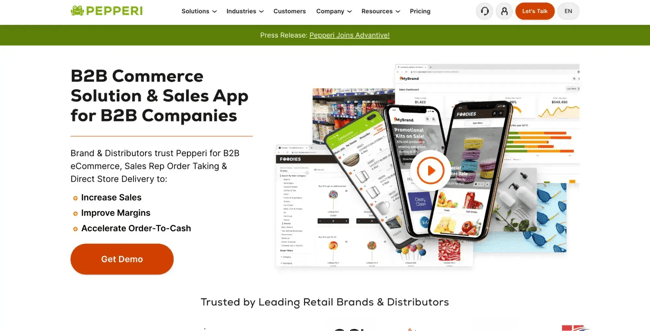
Pepperi uniquely combines CRM functionalities with B2B e-commerce capabilities, mobile order-taking tools, and dedicated field sales solutions, making it a comprehensive platform for wholesale distributors and brands. Sales representatives and buyers alike can leverage Pepperi to access customer-specific catalogs, tailored price lists, dynamic promotions, and efficient order workflows, all accessible through both web and mobile interfaces. Pepperi is particularly well-suited for distributors that require enhanced field sales execution, offline mobile access for remote operations, route-based selling strategies, and personalized customer buying experiences.
Key Features:
- Integrated CRM, B2B e-commerce, and mobile sales tools.
- Customer-specific catalogs and pricing.
- Offline mobile access for order taking.
- Advanced sales analytics and reporting.
- Workflow automation for order management.
Pricing: Available upon request, indicating a tailored approach to enterprise solutions.
Best for: Wholesale distributors requiring an integrated solution that encompasses CRM, a B2B commerce platform, and robust field sales capabilities.
What we like: Its purpose-built nature for wholesale operations provides comprehensive support for mobile sales representatives, efficient order taking, and the delivery of customer-specific catalog experiences.
- Prospect CRM
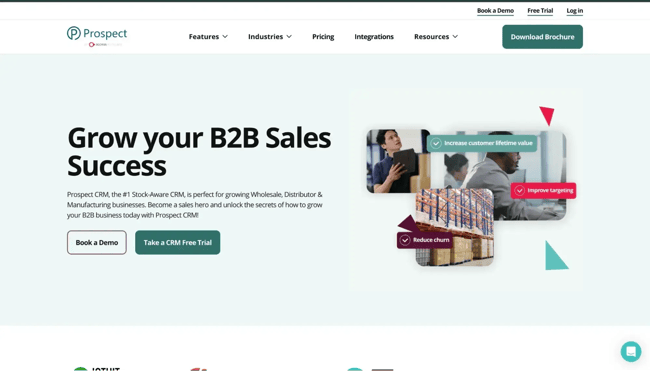
Prospect CRM positions itself as a "stock-aware" CRM, specifically designed for B2B businesses that sell physical products. It establishes a critical link between customer, product, sales, and real-time inventory data. This integration empowers wholesale teams to generate accurate quotes, manage customer accounts effectively, and prioritize sales activities with an informed understanding of stock levels and historical buying patterns. The platform is particularly effective for distributors who need their CRM records to accurately reflect actual product movement, including repeat orders, backorders, and cross-sell opportunities, thereby enhancing sales efficiency and accuracy.
Key Features:
- Real-time inventory visibility integrated directly into the CRM.
- Stock-aware quoting and sales management.
- Management of repeat orders and backorders.
- Customer and product data synchronization.
- Sales forecasting based on available stock.
Pricing: Starts at approximately $243 for a package of four users, with various tiers available.
Best for: Wholesalers who prioritize real-time inventory visibility directly within their CRM interface to inform sales decisions.
What we like: Its designation as a "stock-aware CRM" is a significant advantage, seamlessly connecting sales activities with current inventory data, enabling sales reps to make informed decisions based on product availability.

- Zoho CRM
Zoho CRM offers a highly customizable CRM solution designed for small to mid-sized wholesale teams. It provides essential features such as sales automation, pipeline management, territory management, and a wide array of integration options, all without the typically associated enterprise-level pricing. Wholesale teams can leverage Zoho CRM by connecting it with Zoho Inventory and other applications within the Zoho ecosystem to manage sales activities in tandem with inventory and order workflows. Zoho CRM is an ideal choice for cost-conscious teams that are comfortable configuring their own workflows and integrations or who are already invested in the broader Zoho suite of products.
Key Features:
- Customizable workflows and fields.
- Sales automation and pipeline management.
- Territory management capabilities.
- Integration with Zoho Inventory and other Zoho apps.
- Affordable pricing structure.
Pricing: Per-user pricing starts at $20/user/month for the Standard plan, $35/user/month for Professional, and $52/user/month for Enterprise (billed annually).
Best for: Small to mid-sized wholesalers seeking an affordable CRM with extensive customization options and robust integration capabilities.
What we like: It strikes a strong balance between price and functionality, offering valuable process automation and optional inventory integration through the comprehensive Zoho ecosystem.
- Salesforce Agentforce Sales (formerly Sales Cloud)
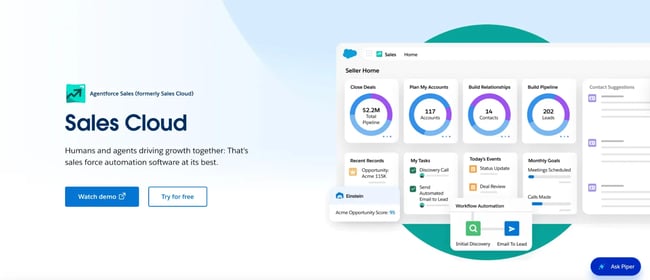
Salesforce Sales Cloud, now presented as part of Agentforce Sales, caters to sales teams that demand deep customization, advanced AI capabilities, sophisticated forecasting, territory management, and extensive product and price book management, alongside a vast ecosystem of app integrations. Wholesale distributors can configure Salesforce to handle complex account structures, intricate pricing models, multi-stage approval workflows, and multi-team coverage strategies. Salesforce is typically best suited for larger distributors with the financial resources and internal expertise to manage its implementation, administration, and ongoing customization needs.
Key Features:
- Advanced AI and forecasting tools.
- Extensive customization and configuration options.
- Robust territory and account management.
- Integration with a vast app ecosystem.
- Scalable for enterprise-level operations.
Pricing: Offers several editions, with Sales Cloud Essentials starting at $25/user/month (billed annually), Sales Cloud Professional at $75/user/month, Sales Cloud Enterprise at $150/user/month, and Sales Cloud Unlimited at $300/user/month.
Best for: Enterprise-level wholesalers with complex territory structures, sophisticated pricing models, and significant customization requirements.
What we like: Its highly configurable platform provides powerful tools for territory forecasting, intricate product pricing structures, and seamless integration with a broad ecosystem of business applications.
- Microsoft Dynamics 365 Sales
Microsoft Dynamics 365 Sales is Microsoft’s CRM solution tailored for sales teams operating within the Microsoft ecosystem. Wholesale distributors can effectively pair Dynamics 365 Sales with other Microsoft tools such as Microsoft 365, Power BI, Teams, and Dynamics ERP solutions. This integration allows for the seamless connection of sales activities with product information, pricing details, quote generation, order processing, and fulfillment context. The platform is particularly advantageous for wholesalers who are already utilizing Microsoft tools or who desire a tighter integration between their CRM and ERP workflows.
Key Features:
- Tight integration with Microsoft 365 and other Microsoft products.
- AI-driven insights and sales intelligence.
- Robust sales process automation.
- Unified interface across Microsoft applications.
- Extensible with Power Platform.
Pricing: Dynamics 365 Sales Professional is priced at $65/user/month, and Dynamics 365 Sales Enterprise is $95/user/month (billed annually).
Best for: Wholesalers already integrated into the Microsoft ecosystem or those requiring close alignment between CRM and ERP systems.
What we like: The strong synergy between CRM, ERP, and productivity tools, coupled with built-in support for diverse pricing models and sales territories, makes it a powerful choice for Microsoft-centric organizations.
Benefits of CRM Software for Wholesalers
Implementing specialized CRM software can significantly enhance how wholesale teams quote, sell, and manage their accounts by unifying customer data with critical pricing, inventory, and order workflows. For distributors managing high order volumes, frequent repeat purchases, and intricate pricing structures, a CRM system is instrumental in reducing manual effort while simultaneously improving visibility across the entire sales cycle.
Operational Efficiency (Faster Quote-to-Cash)
Wholesale teams often find themselves navigating a complex web of disparate systems to generate quotes, verify pricing, confirm inventory availability, and process orders. This fragmentation leads to considerable delays, redundant work, and an increased likelihood of inaccurate customer information. CRM software addresses these inefficiencies by streamlining the entire quote-to-cash process in several key ways:
- Centralized Customer and Product Data: All relevant customer information, including past orders, preferences, and contact details, is housed in one accessible location. Similarly, product catalogs with associated pricing and specifications are readily available, eliminating the need to search multiple databases.
- Automated Quoting and Order Entry: With integrated product catalogs and pricing rules, sales reps can generate accurate quotes rapidly. Many CRMs allow for the direct conversion of quotes into sales orders, significantly reducing manual data entry and the potential for errors.
- Real-time Inventory Visibility: By integrating with inventory management systems, sales reps can instantly check stock levels and commit inventory during the quoting or ordering process, preventing overselling and managing customer expectations effectively.
- Streamlined Approval Workflows: Complex approval processes for discounts or special pricing can be automated, ensuring that quotes and orders move through the necessary stages efficiently, without manual follow-ups.
- Improved Communication and Collaboration: A unified platform facilitates better communication between sales, operations, and finance teams, ensuring everyone is working with the most up-to-date information, which speeds up the entire transaction lifecycle.
Where HubSpot fits: HubSpot facilitates the creation of quotes directly from active deals and automates follow-ups and approvals through its robust workflow capabilities. When combined with Commerce Hub, teams can manage quoting, billing, and payments within a single system, thereby reducing friction between sales and finance departments.
Stronger Retention and Account Growth
Wholesale business growth is intrinsically linked to fostering repeat orders and cultivating long-term, loyal account relationships. Without a CRM, critical account history, communication logs, and purchasing patterns often remain scattered across various systems or are held solely by individual sales representatives. This fragmentation makes it challenging to maintain continuity when account ownership changes or to effectively identify and capitalize on opportunities for account expansion.
A CRM provides a consolidated repository for every customer account, documenting their entire order history, past interactions, and engagement across all channels. This comprehensive view equips wholesale distribution teams with:
- A Complete Customer 360-Degree View: Sales and customer service teams have immediate access to a customer’s entire history, enabling personalized service and proactive engagement.
- Identification of Repeat Order Patterns: The system can flag accounts that are due for reorders or identify purchasing trends, allowing for timely outreach and proactive sales efforts.
- Enhanced Cross-selling and Upselling Opportunities: By analyzing past purchases and customer needs, sales reps can more effectively identify and present relevant complementary products or upgrades.
- Improved Customer Service: With a full history of interactions and orders, customer service representatives can resolve issues more efficiently and provide more informed support.
- Seamless Handoffs and Continuity: In the event of a sales rep change, all account information is readily available, ensuring a smooth transition and uninterrupted customer experience.
Where HubSpot fits: HubSpot’s Smart CRM unifies customer data across all departments, making it easier to track account activity and maintain operational continuity. Workflow automation can be configured to trigger reorder reminders or proactive follow-ups based on specific customer behaviors or purchase cycles.
Revenue Impact and CRM ROI
The adoption of CRM software has a direct and measurable impact on revenue. This is achieved by accelerating the sales cycle, boosting sales representative productivity, and providing enhanced visibility into pipeline performance and individual account contributions. For wholesalers, the most significant revenue gains typically stem from reducing manual administrative tasks, capturing a larger proportion of repeat orders, and effectively identifying opportunities for upselling and cross-selling.
Furthermore, a CRM system significantly improves forecast accuracy by maintaining up-to-date pipeline data and directly linking sales activities to revenue outcomes. This enhanced data integrity empowers leadership teams to make more informed strategic decisions regarding inventory management, staffing levels, and long-term growth planning.
Common revenue drivers resulting from CRM adoption include:
- Increased Sales Velocity: Faster quoting and order processing translate directly into shorter sales cycles and quicker revenue realization.
- Higher Conversion Rates: Better lead qualification and more informed sales interactions lead to improved conversion rates from prospect to customer.
- Increased Average Order Value: Effective cross-selling and upselling strategies, informed by CRM data, can boost the average value of each transaction.
- Improved Customer Retention: Enhanced customer service and proactive engagement fostered by CRM lead to higher retention rates, which are generally more cost-effective than acquiring new customers.
- Reduced Administrative Costs: Automation of repetitive tasks frees up sales reps’ time to focus on selling, thereby increasing their productivity and reducing the cost of sales.
To quantify the return on investment (ROI) of a CRM system, wholesale teams typically analyze:
- Reduction in Quoting Time: Measuring the decrease in time spent generating each quote.
- Increase in Repeat Order Volume: Tracking the percentage increase in recurring purchases from existing clients.
- Improvement in Forecast Accuracy: Assessing the narrowing of the variance between forecasted and actual sales revenue.
- Sales Rep Productivity Gains: Quantifying the increase in the number of deals closed or revenue generated per sales representative.
- Reduction in Order Errors: Measuring the decrease in costly order mistakes and returns.
Even marginal improvements across these key metrics can compound significantly, leading to substantial revenue gains over time.
Where HubSpot fits: HubSpot consolidates pipeline tracking, reporting, and automation into a single, integrated platform, assisting teams in maintaining cleaner data and enhancing forecasting accuracy. AI-driven tools, such as those offered by HubSpot, aid in prioritizing opportunities and executing tasks more efficiently, thereby reducing the time spent on manual administrative work.
8 Important Features for a Wholesale CRM
Wholesale CRM software must be capable of managing complex pricing structures, high-volume ordering processes, and sales workflows that are intrinsically linked to inventory and fulfillment systems. The features outlined below represent the essential capabilities that most distributors require to manage their accounts efficiently and scale their operations effectively in the modern business environment.
- Customer-Specific Pricing and Quoting
A fundamental requirement for wholesale CRM software is the ability to support account-specific pricing. This encompasses not only contract pricing but also volume discounts, negotiated terms, and tiered pricing structures. This capability ensures that quotes generated accurately reflect the agreed-upon pricing for each specific customer, eliminating the need for cumbersome manual adjustments and the associated risk of errors.
Look for:
- Tiered Pricing Structures: The ability to define multiple price levels based on volume or customer segments.
- Contract Pricing Management: Functionality to store and apply specific contract terms for individual accounts.
- Discount Management: Tools to apply percentage or fixed-amount discounts at the line item or overall quote level.
- Quote Generation Tools: Intuitive interfaces for building quotes that automatically pull in product information and apply correct pricing.
HubSpot supports product libraries and quote creation directly from deals, with advanced tiered pricing capabilities accessible through Commerce Hub, offering a robust solution for these needs.
- ERP and Inventory Integration
Seamless integration between wholesale CRM software and ERP and inventory management systems is paramount. This connection ensures that sales workflows are synchronized with real-time inventory data, empowering sales representatives to quote products based on actual available stock and to accurately track fulfillment status without the need to switch between disparate systems. This integration is critical for preventing overselling, managing backorders effectively, and providing customers with reliable delivery information.
Look for:
- Bi-directional Data Sync: The ability for data to flow seamlessly between the CRM and ERP/inventory systems in both directions.
- Real-time Stock Level Visibility: Sales reps should be able to see current inventory counts directly within the CRM interface.
- Order Status Updates: Automatic updates on order fulfillment and shipping status should be reflected in the CRM.
- Product Catalog Synchronization: Consistent product information across both systems.
HubSpot integrates with a wide array of inventory and ERP tools through the HubSpot Marketplace, facilitating shared visibility and streamlined operations across these critical systems.
- Product Catalog and SKU Management
Wholesale operations typically involve managing extensive product catalogs, often comprising thousands of Stock Keeping Units (SKUs), each with multiple variations and complex pricing structures. A robust CRM system should provide comprehensive support for organizing, accessing, and managing this product data throughout the sales workflow. This ensures that sales teams can quickly find and select the correct products when building quotes and processing orders.
Look for:
- Centralized Product Database: A single, organized repository for all product information, including descriptions, images, and specifications.
- SKU and Variation Management: The ability to handle multiple SKUs and product variations (e.g., size, color, material).
- Product Grouping and Categorization: Tools to organize products logically for easier navigation and selection.
- Bundling and Kit Functionality: Support for selling products as pre-defined bundles or kits.
HubSpot’s product libraries are designed to help sales teams efficiently organize products and add the correct items to quotes, eliminating the need to recreate catalog information.
- Repeat Order and Reorder Workflows
The lifeblood of many wholesale businesses lies in repeat purchases from existing customers. CRM software should empower teams to effectively track buying patterns and proactively trigger follow-up actions based on typical reorder timings. This capability is essential for preventing missed reorder opportunities, ensuring consistent customer engagement, and ultimately improving customer retention rates.
Look for:
- Purchase History Tracking: Detailed records of past orders for each customer.
- Automated Reorder Reminders: System-generated alerts or tasks for sales reps when a customer’s typical reorder period is approaching.
- Quick Reorder Functionality: Tools that allow customers or sales reps to easily reorder previous purchases.
- Customer Segmentation based on Purchase Frequency: Ability to group customers based on their ordering habits for targeted campaigns.
HubSpot’s workflow automation capabilities can automate follow-ups and reminders based on customer behavior or specific deal activities, facilitating proactive reengagement.
- Territory Management and Account Ownership
Wholesale sales organizations are frequently structured based on geographical regions, specific account coverage areas, or product line responsibilities. CRM software must provide the functionality to clearly define and manage account ownership and to support territory-based reporting. This ensures accountability, facilitates performance tracking, and allows for equitable distribution of sales efforts.
Look for:
- Defined Sales Territories: The ability to segment customer accounts into distinct geographical or strategic territories.
- Account Assignment Rules: Automated or manual assignment of accounts to specific sales representatives or teams.
- Territory-Based Reporting: Reports that aggregate sales data and performance metrics by territory.
- Ownership Tracking: Clear designation of primary and secondary account owners.
HubSpot assists teams in assigning and tracking account ownership through company records, custom properties, lists, and reporting views that accurately reflect various territory or coverage models.
- Mobile Access for Field Sales Teams
In today’s dynamic business environment, field sales representatives require immediate access to CRM data while they are on the road visiting clients, taking orders, or managing accounts. A robust mobile CRM application is no longer a luxury but a necessity for enabling field teams to remain productive and informed wherever they are.
Look for:
- Comprehensive Mobile App: A well-designed mobile application that mirrors key desktop functionalities.
- Offline Access: The ability to access and update data even when internet connectivity is unavailable, with data syncing once online.
- Mobile Quoting and Ordering: Functionality to generate quotes and place orders directly from a mobile device.
- Contact and Account Management: Easy access to customer information, notes, and interaction history.
HubSpot’s mobile app empowers sales representatives to manage deals, tasks, and contacts efficiently from any location, ensuring they are always connected and informed.
- Reporting and Revenue Visibility
Effective wholesale CRM software must provide the capability to connect sales activities directly to revenue outcomes. This is crucial for enabling teams to accurately track performance, forecast demand, and make data-driven strategic decisions. Comprehensive reporting tools allow for the analysis of sales pipeline health, conversion rates, and the overall financial impact of sales efforts.
Look for:
- Customizable Dashboards: Visual representations of key sales metrics and pipeline status.
- Pipeline Forecasting Tools: Features that help predict future sales revenue based on current deal stages and probabilities.
- Sales Performance Reports: Detailed analysis of individual and team performance against targets.
- Revenue Trend Analysis: Insights into revenue growth, decline, and contributing factors.
HubSpot offers customizable dashboards and reporting tools that provide deep insights into pipeline performance and overall sales achievements, enabling better strategic planning and execution.
- Automation for Sales and Operations Workflows
Automation plays a pivotal role in reducing manual workload and ensuring consistency across both sales and operational processes. This enhancement of workflow efficiency is particularly critical for wholesalers managing high order volumes and complex, multi-step approval processes. Automating repetitive tasks minimizes human error, accelerates cycle times, and allows teams to focus on higher-value activities.
Look for:

- Workflow Automation Builders: Intuitive tools for creating custom automated sequences for tasks like follow-ups, notifications, and data updates.
- Lead Nurturing Automation: Automated sequences to engage and qualify leads over time.
- Task and Activity Automation: Automatic creation of tasks or follow-up activities based on specific triggers.
- Integration with Other Business Processes: The ability to trigger actions in other systems based on CRM events.
HubSpot’s workflow automation capabilities enable teams to automate repetitive tasks and streamline handoffs between sales and operations, ensuring a smoother and more efficient business process.
How to Choose a CRM for Wholesalers (Step-by-Step)
Selecting the right CRM is a strategic decision that requires careful consideration. A structured approach can ensure that the chosen solution aligns with the unique needs of the wholesale business and delivers tangible value.
Step 1: Map Your Current Processes.
Begin by thoroughly documenting all existing sales and operational workflows. Identify the specific pain points and inefficiencies within these processes where a CRM could provide a significant improvement. Consider aspects such as order processing, customer communication strategies, reporting requirements, and inventory management procedures. A clear understanding of the current state is essential for defining future needs.
Step 2: Define Integration Requirements.
Create a comprehensive list of all external systems that need to integrate with your new CRM. This typically includes ERP systems, inventory management software, accounting platforms, and marketing automation tools. Thoroughly investigate each potential CRM platform’s integration capabilities, including the availability of pre-built connectors or the feasibility of custom integrations through APIs or middleware solutions.
Step 3: Calculate Total Cost of Ownership.
Beyond the initial subscription fees, it is crucial to calculate the total cost of ownership (TCO). This should encompass implementation costs, data migration expenses, user training programs, potential customization fees, and ongoing support and maintenance charges. Understanding the full financial commitment will prevent unexpected budget overruns.
Step 4: Involve Key Stakeholders.
Ensure that representatives from all relevant departments, including sales, customer service, operations, and finance, are actively involved in the CRM selection process. Their diverse perspectives are invaluable for identifying the full range of requirements and ensuring that the chosen CRM meets the needs of all end-users.
Step 5: Test with Real Scenarios.
Leverage free trials or request personalized demonstrations to test potential CRMs using actual business scenarios. Simulate key processes such as creating sample quotes with specific pricing, managing test orders, and evaluating the ease of use and intuitiveness of the interface. This hands-on testing is critical for assessing the practical usability of the software.
Step 6: Plan for Scalability.
Select a CRM system that is designed to grow alongside your business. Opt for a platform that offers flexible plans and features that can be scaled up or down as your needs evolve. HubSpot’s scalable platform, for instance, allows businesses to start with its free tools and progressively add advanced features and capacity as their growth dictates.
Frequently Asked Questions
What is the best CRM for wholesalers?
The determination of the "best" CRM for wholesalers is highly dependent on individual business characteristics, including size, sales complexity, and the extent to which integration with inventory, pricing, and order systems is required.
HubSpot stands out as a strong contender for teams aiming for a unified platform that integrates sales, service, and marketing. Its robust automation capabilities, AI-driven tools, and extensive integrations with ERP and inventory systems make it exceptionally well-suited for wholesalers looking to streamline their quote-to-order processes and enhance overall visibility throughout the customer lifecycle.
What features should I look for in a wholesale CRM?
Wholesale CRM software must effectively support complex pricing strategies, sales workflows that are closely tied to inventory levels, and efficient repeat ordering processes. Essential features include customer-specific pricing and quoting capabilities, seamless ERP and inventory integration, robust product catalog management, and automated reorder workflows.
Additional critical functionalities such as territory management, mobile accessibility for field sales teams, revenue-linked reporting, and comprehensive workflow automation are vital for wholesalers aiming to scale their operations and maintain accurate pipeline visibility. Platforms like HubSpot incorporate these features through advanced product libraries, sophisticated automation tools, and a wide range of integrations with essential inventory and ERP systems.
Is HubSpot suitable for wholesale businesses?
Yes, HubSpot is highly suitable for wholesale businesses, particularly those focused on centralizing their sales, service, and marketing operations onto a single, cohesive platform.
HubSpot effectively supports wholesale workflows through its customizable properties, powerful automation features, and extensive integration capabilities with ERP and inventory systems. Features like its product libraries, streamlined quote creation tools, and the integrated Commerce Hub are instrumental in helping teams manage pricing effectively and expedite the journey of deals from quotation to payment. Furthermore, HubSpot’s AI-powered tools assist teams in automating tasks, prioritizing sales opportunities, and maintaining cleaner pipeline data, which is indispensable for managing the high-volume, repeat-order sales environments characteristic of wholesale distribution.
How much does a wholesale CRM typically cost?
The cost of CRM solutions for wholesalers can vary significantly, influenced by factors such as the breadth of features offered, the number of users requiring access, and the degree of customization needed.
For example, Pepperi’s pricing begins at $500 per month for its Pro plan, while Prospect CRM offers plans starting at approximately $243 for four users. Zoho CRM provides a more budget-friendly per-user pricing model, commencing at $20 per user per month, making it a popular choice for smaller teams. Enterprise-level platforms such as Salesforce and Microsoft Dynamics 365 typically have higher starting price points per user.
HubSpot offers a compelling entry point with its free CRM tools, which include essential functionalities like contact management, deal tracking, and basic reporting. Its paid plans for Sales Hub, which encompasses CRM functionalities, are structured as follows: Smart CRM Starter at $20 per month per seat, Smart CRM Professional at $100 per month per seat (with annual discounts available), and Smart CRM Enterprise at $150 per month per seat. The current public pricing page for Smart CRM also indicates annual promotional pricing for Professional at $45 per month per seat.
Meet HubSpot, a Top CRM Choice for Wholesale Distributors
HubSpot emerges as a particularly flexible and powerful CRM solution for wholesalers aiming to modernize their operations, streamline quote-to-order workflows, and cultivate more robust customer relationships. Several compelling reasons underscore why wholesale businesses are increasingly choosing HubSpot:
- Unified Platform: Integrates sales, marketing, and customer service, providing a holistic view of the customer journey.
- Scalability: Offers a tiered pricing structure, starting with free tools and expanding to enterprise-level solutions, allowing businesses to scale their investment as they grow.
- Automation Capabilities: Robust workflow automation reduces manual tasks, speeds up processes, and ensures consistency.
- Integration Ecosystem: Extensive app marketplace for seamless integration with critical ERP and inventory management systems.
- AI-Powered Tools: Leverages artificial intelligence to enhance productivity, provide insights, and improve sales forecasting.
- Ease of Use: Intuitive interface and comprehensive training resources make adoption more straightforward for sales teams.
Transform your wholesale operations by starting with HubSpot’s complimentary CRM tools, then progressively integrating advanced sales, marketing, service, automation, and commerce features to support your business’s expansion and evolving needs.
Editor’s note: This article was originally published in July 2025 and has been comprehensively updated to reflect the latest advancements and market trends in CRM solutions for wholesale distributors.
About the Author