In an era where artificial intelligence is rapidly transforming how consumers discover information and make purchasing decisions, traditional Search Engine Optimization (SEO) strategies are no longer sufficient. The rise of advanced AI-powered answer engines like ChatGPT, Perplexity, and Gemini has created a new frontier for brand visibility: Answer Engine Optimization (AEO). For marketing professionals, content strategists, and growth leaders, understanding and measuring performance within these new platforms is paramount. This necessitates the adoption of specialized AEO audit tools, a measurement layer that many organizations have yet to implement.
While conventional SEO audits meticulously track keyword rankings and website crawlability, AEO audit tools go a step further. They focus on a brand’s presence and accuracy across the digital ecosystems where users now receive direct recommendations. This shift in consumer behavior, driven by the increasing sophistication of AI, means that brands must actively monitor whether their information is being cited by these emerging search interfaces, and crucially, whether those citations are correct. The challenge lies not in a scarcity of available technology, but in discerning the most effective solutions and integrating them seamlessly with existing SEO infrastructure. This comprehensive guide delves into the critical importance of AEO audit tools, outlines how to conduct an effective audit, and provides a tiered approach to selecting the right tools based on company size and team maturity, ensuring businesses can navigate this evolving search landscape successfully.
The Imperative of AEO Audit Tools in a 2026 Strategy
The current digital environment is characterized by a fundamental shift in user behavior. Instead of sifting through traditional search results, a growing number of consumers are turning to conversational AI interfaces for direct answers and recommendations. Platforms like ChatGPT, Perplexity, and Gemini have become go-to sources for product suggestions, service providers, and general information. This trend underscores a critical need for brands to ensure their presence and accuracy within these AI-generated responses. The era of answer-driven discovery demands that marketing teams possess the capability to measure their brand’s visibility across these new channels and for the specific queries that matter most.
However, the dynamic nature of AI models and the constant evolution of online content mean that AEO visibility is not a static achievement. AI models undergo frequent retraining, incorporating new data and adjusting their ranking algorithms. Simultaneously, competitors are continuously publishing fresh content that may supersede existing information. A brand that enjoys prominent placement in a Perplexity citation today could find itself absent from the same answer engine next month if a more authoritative or relevant source emerges. Therefore, the most effective AEO audit tools treat visibility tracking as an ongoing, iterative process rather than a one-time assessment. This continuous monitoring is vital for maintaining and enhancing a brand’s competitive edge in the AI-driven search landscape.
Conducting a Comprehensive Answer Engine Optimization Audit
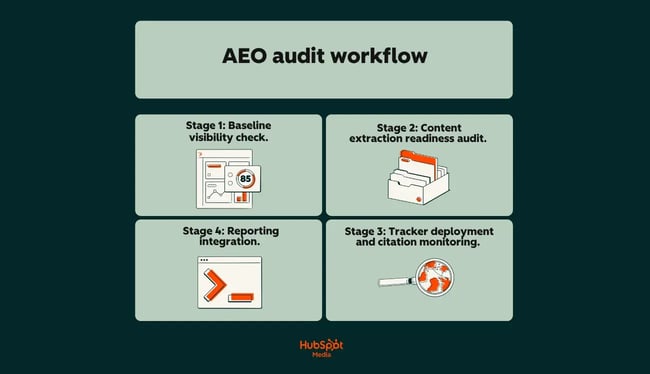
The process of auditing Answer Engine Optimization involves a systematic approach to understanding and improving a brand’s visibility within AI-powered search interfaces. This multi-step methodology ensures that businesses can identify their current standing, address technical and content-related gaps, and implement robust tracking mechanisms.
Step 1: Baseline Visibility Check
Before investing in any specialized AEO software, it is crucial to establish a foundational understanding of a brand’s current presence. Free diagnostic tools can provide an initial assessment, allowing teams to identify precisely where their brand appears and where it is notably absent across key answer engines. This preliminary step is invaluable for making informed decisions about subsequent investments.
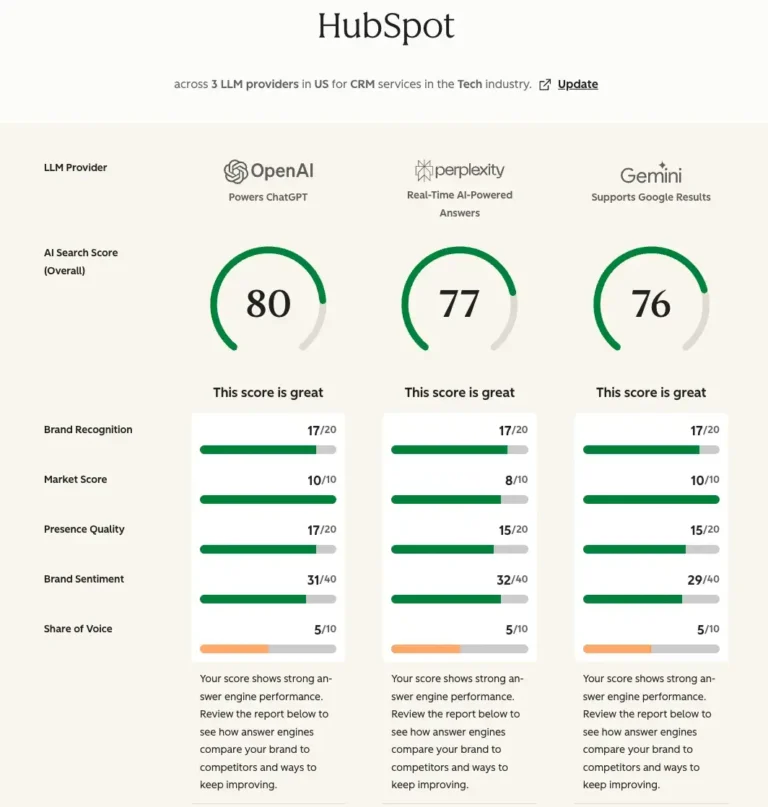
HubSpot’s AI Search Grader is an example of a tool that offers a baseline visibility check. By running this assessment, organizations can gain an objective snapshot of their brand’s performance across platforms like ChatGPT, Perplexity, and Gemini without incurring any initial costs. This data serves as a critical starting point for developing an AEO strategy and justifying the need for more sophisticated tools.
Step 2: Content Extraction Readiness Audit
Answer engines operate by parsing and extracting information from individual content segments, typically paragraphs, within web pages. Consequently, the structure and format of published content play a significant role in its discoverability and citation by AI. A content extraction readiness audit involves evaluating existing content to ensure it adheres to best practices for AI consumption.
Content marketers should prioritize reformatting introductions to provide direct answers upfront, a practice known as "answer-first" content. Incorporating clearly defined Question and Answer (Q&A) blocks and comparison tables also enhances the ability of AI algorithms to scan and extract relevant information efficiently. Auditing the top 50 pages of a website against these structural criteria can reveal significant opportunities for improvement.
Step 3: Tracker Deployment and Citation Monitoring
Once a baseline visibility has been established and content has been optimized for AI extraction, the next logical step is to deploy dedicated AEO trackers. These tools are essential for continuously monitoring citation coverage and the accuracy of brand mentions. The value of these dedicated audit tools lies in their ability to map which specific queries trigger citations and whether a brand is consistently and correctly represented in those AI-generated responses. This ongoing monitoring allows for timely adjustments and ensures that the brand’s narrative is accurately conveyed.
Step 4: Reporting Integration
The ultimate goal of AEO auditing is to integrate the gathered data into existing marketing dashboards and reporting frameworks. This integration allows for a holistic view of marketing performance, enabling teams to measure AEO success not in isolation, but in conjunction with other key performance indicators (KPIs) such as SEO gains, customer sentiment, and share of voice. By connecting AEO citation data with broader marketing analytics, organizations can demonstrate the tangible impact of their AI optimization efforts on overall business objectives.
Tailoring AEO Audit Tools to Company Size and Team Maturity
The selection of appropriate AEO audit tools should be guided by the specific needs and resources of an organization. A startup with a lean marketing team will have vastly different requirements compared to a large enterprise with multiple product lines and a mature marketing department.
Startup and Small to Medium-Sized Business (SMB) Stack
For emerging businesses, the primary concern is often establishing whether AI search surfaces their brand at all. A foundational stack for this segment focuses on validating AI visibility across the major answer engines.
-
Core Components:
- Free Baseline Testers: Tools like HubSpot’s AI Search Grader provide an essential, cost-free initial assessment of brand presence.
- Manual Query Testing: Performing targeted searches across ChatGPT, Perplexity, and Gemini for relevant brand and industry terms.
- Content Audit Checklist: A structured review of top-performing content for answer-first intros, Q&A sections, and comparison tables.
-
Ideal For: Teams of one to five marketers who need to confirm AI search as a viable channel before allocating budget to dedicated AEO tracking software.
-
Key Advantage: This approach is budget-friendly and directly addresses the most fundamental question: "Is AI search a relevant channel for our brand?" If initial audits reveal zero brand presence, the immediate priority should be content optimization rather than software acquisition. A crucial tip for this stage is to ensure at least 30% of top content pages are structured for AI extraction (answer-first intros, Q&A, comparison tables) before considering paid tools.
Mid-Market Stack
As businesses grow, manual testing becomes increasingly inefficient and unscalable. Mid-market teams require more robust solutions for ongoing citation monitoring and query research, without necessarily needing the complexity or cost of enterprise-level platforms.
-
Core Components:
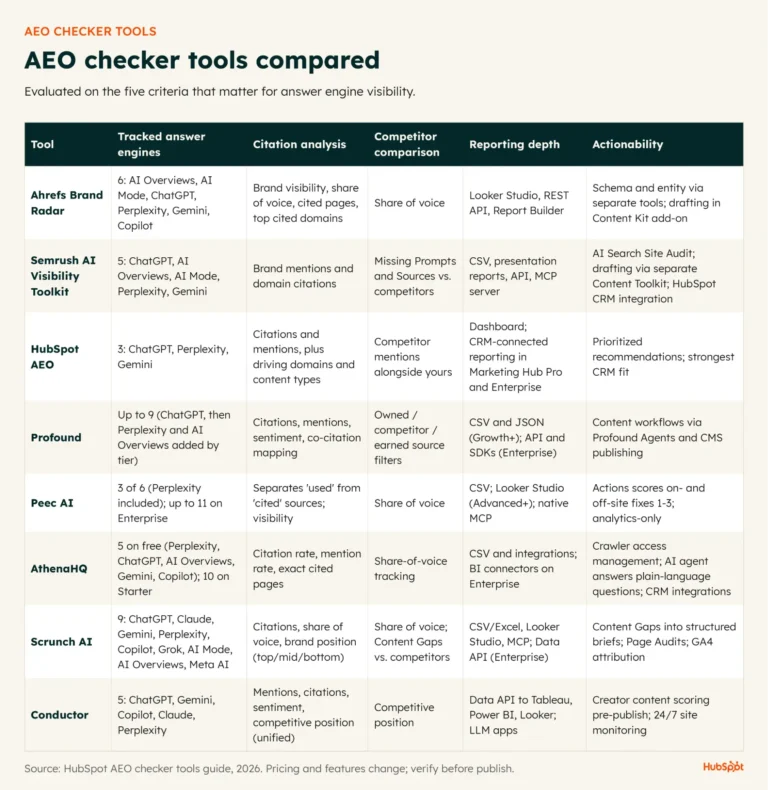
- Integrated AEO Tracking Platforms: Solutions that layer citation monitoring onto existing SEO and CRM workflows, often without necessitating a separate, standalone dashboard.
- Keyword Research Tools with AEO Focus: Tools that can identify relevant queries likely to trigger AI answers.
- Reporting and Analytics Software: Platforms capable of integrating AEO data with broader marketing performance metrics.
-
Ideal For: Marketing teams of five to 20 individuals with a dedicated SEO function that requires consistent citation monitoring, in-depth query analysis, and seamless integration with current reporting systems.
-
Key Advantage: Dedicated AEO tools enable teams to monitor citations with significantly reduced manual effort, providing a more efficient and accurate view of their AI search performance.
Enterprise Stack and Compliance Checklist
Enterprise-level organizations, often managing multiple brands, business units, or product lines, face the challenge of standardizing measurement and ensuring consistency across diverse operations. The most effective AEO audit tools at this tier are those that consolidate citation tracking and content governance within existing technology stacks, thereby preventing unnecessary tool sprawl.
-
Core Components:
- Comprehensive AEO Measurement Platforms: Solutions designed for enterprise-scale monitoring, offering advanced analytics, multi-brand support, and robust reporting capabilities.
- Marketing Attribution Tools: Platforms like HubSpot’s Marketing Hub enable the connection of AEO performance to broader marketing campaigns and revenue attribution.
- Content Governance and Management Systems: Tools that help enforce content standards and ensure AEO best practices are consistently applied across the organization.
-
Ideal For: Teams of 20 or more marketers, organizations with multiple brands, and those operating in regulated industries that demand stringent measurement and compliance.
-
Key Advantage: The synergy between robust marketing attribution and dedicated AEO trackers effectively addresses the measurement challenges that often impede enterprise-level AEO initiatives. When senior leadership inquires about AEO success, these integrated systems can present citation trends alongside established metrics like pipeline generation and customer acquisition cost.
Before committing to an enterprise AEO vendor, it is imperative to conduct thorough due diligence. Key considerations include:
- Data Privacy and Security Compliance: Ensuring the vendor adheres to all relevant data protection regulations (e.g., GDPR, CCPA).
- Scalability of Tracking Capabilities: Confirming the platform can handle the volume of queries and answer engines required by a large organization.
- Integration with Existing MarTech Stack: Verifying seamless compatibility with current CRM, analytics, and content management systems.
- Customization and Reporting Flexibility: Ensuring the platform can be tailored to meet specific organizational reporting needs.
- Vendor Support and Training: Assessing the quality and availability of customer support and training resources.
A critical pro tip for enterprise negotiations involves focusing on pricing models that are driven by the number of tracked queries and answer engines, rather than user seats. At scale, the primary cost driver for AEO software is data volume and the complexity of the tracking infrastructure, not simply the number of individuals with access.
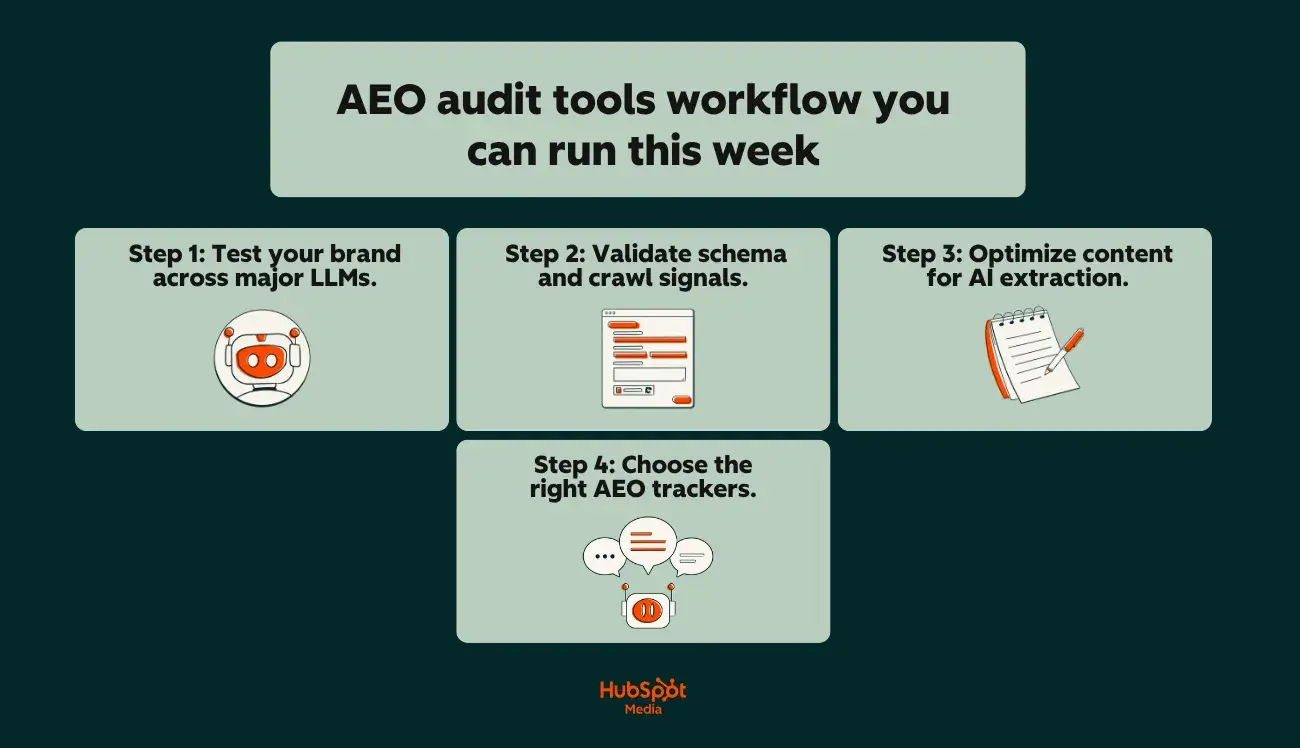
A Practical AEO Audit Tools Workflow to Implement This Week
For immediate action, a streamlined workflow can be implemented to assess and begin optimizing AEO performance. This practical approach ensures that foundational steps are taken, laying the groundwork for more advanced strategies.

Step 1: Test Brand Visibility Across Major Answer Engines
The initial phase involves a direct assessment of brand presence on key AI search platforms.
-
Methodology:
- Compile a list of 50-100 specific, long-tail queries that are highly relevant to your products, services, and industry.
- Manually search for these queries on ChatGPT, Perplexity, and Gemini.
- Document which queries trigger AI-generated responses and whether your brand is cited.
- Note the accuracy and context of any brand citations.
- Utilize tools like HubSpot’s AI Search Grader to automate a portion of this process and cross-reference results.
-
Pro Tip: Maintain an exact record of your query list. Regularly re-running these same prompts monthly will allow for consistent tracking of directional progress, emphasizing consistency over exhaustive coverage in the early stages.
Step 2: Validate Schema and Crawl Signals
For AI engines to cite your content, they must first be able to access and parse it effectively. This step focuses on technical SEO elements that impact discoverability.
- Methodology:
- Schema Markup Audit: Verify that your website uses structured data (e.g., Schema.org) to provide clear context for AI crawlers.
- Robots.txt Review: Ensure your robots.txt file is not inadvertently blocking AI crawlers from accessing important content.
- XML Sitemap Check: Confirm your XML sitemap is up-to-date and correctly submitted to search engines, facilitating content discovery.
- Indexation Status: Use Google Search Console and similar tools to verify that your key pages are indexed and accessible.
Step 3: Optimize Content for AI Extraction
Technical accessibility is only one part of the equation; content must also be structured for efficient AI extraction.
-
Methodology:
- Answer-First Intros: Review your top pages and rewrite introductions to provide immediate answers to likely user questions.
- Q&A Blocks: Integrate clearly formatted Q&A sections that directly address common inquiries.
- Comparison Tables: Utilize tables to present data, product comparisons, or feature lists in a structured, easily digestible format for AI.
- Audit Top Pages: Assess your top 20 pages against these criteria, creating a prioritized list for reformatting actions.
-
Pro Tip: Platforms like HubSpot’s Content Hub offer pre-built AI-optimized content modules, including answer-first layouts, FAQ components, and comparison table templates, streamlining this optimization process.
Step 4: Select the Right AEO Trackers
With a solid understanding of your current state and a plan for content optimization, you are well-positioned to evaluate and select appropriate paid AEO audit tools.
- Selection Criteria:
- Answer Engine Coverage: Ensure the tool supports the AI platforms most relevant to your audience (e.g., ChatGPT, Perplexity, Gemini).
- Citation Accuracy Monitoring: The tool should accurately track brand mentions and flag inaccuracies.
- Query Tracking Capabilities: Ability to monitor performance for specific, relevant search queries.
- Reporting and Analytics: Robust reporting features that integrate with existing dashboards.
- Cost-Effectiveness: Alignment with your budget and demonstrated ROI.
- Ease of Use and Integration: User-friendly interface and straightforward integration with your current marketing technology stack.
Automating Recurring AEO Reports
A one-time AEO audit provides a snapshot in time, but sustained success requires a system for ongoing monitoring and reporting. Automating recurring reports transforms manual checks into sustainable workflows.
Weekly: Citation Alerts and Brand Accuracy Flags
Weekly monitoring is crucial for catching emerging issues before they escalate. The focus here is on immediate accuracy and coverage.
-
Automated Tasks:
- Citation Alerts: Set up automated notifications for new brand citations or significant changes in citation volume.
- Brand Accuracy Flags: Implement checks that flag any AI responses containing inaccurate information about your brand, products, or services.
- Competitor Mentions: Monitor competitor citations to understand their AEO performance relative to yours.
-
Pro Tip: Route these alerts to the same communication channels (e.g., Slack, email) used for SEO alerts. Disconnected workflows between SEO and AEO efforts can create significant friction for content teams.
Monthly: Citation Share Reviews and Content Performance
Monthly reviews shift the focus from reactive monitoring to strategic analysis, addressing the critical question of how to measure AEO success beyond mere presence.
- Automated Tasks:
- Citation Share Analysis: Track your brand’s share of citations within relevant query categories compared to competitors.
- Top Performing Content: Identify which pages are most frequently cited by answer engines.
- Emerging Query Trends: Analyze new queries that are driving AI-generated answers and citations.
- Content Performance Correlation: Correlate AEO citation data with website traffic, engagement, and conversion metrics.
Quarterly: Full Engine Tests and Stack Evaluation
Quarterly reviews provide a strategic overview, allowing for comprehensive reassessments and long-term planning.
- Automated Tasks:
- Comprehensive Baseline Rerun: Re-execute the full baseline visibility test across all prioritized answer engines.
- Tool Stack Evaluation: Assess whether current AEO tools continue to meet evolving needs and if adjustments to the software stack are necessary.
- Leadership Reporting: Compile detailed reports on AEO performance, ROI, and strategic recommendations for executive leadership.
- Competitive Landscape Analysis: Conduct a broader analysis of how your brand’s AEO performance stacks up against key competitors over a longer period.
Pitfalls to Avoid in AEO Audit Tool Adoption
Navigating the adoption of AEO audit tools requires awareness of common missteps that can hinder effectiveness and lead to wasted resources.
Pitfall 1: Tool-First Buying
A prevalent error is purchasing AEO software before conducting a foundational visibility assessment. The logical progression is to first understand current performance and identify specific areas for improvement. This often involves a content audit to gauge the readiness of the existing library for AI extraction. Investing in tools without this prerequisite understanding can lead to acquiring solutions that do not address the most pressing needs.
Pitfall 2: Weak Documentation and No Measurement Framework
Organizations may adopt advanced AEO tools but fail to establish clear definitions of success or a robust measurement framework. Running tools for a period without a defined strategy for what to track, why it matters, and what constitutes a positive outcome, renders the data less actionable. Before deploying any AEO trackers, it is essential to build a measurement framework that outlines key metrics, targets, and reporting cadences.
- Pro Tip: Centralize your measurement framework and baseline data within the same platform where your citation reports are generated. HubSpot’s Marketing Hub, for instance, allows for the consolidation of AEO reporting alongside campaign attribution and pipeline data, providing a unified view of marketing performance.
Pitfall 3: Single-Engine Focus
A significant oversight is testing visibility solely within one answer engine, such as ChatGPT, and assuming these results are representative of the broader AI search landscape. This approach creates critical blind spots. Each AI engine draws from distinct data sources, employs unique retraining schedules, and applies different citation logic. A brand that performs exceptionally well in ChatGPT responses might be entirely absent from Perplexity or Gemini, leading to a skewed perception of overall AI visibility. A diversified testing approach is crucial for a comprehensive understanding.
Frequently Asked Questions About AEO Audits
Addressing common inquiries can further clarify the strategic importance and practical application of AEO audit tools.
How Often Should We Run an AEO Audit?
A tiered cadence is recommended:
- Weekly: For immediate alerts on citation accuracy and emerging issues.
- Monthly: For strategic review of citation share, content performance, and trend analysis.
- Quarterly: For comprehensive baseline retesting, full engine evaluations, and strategic stack assessment.
Which Answer Engines Should We Prioritize First?
Prioritize ChatGPT, Perplexity, and Gemini initially. Relying on a single engine creates blind spots, as each platform has unique data sources, retraining schedules, and citation logic.
Can We Adapt Our Existing SEO Tools for AEO?
While existing SEO tools offer valuable insights into website health and traditional search performance, they cannot entirely replace dedicated AEO audit tools. AEO tools are specifically designed to track how frequently a brand is cited by AI, the accuracy of those citations, and to identify specific visibility gaps within AI-driven discovery channels. The most effective AEO tools are those that integrate seamlessly with current SEO infrastructure.
How Can I Measure AEO Success Without New Software?
It is possible to establish a meaningful AEO measurement baseline using free tools and manual processes. HubSpot’s AI Search Grader offers a free solution for initial assessments. AEO success can be measured by key metrics such as citation share, citation accuracy, share of voice within AI responses, and overall customer sentiment derived from these citations.
Conclusion: The Inevitability of AEO Audit Tools in Modern Search
The current search landscape is irrevocably shaped by the increasing adoption of AI-powered answer engines. Consumers are actively querying platforms like ChatGPT, Perplexity, and Gemini for product recommendations and information, making it imperative for brands to ensure their presence and accuracy within these responses. AEO audit tools provide the essential capabilities for teams to evaluate their performance in this new domain and strategically position themselves for optimal visibility. To embark on this critical journey:
- Conduct a baseline visibility test: Understand your current standing across key AI engines.
- Audit your content: Ensure your web pages are structured for AI extraction.
- Deploy tracking tools: Monitor citations and brand accuracy consistently.
- Integrate data: Connect AEO insights with your broader marketing analytics.
The future of search is here, and embracing AEO audit tools is no longer an option but a necessity for brands aiming to thrive in an AI-driven world.
About the Author