The burgeoning field of Answer Engine Optimization (AEO) presents marketers and SEO professionals with a critical new frontier for buyer engagement. As AI-powered chatbots and generative AI platforms like ChatGPT, Gemini, and Perplexity increasingly become the initial touchpoint for product research, understanding how brands appear in these conversational interfaces is paramount. This evolving digital ecosystem necessitates sophisticated tools to monitor and leverage AI visibility. Two prominent platforms vying for attention in this space are HubSpot AEO and Scrunch. While both aim to address the challenge of AI-driven discovery, they offer distinct approaches catering to different workflow needs and technological stacks.
HubSpot AEO positions itself as a comprehensive insight-to-execution platform, seamlessly integrating AI visibility data with a company’s existing Customer Relationship Management (CRM) and content workflows. Conversely, Scrunch operates as a focused monitoring and benchmarking tool, excelling in multi-engine tracking and providing detailed competitive share-of-voice analysis. The choice between them hinges on whether an organization prioritizes a unified ecosystem that bridges research and action, or a specialized tracker that feeds data into an established, potentially disparate, workflow.
The underlying shift driving the demand for these tools is undeniable. HubSpot’s own data indicates a significant trend: organic traffic for its customers saw a decline of 27% year-over-year between 2025 and 2026. Concurrently, AI referral traffic experienced a threefold increase over the same period. This stark contrast highlights a critical challenge for businesses: failure to monitor and optimize for AI visibility risks ceding valuable early-funnel opportunities to more agile competitors. This analysis provides a comparative guide for marketing leaders, SEO strategists, content teams, and RevOps professionals tasked with evaluating these solutions, considering their specific workflow, tech stack, and reporting requirements.
TL;DR: HubSpot AEO vs. Scrunch in One Minute
For teams seeking to bridge the AI visibility gap and streamline content creation within their existing infrastructure, HubSpot AEO emerges as a compelling solution. This platform monitors brand presence across ChatGPT, Gemini, and Perplexity, delivering prioritized recommendations that, for Marketing Hub Pro and Enterprise customers, directly integrate with their established content tools and CRM data. Standalone, HubSpot AEO is priced at $50 per month, or it is included at no extra charge within Marketing Hub Pro and Enterprise plans.
Scrunch, on the other hand, is best suited for organizations requiring extensive AI engine benchmarking without altering their current content production stack. Its core strength lies in its ability to track multiple engines with granular prompt-level insights, sentiment analysis, and competitive share-of-voice metrics.
The fundamental trade-off is clear: HubSpot AEO offers a shorter time-to-value for existing HubSpot users due to its native CRM and content tooling integration. Scrunch, conversely, provides deeper standalone benchmarking across a wider array of engines, making it a strong contender for companies with more complex, multi-vendor technology stacks, particularly at the enterprise level.
HubSpot AEO vs. Scrunch at a Glance
To facilitate a quick comparison, the following table outlines how each tool addresses the typical stages of an Answer Engine Optimization workflow. This provides a snapshot of where each platform adds distinct value and where supplementary tools or processes might be necessary.
| Workflow Stage | HubSpot AEO | Scrunch |
|---|---|---|
| Research / Prompt Strategy | CRM-informed prompt suggestions based on your industries, competitors, and customer segments. | Manually configured custom prompts; persona segmentation available on paid plans. |
| AI Engine Coverage | ChatGPT (GPT-5.2), Gemini, Perplexity (3 engines, standalone). | Core: ChatGPT, Perplexity, Google AI Overviews, Copilot (4 engines); Enterprise: up to 9 engines. |
| Content Production | Recommendations link directly to HubSpot’s Content Hub and Blog tool (Marketing Hub Pro/Enterprise). | No native content generation; recommendations surface gaps, execution is handled externally. |
| Optimization | Prioritized recommendations (create new page, fix technical gap, publish social post, earn citations). | Site audit, content gap analysis, schema/structured data guidance; optimization workflow is research-oriented. |
| Distribution/Collaboration | Native HubSpot workflows; seamless action within the same platform used for social, email, landing pages. | No native distribution; data exports and API available for external workflows. |
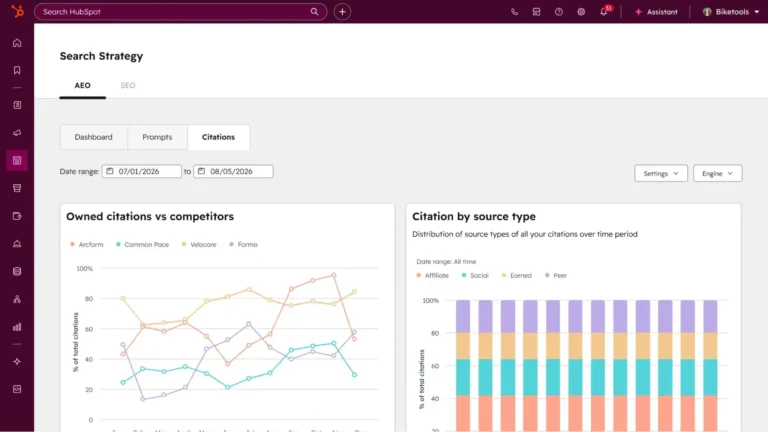
| Measurement/Reporting | Brand visibility score, share of voice, sentiment, citation analysis; native Marketing Hub reporting. | Prompt-level visibility, sentiment, competitive benchmarking; GA4 integration for AI referral traffic; API. |
| Integrations | Native HubSpot Smart CRM, Content Hub, Marketing Hub, Breeze Assistant. | GA4, Google Search Console, Looker Studio, Tableau, Power BI, Shopify, Webflow; CDN integrations (Enterprise). |
| Pricing Posture | $50/month standalone; included in Marketing Hub Pro ($800/month) and Enterprise. | Core: $250/month (annual); Enterprise: custom. |
| Free Trial | 28-day free trial, no credit card required. | 7-day free trial. |
| Governance/Security | HubSpot platform security; SSO and RBAC (Marketing Hub Enterprise). | SOC 2 Type II; SAML/OIDC SSO; RBAC; Enterprise Data API. |
Legend: "Included" denotes native functionality, "External" implies reliance on separate tools, and "Enterprise" signifies features requiring a custom-priced plan.
The unified platform advantage of HubSpot AEO is particularly pronounced for teams already invested in the HubSpot ecosystem. The inherent connection between their CRM, content tools, and reporting streamlines the entire process. Recommendations are informed by actual customer segments, not generic industry queries, and directly feed into existing workflows. While Scrunch offers robust monitoring data, the need to execute insights in a separate system introduces coordination overhead for content teams.
Research and Prompt Strategy: Divergent Starting Points
The initial divergence between HubSpot AEO and Scrunch lies in their approach to prompt selection. HubSpot AEO leverages CRM data to automatically suggest relevant prompts. These suggestions are informed by the company’s profile, tracked competitors, and established customer segments within the HubSpot account. This means a B2B SaaS company targeting HR teams will receive different prompt recommendations than a professional services firm. Custom prompts can also be added without a strict limit, though each prompt consumes credits toward the plan.
In contrast, Scrunch requires user-configured prompts. The platform lacks inherent knowledge of a business’s specific context until it’s provided. Users must define the questions, segment them by persona, and map them to funnel stages. This approach is effective for teams with a well-defined prompt taxonomy and a clear understanding of buyer inquiries. However, for organizations new to AEO, it represents a more significant initial setup burden.
A valuable tip for those building an AEO prompt library from scratch is to utilize HubSpot’s AEO Grader. This free tool provides a one-time snapshot of current visibility across ChatGPT, Perplexity, and Gemini, serving as a useful starting point before committing to ongoing tracking.
Content Production and Optimization: Bridging the Gap to Execution
The most significant divergence between the two platforms occurs in content production and optimization. HubSpot AEO is engineered to facilitate a seamless transition from data diagnosis to content execution, all within a single interface. Its recommendations are prioritized and action-oriented, moving beyond vague suggestions like "improve your content" to concrete steps such as creating a new post, rectifying a page issue, publishing a social update, or securing a third-party citation. For Marketing Hub Pro and Enterprise customers, these recommendations are directly linked to HubSpot’s content creation tools, where writers and strategists already operate.
Scrunch, while adept at identifying visibility gaps and offering site audit data, leaves content creation and optimization to external processes. It functions primarily as a monitoring and analytics layer, requiring teams to manage the workflow between insight generation and content publication independently.
What sets HubSpot AEO apart is its ability to transform AEO from a reporting exercise into a tangible production queue. Recommendations are not only identified but also accompanied by clear reasoning for prioritization, specifying what needs to be built. This is a significant advantage for content teams juggling multiple topics and competing demands.
Scrunch’s strength lies in its thorough site audit functionality and the detailed diagnostic data it provides, such as explaining why a brand might be absent from a specific AI answer. For organizations with established content operations, Scrunch’s gap data can effectively inform their existing processes.
Distribution and Collaboration: Native vs. External Workflows
HubSpot AEO’s native integration with the HubSpot platform provides a distinct advantage in distribution. Recommendations for social posts, landing pages, or blog content seamlessly connect to the publishing tools already in use. This eliminates context switching and allows teams to act on AEO insights without leaving their familiar environment. For Marketing Hub Pro or Enterprise users, AEO recommendations can be directly converted into tasks, drafts, or published content within the same workflow used for all other marketing activities.
Scrunch, lacking native distribution capabilities, focuses on the monitoring and reporting layer. Teams utilizing Scrunch typically maintain separate content workflows (e.g., in Notion, Asana, or CMS platforms) and leverage Scrunch’s insights to inform their content backlogs.
For teams considering Scrunch as a standalone solution, it is crucial to factor in the additional cost and coordination overhead associated with maintaining a separate content workflow. The true total cost encompasses monitoring, production, publishing, and reporting.
Measurement and Reporting: Integrated vs. Granular Data
Both HubSpot AEO and Scrunch provide core AEO metrics such as brand visibility scores, share of voice, sentiment analysis, and citation analysis. The key differentiator lies in how these metrics integrate with broader reporting frameworks.
HubSpot AEO’s reporting is embedded within the HubSpot platform. For Marketing Hub Pro and Enterprise customers, AI referral traffic data appears alongside other marketing analytics, enabling the correlation of AEO visibility trends with lead volume, contact attribution, and campaign performance without the need for custom dashboards.
Scrunch excels in reporting granularity and portability. Its integration with Google Analytics 4 (GA4) is a notable feature, identifying AI crawlers visiting a site and their interaction patterns, offering a level of technical detail often missed by traditional analytics tools. Furthermore, Scrunch offers integrations with Looker Studio, Tableau, and Power BI, alongside an enterprise-tier Data API, making it attractive to analytics-forward teams with established business intelligence infrastructure.
HubSpot AEO’s native integration is best for teams seeking to contextualize AEO data within their overall marketing performance. Scrunch’s extensive analytics integrations and API are ideal for teams with complex BI stacks who prefer to manage their reporting layer independently.
Integrations and Ecosystem: A Tale of Two Approaches
HubSpot AEO’s integration narrative is intrinsically linked to its position within the HubSpot customer platform. Rather than connecting to external systems, it inherits seamless integration with existing HubSpot tools like the Smart CRM, Marketing Hub, Content Hub, and Breeze Assistant. This eliminates the need for additional connector setup, data syncing, or separate logins for teams already utilizing the HubSpot suite. However, for organizations not using HubSpot, the integration capabilities are more constrained. HubSpot AEO operates as a standalone product and does not natively connect with competitors like Salesforce or third-party content platforms. While it provides AEO tracking and recommendations, CRM-powered intelligence is contingent on a HubSpot CRM subscription.
Scrunch adopts a different strategy, designed to integrate into existing technology stacks as an analytics layer. Its native integrations include GA4, Google Search Console, Looker Studio, Tableau, Power BI, Shopify, and Webflow. At the enterprise tier, it offers advanced CDN integrations with Cloudflare, Vercel, and Akamai, enabling an Agent Experience Platform (AXP) that delivers AI-optimized content to AI crawlers without compromising the human visitor experience. A Data API is also available at the enterprise level for custom pipeline development.
Data Coverage and Engines: Breadth vs. Depth
The efficacy of an AI visibility score is directly tied to the engines being monitored. As of mid-2026, dominant AI answer surfaces for many buyers include ChatGPT, Google Gemini, and Perplexity. However, platforms like Claude, Google AI Mode, Microsoft Copilot, and Meta AI are rapidly gaining traction, and their prominence varies significantly by industry and audience. A tool that tracks only a limited number of engines might overlook crucial visibility gaps or present a misleadingly strong performance picture.
HubSpot AEO tracks three engines across all its plans: ChatGPT, Gemini, and Perplexity. While these cover the majority of high-intent AI search activity for many B2B SaaS and mid-market businesses, they do not encompass engines like Claude, Microsoft Copilot, or Meta AI. This is a notable limitation for teams whose enterprise buyers heavily utilize Microsoft Copilot or for whom Claude represents a significant visibility surface.
Scrunch offers broader engine coverage, with the specific number depending on the plan tier. The Core plan monitors four engines: ChatGPT, Perplexity, Google AI Overviews, and Microsoft Copilot. The Enterprise tier expands this to up to nine engines, including Claude, Gemini, Meta AI, Google AI Mode, and Grok. It is important to note that the widely cited "nine-engine coverage" is an Enterprise-tier feature, not available at entry-level pricing.
The practical implication of engine coverage is its direct impact on editorial priorities. A team tracking ChatGPT, Gemini, and Perplexity will identify different visibility gaps and content priorities compared to a team monitoring Copilot and AI Mode. Before committing to a tool, auditing which engines are actively used by one’s target buyers is essential. For instance, financial services buyers may lean towards Copilot and Gemini, while tech buyers frequently use ChatGPT and Perplexity, and consumer audiences are increasingly engaging with Meta AI.
Both HubSpot AEO and Scrunch refresh prompts on a recurring cadence, providing trend data over time. This is crucial for assessing visibility improvements and identifying content updates that drive citations. Daily refresh cadences enable editorial teams to make rapid adjustments in response to competitor activity or model updates.
Pricing and Value: Beyond the Sticker Price
The pricing structures of HubSpot AEO and Scrunch reflect their different value propositions.
| Feature | HubSpot AEO (Standalone) | HubSpot AEO (Marketing Hub Pro) | Scrunch Core | Scrunch Enterprise |
|---|---|---|---|---|
| Price | $50/month | Included in Marketing Hub Pro | $250/month (annual) | Custom |
| Prompts | 25 | Expanded set | 125 | Custom |
| Engines | 3 | 3 | 4 | Up to 9 |
| Users/Seats | – | Based on Marketing Hub tier | 5 seats | Custom |
| Free Trial | 28 days | N/A | 7 days | N/A |
| Content Tooling | Recommendations only | Full HubSpot content tools | None | None |
| CRM Integration | Native (HubSpot CRM) | Native (HubSpot Smart CRM) | None | None |
When considering the total cost of execution, the prompt-level price comparison can be misleading. With Scrunch, the monitoring cost is only one component. Organizations still need separate tools for content production, publishing, a content management system (CMS), and potentially an additional analytics layer. In contrast, HubSpot AEO, particularly when bundled within Marketing Hub Pro, already provides much of this necessary infrastructure. For teams that would otherwise incur separate costs for content tools, CRM, and analytics, the bundled value of Marketing Hub Pro can significantly reduce the overall workflow expenses.
For smaller teams or those exploring AEO as a new channel, HubSpot AEO presents an accessible entry point. Its 28-day free trial, requiring no credit card, further lowers the barrier to evaluation.
Which Tool is Right for Your Team?
The decision between HubSpot AEO and Scrunch ultimately depends on an organization’s primary objectives and existing infrastructure.
Choose HubSpot AEO if you need unified execution.
HubSpot AEO is the optimal choice for teams whose main goal is to connect AI visibility data directly to content actions without introducing new systems. It is particularly advantageous for organizations that:
- Are already using HubSpot for CRM, marketing, and sales.
- Prioritize closing the loop from AI insight to content creation and publication.
- Seek a streamlined workflow that minimizes context switching.
- Value CRM-driven prompt suggestions and integrated content tooling.
A free trial of HubSpot AEO offers 25 prompts across ChatGPT, Gemini, and Perplexity, requiring no credit card.
Choose Scrunch if you need focused competitor benchmarks.
Scrunch is the stronger option for organizations prioritizing deep, multi-engine competitive benchmarking, especially if they have an established content production and publishing workflow they wish to maintain. It is best suited for teams that:
- Require comprehensive AI engine coverage beyond the core three.
- Need detailed competitive share-of-voice and benchmarking data.
- Have a complex, multi-vendor tech stack and prefer specialized tools.
- Are comfortable managing the integration between monitoring data and external content workflows.
When a Hybrid Stack Makes Sense
Some organizations may opt to run both HubSpot AEO and Scrunch concurrently. This hybrid approach can be practical when using HubSpot AEO for day-to-day recommendation-driven execution while leveraging Scrunch for broader benchmarking and competitive intelligence across engines not covered by HubSpot (e.g., Microsoft Copilot, Claude). This strategy is most effective when:
- Specific AI engines not covered by HubSpot are critical to the buyer journey.
- The need for comprehensive competitive intelligence outweighs the coordination overhead.
- Budget allows for dual investment without compromising other critical marketing functions.
However, for many teams, the added coordination complexity of a hybrid stack may not justify the marginal gain in coverage. It is generally advisable to start with the tool that best aligns with the primary workflow, validate AEO as a channel, and then consider expanding coverage as the practice matures.
Alternatives to HubSpot AEO and Scrunch
The AEO tool category has rapidly expanded, offering several adjacent solutions worth considering. The evaluation process should focus on three key questions: identifying the biggest workflow gap (monitoring, content production, or reporting), determining which AI engines are demonstrably used by buyers, and assessing what existing stack components are already covered versus what would be added net-new.
For organizations uncertain about their current AI visibility, HubSpot’s free AEO Grader provides a valuable snapshot across ChatGPT, Perplexity, and Gemini, serving as a baseline before committing to a paid tool.
How AEO Differs from SEO
For those new to the discipline, Answer Engine Optimization (AEO) complements traditional Search Engine Optimization (SEO). SEO focuses on improving content rankings in traditional search engine results pages (SERPs), primarily on Google and Bing, through keywords, backlinks, and technical site health. The goal is to drive users to a website via links.
AEO, conversely, aims to enhance brand presence within AI answer engines like ChatGPT, Gemini, and Perplexity. Instead of ranking on a results page, the objective is to be featured directly within the AI-generated answer. AEO emphasizes structured content, entity authority, citation signals, and the accuracy of information used by AI models. It is not a replacement for SEO but a complementary discipline crucial for a comprehensive modern search visibility strategy.
The buyers who utilize AI search do not cease using traditional search engines, and vice versa. A dual-channel strategy captures a more complete discovery journey. Many fundamental principles overlap: high-quality, structured content, strong E-E-A-T (Experience, Expertise, Authoritativeness, Trustworthiness) signals, and authoritative third-party coverage benefit brands across both SEO and AEO.
Practical differences emerge in measurement (rank positions vs. visibility scores and share of voice), content format (keyword-optimized copy vs. answer-first, structured, citation-ready content), and the signals that matter most (backlinks and technical SEO vs. entity authority, source credibility, and structured data). Teams evaluating where to begin can use the free AEO Grader to assess their current AI visibility before committing to a full optimization strategy.
Frequently Asked Questions About HubSpot AEO vs. Scrunch
Do I need HubSpot Marketing Hub to use HubSpot AEO?
No, HubSpot AEO is available as a standalone product for $50/month (or $45/month billed annually). It allows tracking of 25 prompts across ChatGPT, Gemini, and Perplexity, along with access to brand visibility scores, citation analysis, and prioritized recommendations, without requiring any other HubSpot subscription. However, the most advanced features, such as CRM-informed prompt suggestions and direct integration with HubSpot’s content tools for actioning recommendations, are available with Marketing Hub Pro or Enterprise, which includes AEO at no additional cost.
Can I run HubSpot AEO and Scrunch together?
Yes, there are no technical conflicts, and some teams utilize both. A common setup involves using HubSpot AEO for daily, action-oriented tasks (recommendations, content workflow) and Scrunch for broader benchmarking across engines not covered by HubSpot (e.g., Microsoft Copilot, Claude). The necessity of this hybrid approach depends on the critical importance of those additional engines in the buyer’s journey. If ChatGPT, Gemini, and Perplexity cover the bulk of high-intent AI search activity, a hybrid stack might not be essential.
How quickly will we see impact after implementation?
With HubSpot AEO, a baseline visibility is established during the initial session, with prompt-level data available from day one of the trial. Measurable content-driven impact, such as actual visibility improvements in AI answers, typically occurs within 4-8 weeks of acting on recommendations, contingent on publishing speed and domain authority. For Scrunch, establishing a monitoring baseline is similarly rapid, but execution timelines are tied to the organization’s existing content workflow. Neither tool promises overnight visibility; AEO impact is cumulative as citation-worthy, answer-first content is developed.
Which AI engines should we prioritize first?
It is recommended to prioritize the three engines with the highest buyer intent in your specific category: ChatGPT, Gemini, and Perplexity. These currently account for the majority of high-intent AI search activity among B2B and B2C buyers. Once a baseline and optimization rhythm are established, additional engines relevant to your specific audience can be incorporated. Enterprise buyers in financial and professional services often use Microsoft Copilot more frequently, while consumer and SMB audiences are increasingly active on Meta AI. Utilizing tools like HubSpot’s AI Search Sensor can help monitor industry-wide trends before expanding tracking sets.
How should we structure content for AI citations?
AI engines favor content that directly answers buyer questions, is clearly structured for readability (using headings, concise paragraphs, and defined terms), originates from authoritative sources, and is supported by third-party citations. This translates to an "answer-first" approach, leading with the direct answer before providing context. Utilizing structured data and schema markup where appropriate, building E-E-A-T signals through bylines and expert sourcing, and actively pursuing third-party mentions and links from credible domains are crucial strategies.
About the Author