Answer Engine Optimization (AEO) represents a pivotal shift in digital marketing, focusing on tailoring content for artificial intelligence models like ChatGPT, Claude, and Gemini. While traffic generated through AEO currently constitutes a small fraction of overall website visits, its growth trajectory is steep, and its impact on conversion rates is disproportionately significant. Emerging data from sources like Microsoft Clarity, with November 2025 figures indicating that AEO traffic converts between three to fifteen times better than traditional search, underscores its burgeoning importance. As traditional search engine traffic faces challenges, forward-thinking marketers are strategically adapting to capture this high-intent audience, prioritizing quality engagement over sheer volume.
This new era presents a profound opportunity for brands to influence large language models (LLMs), effectively pre-qualifying leads and directing the most valuable prospects towards their platforms. Understanding and implementing AEO strategies is no longer a speculative endeavor but a critical component of a robust digital marketing strategy.
Understanding the Unparalleled Intent of AEO Visitors
The fundamental difference between AEO and traditional search lies in how information is delivered and how user intent is perceived. Answer engines are designed to provide comprehensive, context-rich responses that directly address a user’s underlying intent, rather than merely matching keywords. This inherent capability acts as a powerful lead pre-qualification mechanism. When a visitor arrives on a website via an answer engine, it signifies that their query has been directly matched to the content as the definitive answer, a stark contrast to traditional search results where a user might sift through multiple options.
The Power of Query Fan-Out in Pre-Qualifying Leads
A key mechanism driving this heightened intent is "query fan-out." This process, as described by Google’s documentation on AI features, efficiently consolidates research by resolving multiple related and implied sub-questions within a single interaction. Instead of a user manually typing a series of follow-up questions, the AI anticipates these needs and executes the sub-searches autonomously, synthesizing a single, cohesive answer. For a potential buyer, this means a complex research process that might have previously involved five separate queries is now condensed into one resolved response. This eliminates the iterative back-and-forth characteristic of traditional research, bringing users closer to a decision point much faster.
Navigating Further Down the Customer Journey
The inherent structure of AI answer engines means that much of the initial research and definitional phase occurs within the chat interface itself. Consequently, visitors who click through to a website have already progressed significantly along the customer journey. Microsoft Advertising has reported that Copilot ads, specifically targeting lower-funnel journeys, demonstrate a 76% higher conversion rate than traditional search ads. This contrasts with organic search, which typically delivers a broader mix of visitors, encompassing those in the early research stages alongside those with more immediate intent. Therefore, an equivalent number of clicks from AI-driven sources carries a demonstrably higher average intent.
A Divergent Path from Traditional Search Behavior
Independent research, such as the extensive query testing conducted by Robert Carnes, suggests that AI is not merely replacing search but rather integrating with and evolving it. Answer engines increasingly provide direct resolutions to queries upfront, often citing their sources without necessarily driving a click. Traditional search, conversely, tends to fragment the research process across numerous distinct sessions, each prompting a separate click. By resolving this research loop internally, answer engines ensure that the visitors who do proceed to a website have a significant portion of their initial questions already addressed.
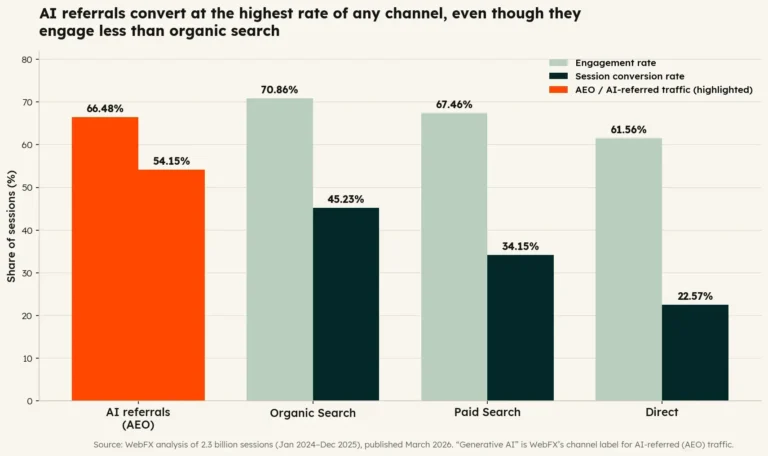
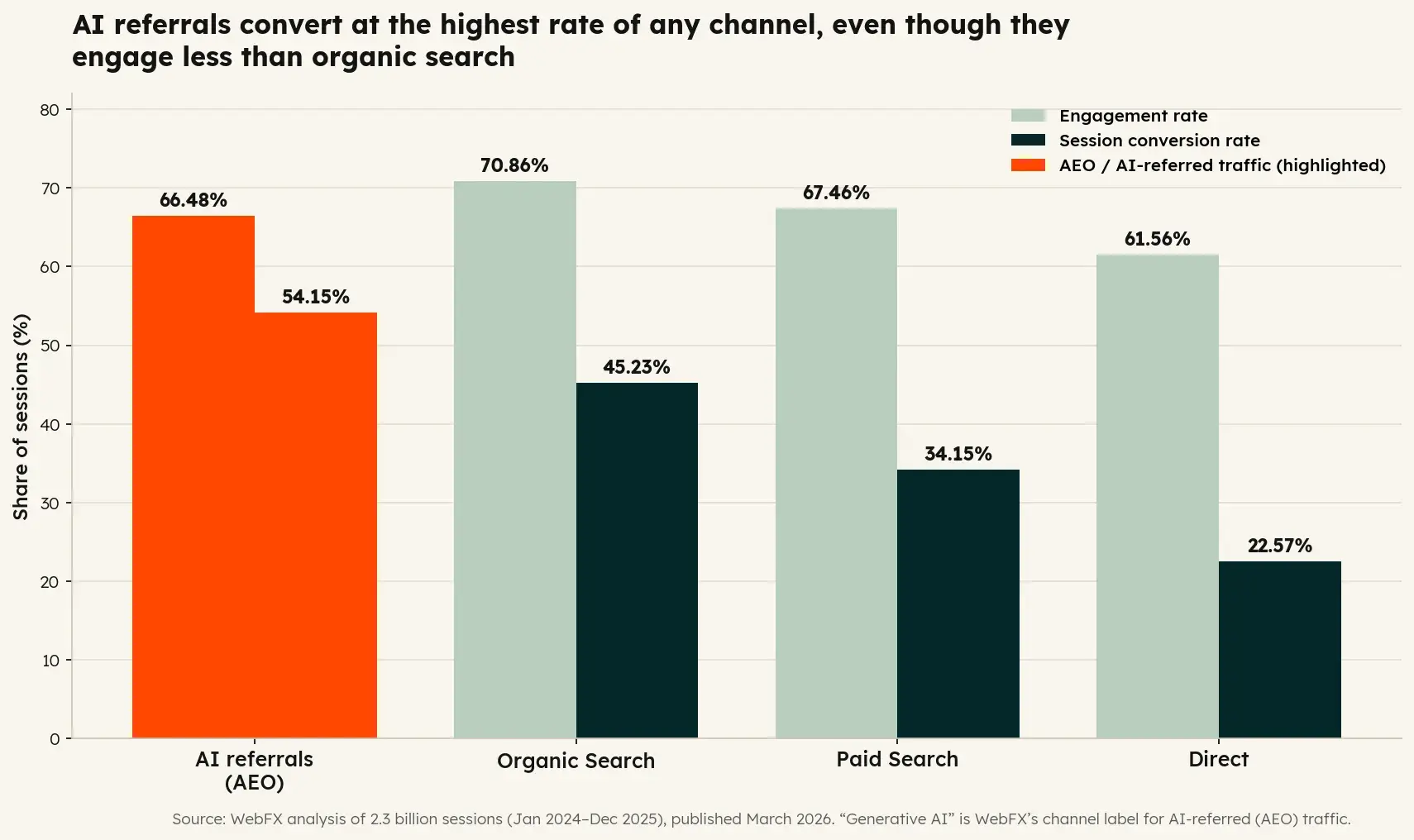
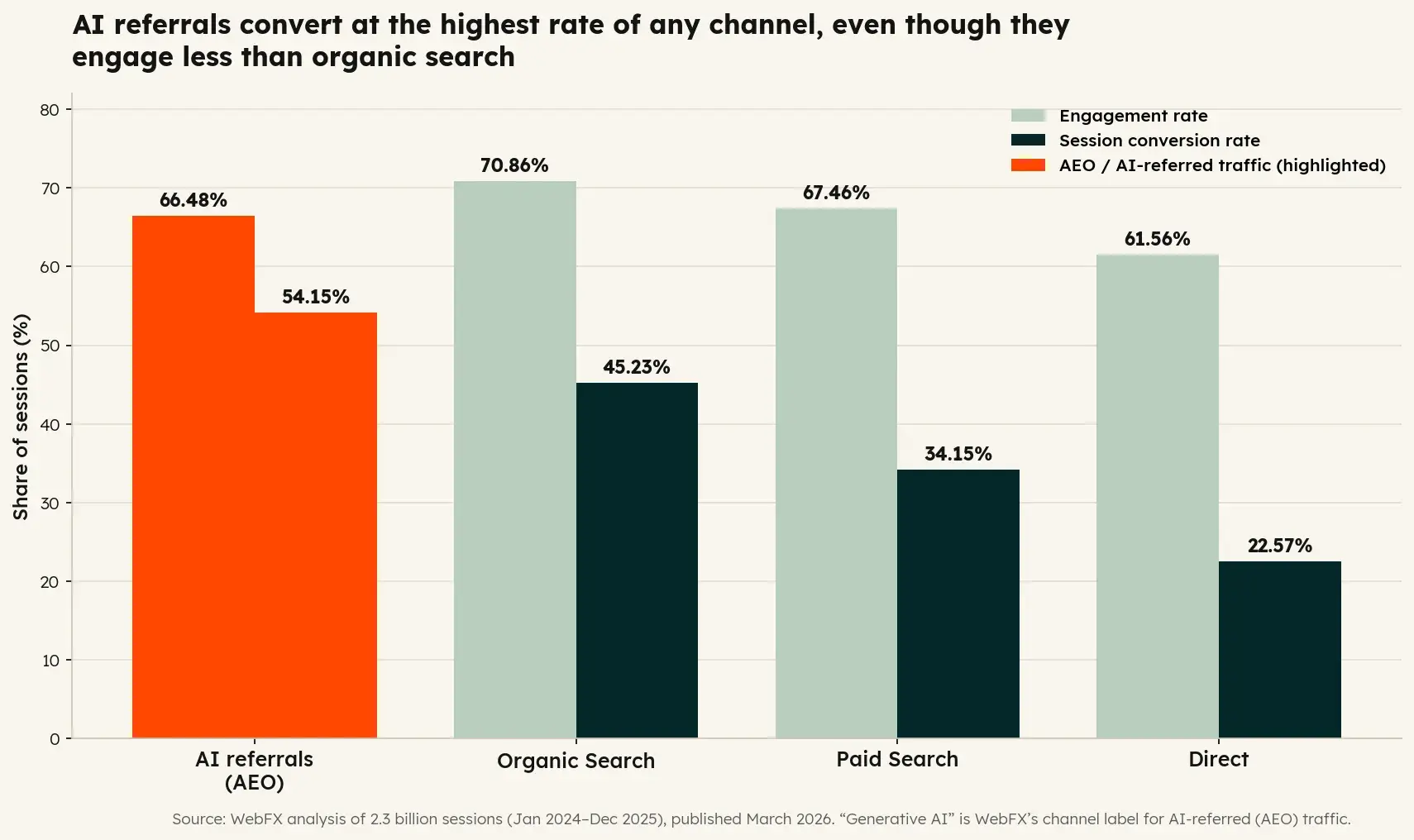
This pre-qualification advantage is directly reflected in website analytics. Visitors arriving from AEO channels exhibit higher conversion rates and progress through the sales funnel more rapidly than those acquired through paid, organic, or social media efforts. A March 2026 analysis by WebFX, examining over 2.3 billion sessions, found that AI-referred visitors converted approximately 1.2 times higher than organic search visitors, outperforming all other free traffic channels. The subsequent sections will delve into how to identify these intent signals, benchmark them against other traffic sources, and effectively track AEO visitors from their initial interaction to a completed sale.
Benchmarking AEO Visitor Intent Against Other Traffic Channels
Quantifying visitor intent is not a singular metric but rather a composite understanding derived from patterns in engagement, source behavior, and downstream conversion activities. To establish a meaningful comparison, these same signals must be consistently measured across all traffic channels.
Key Intent Signals for Identifying High-Quality AEO Visitors
Four primary signals within Google Analytics 4 (GA4) are instrumental in differentiating high-intent AEO traffic from other sources:
- Engagement Rate: This metric reflects the percentage of sessions that are considered "engaged," meaning they last longer than a certain duration, have more than one page view, or trigger a conversion event. Higher engagement rates from AEO visitors suggest they are actively interacting with content.
- Views per Session: A higher number of views per session indicates a user is exploring multiple pages, signifying deeper interest and research.
- Average Engagement Time: This measures the duration of active user engagement with a page or the website. Longer engagement times from AEO visitors point to a more thorough evaluation of content.
- Key Event Completions: Tracking specific actions that signify progression down the funnel, such as form submissions, demo requests, or product page views, is crucial. A higher rate of key event completions from AEO traffic demonstrates a stronger intent to convert.
When analyzed collectively, these intent signals reveal whether a visitor is actively exploring with purpose or simply performing a cursory glance. Because answer engines pre-qualify visitors before the click, AEO traffic tends to exhibit high performance across these metrics, unlike the more varied intent levels often seen with organic search. Incorporating metrics like returning-user rate and scroll depth further sharpens the distinction between a serious buyer conducting an evaluation and a casual visitor.
Benchmarking AEO Engagement Against Organic, Paid, and Social Traffic
In May 2026, Google introduced a dedicated "AI Assistant" channel within GA4. When traffic from an AI assistant is detected, GA4 can automatically assign an ai-assistant medium, eliminating the need for manual configuration. However, the visibility of this channel may vary across different properties. Therefore, the absence of an "AI Assistant" row in analytics should not be interpreted as a lack of AEO traffic, as some AI-referred visits may still be categorized under "Referral," "Unassigned," or "Direct."
A valuable tip for identifying specific AI referrals, such as those from ChatGPT, is to look for UTM parameters. OpenAI has stated that ChatGPT automatically appends utm_source=chatgpt.com to referral URLs. This UTM parameter can preserve attribution data, even when referrer information is unreliable, provided it survives redirects and landing page processing.
Visualizing this data in Google Analytics can highlight the unique referral traffic patterns from sources like ChatGPT. To effectively benchmark AEO traffic against search and social channels, it’s imperative to accurately identify it within your analytics. Three methods can be employed within GA4, ranging from a quick diagnostic check to a more refined reporting setup.
Option 1: Spot-Check with Session Source / Medium
Before implementing any advanced configurations, a rapid assessment can be performed by examining the "Session source / medium" report in GA4. This involves filtering for potential AI referral domains or known AI assistant sources. This quick check provides an immediate indication of the volume of AEO traffic, helping to determine if further setup is warranted.
Option 2: Build a Custom Channel Group
For a more comprehensive and accurate tracking solution, particularly when the native "AI Assistant" channel is unavailable or incomplete, creating a custom channel group is recommended. This workaround, widely adopted by SEO professionals, can capture additional source patterns beyond native channel detection. Implementing a custom channel group requires "Editor" or "Administrator" access to the GA4 property. This typically involves defining regular expressions (regex) to identify AI-driven traffic sources based on domain names or UTM parameters.
Option 3: Utilize the Native AI Assistant Channel (If Available)
If the native "AI Assistant" channel has been rolled out to your GA4 property, it offers the most straightforward and low-maintenance approach to identifying AEO traffic. This involves simply navigating to the appropriate channel grouping report and observing the data attributed to the "AI Assistant" channel.
It is crucial to note that any method of identifying AEO traffic may undercount its true influence. Visits originating from AI without a referrer header, such as those from in-app browsers, copied links, or privacy-restricted environments, might still be categorized as "Direct" traffic. Therefore, the native "AI Assistant" channel should be considered a cleaner signal rather than an exhaustive count of all AEO-influenced traffic.
Regardless of the method used to identify AEO traffic, the benchmarking process remains consistent: align AI Search or AI Assistant traffic alongside Organic Search, Paid Search, and Organic Social within the same date range. Compare identical engagement signals and use a primary conversion goal for the headline benchmark. Supplementing this with secondary key events, categorized by funnel stage, ensures a nuanced understanding of channel performance without over- or under-crediting their respective roles.
Condensed Search Paths and Enhanced Conversion Readiness
The observation that fewer sessions to conversion from AEO traffic signifies higher readiness, rather than weaker engagement, might seem counterintuitive. Traditionally, multiple touchpoints were considered necessary to nurture leads. However, when an answer engine resolves the research loop through query fan-out, a substantial portion of this "warming" process occurs before the visitor even reaches the website. This compression of the buyer’s journey directly translates to higher conversion readiness. The subsequent sections will detail how to measure this compression directly, providing empirical evidence to compare against organic, paid, and social channels.
Measuring AEO Visitor Quality Through CRM Integration
While GA4 provides invaluable insights into acquisition and engagement, it often falls short in proving B2B pipeline quality or closed-won revenue on its own. To bridge this gap and connect AEO traffic to tangible business outcomes, the source attribution must extend seamlessly into the Customer Relationship Management (CRM) system.
Tracking AEO Visitor Progression: From Session to Closed Deal
HubSpot’s Smart CRM offers a robust solution for tracking visitor activity from their initial anonymous interactions through to becoming a recognized contact. Once a visitor converts, HubSpot intelligently associates the new contact record with their preceding anonymous activity. This ensures that the "Original Traffic Source" accurately reflects their very first visit, rather than the session during which they completed a form. This attribution is then automatically inherited by "Deals," as the Original Traffic Source on a deal is derived from the associated contact with the earliest recorded activity.
Furthermore, HubSpot classifies AI Referrals as a distinct traffic source. When a visitor clicks a cited link within a response from platforms like ChatGPT, Claude, Perplexity, or Gemini, HubSpot automatically tags that session as "AI Referrals" without requiring any custom configuration. This end-to-end tracking capability, from an answer engine visit to contact creation and ultimately to a closed-won deal, is facilitated by HubSpot’s integrated platform, preserving the crucial source attribution throughout the customer lifecycle.
Leveraging Intent Scoring to Quantify AEO Visitor Advantage
Intent scoring provides a powerful method for consolidating multiple behavioral signals into a single, comparable figure per session. By assigning point values to behaviors indicative of a serious evaluator—such as exceeding median engagement time, achieving target scroll depth, visiting pricing or comparison pages, and completing key events—a comprehensive intent score can be generated for each session. Averaging these scores by channel allows for direct comparison.
This scoring mechanism offers two key advantages over raw conversion rates. Firstly, it captures intent prior to conversion, enabling the assessment of a channel’s effectiveness even when its volume is too low for a statistically stable conversion rate. Secondly, it holds all sources to a uniform standard, transforming the assertion "AEO visitors are higher intent" into an auditable claim supported by data.
HubSpot’s AEO solution monitors brand presence across platforms like ChatGPT, Perplexity, and Gemini. This visibility data, when combined with channel intent scores, establishes a direct correlation between the content answer engines cite and the quality of traffic they drive.
Metrics That Prove AEO Drives Higher-Intent Visitors
The evidence to support the claim of higher AEO visitor intent is readily available within GA4 and CRM data. To present this evidence compellingly to stakeholders, a two-pronged approach is necessary:
- Isolate and Benchmark: Implement robust tracking to identify AEO traffic accurately and then compare its performance against other key channels using consistent metrics and date ranges.
- Quantify and Qualify: Utilize intent scoring and CRM data to demonstrate not just the volume but the revenue-generating potential of AEO-referred leads.
Optimizing for AEO Visitor Quality Over Mere Volume
Given that AEO typically generates fewer visitors than mature organic or paid channels, the strategic imperative is to optimize for quality. Three core strategies can achieve this:

1. Anticipate Query Fan-Out:
Answer engines do not simply address a single question; they deconstruct it into multiple sub-queries, resolve each, and then synthesize a comprehensive response. To ensure your content appears in citations, it must address the entire "fan-out"—the initial question along with all anticipated related sub-queries a potential buyer might ask. This involves creating content that comprehensively covers the user’s informational journey.
2. Write for Buyer Prompts, Not Generic Search Queries:
Traditional SEO focuses on optimizing for terms users type into search engines. AEO, however, requires optimizing for the more conversational, decision-oriented prompts that buyers use in platforms like ChatGPT and Perplexity. Examples include "best CRM for a 10-person sales team that already uses HubSpot" rather than a generic "best CRM." AEO tools within marketing platforms can leverage CRM data to suggest relevant prompts informed by specific business contexts, ensuring tracking is tailored to existing customer personas.
3. Tie Every Cited Page Back to Revenue:
Content that gets cited by AI does not automatically guarantee conversions. It is essential to track each AEO-driven page’s journey all the way to a closed-won deal. By analyzing which topics attract traffic but fail to generate pipeline, marketers can refine their content strategy to focus on high-performing assets. Utilizing integrated CRM and marketing platforms allows for unified reporting that connects AI-referred traffic directly to generated contacts and deals. Prioritizing cited pages based on average deal amount, rather than traffic volume, can reveal the most lucrative content areas for further development.
Demonstrating AEO ROI Through Channel Comparison Reporting
Once optimization efforts are in place, consolidating proof into a clear comparison is essential. This involves using the same date range, the same key event, and holding every channel to the same measurement standards.
The three headline metrics that are crucial for leadership reporting include:
- Conversion Rate: The percentage of visitors who complete a desired action.
- Average Deal Value: The average monetary value of deals closed from each channel.
- Revenue Generated: The total revenue attributed to each traffic source.
The four GA4 engagement signals that feed into intent scoring are:
- Average Engagement Time
- Engaged Sessions per Active User
- Views per Session
- Key Event Completions
The two proof-past-the-session pairs that extend attribution beyond the initial visit include:
- Contact-to-Deal Conversion Rate
- Deal-to-Closed-Won Rate
Reporting these metrics side-by-side—AI Search against Organic Search, Paid Search, and Organic Social—over a consistent date range and with a defined key event, provides a comprehensive overview of channel performance.
Building a Channel Comparison Framework for AEO
A robust and trustworthy channel comparison framework hinges on three foundational elements: clear ownership, shared documentation, and meticulous data handling.
Assigning Ownership to Each Component
To prevent fragmentation and ensure accountability, responsibilities for each aspect of the channel comparison must be explicitly assigned:
- Marketing Team: Responsible for content strategy, AEO optimization, and campaign execution.
- Analytics Team: Oversees data collection, GA4 configuration, custom channel grouping, and reporting integrity.
- Sales Team: Provides insights into lead quality, deal progression, and CRM data accuracy.
Documenting for Universal Understanding
A shared, single source of truth is vital to ensure that Marketing, Analytics, and Sales interpret "AEO traffic" consistently. This documentation should include:
- Definitions: Clear definitions of AEO, AI Referrals, and any other relevant traffic source classifications.
- Tracking Implementation: Detailed explanation of how AEO traffic is identified and tracked in GA4 and the CRM.
- Metric Definitions: Standardized definitions for all key performance indicators used in the comparison.
- Reporting Cadence: Scheduled frequency for generating and reviewing channel comparison reports.
Regular quality assurance checks of the data capture path, conducted quarterly, are essential. This includes verifying that the AI Search channel continues to capture new answer engine domains and that AI-referred visits are accurately logged in the CRM. Channel definitions should be revisited whenever new AI answer engines gain prominence, and intent scoring weights should be adjusted as engagement patterns evolve.
Ensuring Privacy, Consent, and Data Retention Compliance
Two critical settings dictate whether a channel comparison is both compliant and comprehensive:
- Data Privacy and Consent Management: Adhering to regulations like GDPR and CCPA is paramount. This involves obtaining user consent for data collection and ensuring that privacy preferences are respected across all tracking mechanisms.
- Data Retention Policies: Establishing clear policies for how long user data is stored is crucial for compliance and efficient data management.
It is imperative to consult with legal counsel to ensure full compliance with all applicable jurisdiction-specific data privacy laws.
Proving AEO Visitor Quality: A Step-by-Step Approach
The framework for honest channel comparison remains consistent as teams and tools evolve. However, an initial assessment of AEO visitor quality can be achieved within a week by following a structured five-step process:
- Visibility Audit: Assess how your brand appears across major answer engines. Tools like the AEO Grader can provide a baseline understanding of your AI visibility. A brand already surfacing well is better positioned to leverage the pre-qualified traffic described in this guide.
- GA4 Channel Identification: Implement the chosen method (spot-check, custom channel group, or native AI Assistant channel) to accurately identify and isolate AEO traffic within GA4.
- CRM Attribution Setup: Ensure your CRM is configured to capture and retain AEO traffic source attribution from the initial visit through to deal closure.
- Intent Scoring Implementation: Define and assign point values to key engagement signals within GA4 to create a session-level intent score.
- Channel Comparison Reporting: Generate side-by-side reports comparing AEO traffic against other channels using defined metrics and date ranges.
This sequence transforms scattered analytics data into a defensible channel comparison. Starting with a visibility read and proceeding through accurate identification, attribution, and scoring provides a clear pathway to understanding and proving the value of AEO.
Frequently Asked Questions About AEO Visitor Intent
How do I prove AEO visitors have higher intent than organic search traffic?
By comparing identical engagement signals—average engagement time, engaged sessions per active user, views per session, and key event completions—across all channels within a single date range and for a key event. AEO traffic typically clusters at the high end of these metrics, whereas organic search exhibits a broader navigational mix. For connecting this intent to revenue, multi-touch revenue attribution models can credit each touchpoint to closed deals once AEO is isolated as a source.
What engagement metrics best demonstrate AEO visitor quality?
The four primary GA4 signals are average engagement time, engaged sessions per active user, views per session, and key event completions. Collectively, these metrics illustrate whether a visitor engaged with purpose or left after a brief interaction.
How does query fan-out improve visitor quality compared to traditional search?
Traditional search disperses research across multiple sessions and queries. Query fan-out, by contrast, consolidates these sub-searches into a single interaction, delivering a synthesized answer. This means a buyer who might have previously required five queries receives one resolved response, completing much of the definitional and comparative work before clicking through. This compression leads to visitors arriving further along the buyer journey, with fewer sessions to conversion signifying higher readiness.
How often should I refresh my channel comparison analysis?
Quality assurance of the capture path should be performed quarterly. This involves verifying that the AI Search channel continues to identify new answer engine domains and that AI-referred visits are correctly attributed in the CRM. Channel definitions should be updated when new answer engines gain traction, and intent score weights may need recalibration if engagement patterns shift.
What if my AEO traffic volume is lower than other channels?
Lower volume is an expected characteristic of AEO compared to established organic or paid channels. While raw session counts may appear lower, the true strength lies in the quality signals. Rely on per-channel intent scores, which capture intent before conversion and allow for channel effectiveness assessment even with low volume. A high-scoring, low-volume channel is not underperforming but rather underexploited.
About the Author