Answer Engine Optimization (AEO) is rapidly emerging as a critical discipline for marketers and businesses seeking to capitalize on the burgeoning influence of artificial intelligence in information retrieval. This evolving practice focuses on crafting content that AI models like ChatGPT, Claude, and Gemini can effectively reference and utilize within their outputs. While AI-referred traffic currently represents a small fraction of overall website visitors, its growth trajectory is steep, and its impact on conversion rates is disproportionately significant. Data from Microsoft Clarity in November 2025 indicated that AEO traffic, though less than 1% of total traffic, converts three to fifteen times more effectively than traditional search engine traffic. As the broader digital landscape grapples with declining search volumes, forward-thinking marketers are proactively adapting to harness the high-intent traffic generated by AEO, prioritizing quality over sheer quantity.
The implications of AEO are profound, offering a unique opportunity to engage with Large Language Models (LLMs) in a way that can effectively pre-qualify leads and channel them towards conversion. Visitors arriving on a website via an AI answer engine exhibit a demonstrably higher propensity to purchase compared to those acquired through conventional channels. This heightened intent is a direct consequence of how AI answer engines function, providing comprehensive responses that are deeply contextual and aligned with user intent, rather than merely matching keywords.
The Mechanics of Higher Intent: Why AEO Visitors Are More Qualified
The enhanced conversion rates associated with AEO traffic stem from the inherent design and user experience of AI-powered answer engines. These platforms operate on principles that fundamentally alter the research and discovery process, leading to a more informed and decisive visitor by the time they reach a website.
Query Fan-Out: Condensing Research into a Single Exchange
A key mechanism driving AEO visitor quality is "query fan-out." This process allows AI answer engines to anticipate and resolve multiple related sub-questions within a single user interaction. Instead of a user conducting a series of individual searches to gather information, the AI consolidates these into one synthesized response, citing relevant sources. For a potential buyer, this means that the extensive research and comparative analysis that once required multiple queries and sessions can now be condensed into a single, comprehensive answer. This significantly shortens the traditional research loop, bringing the user much closer to a purchase decision before they even click through to a website.
Advanced Stages of the Customer Journey
By handling the initial research and informational gathering directly within the chat interface, AI answer engines effectively pre-qualify users. Visitors who subsequently click through to a website have already progressed beyond the foundational stages of understanding a problem or exploring basic solutions. Microsoft Advertising reported in April 2025 that Copilot ads targeting lower-funnel journeys demonstrated a 76% higher conversion rate than traditional search ads. This contrasts with organic search, which often delivers a mixed audience of early-stage researchers and those seeking navigational information, diluting the average intent of clicks from this channel.
A New Paradigm: AI-Assisted Search vs. Traditional Search
The landscape of online search is undergoing a significant transformation, with AI answer engines not necessarily replacing traditional search but rather merging with it. As Robert Carnes’ extensive experiments with AI search queries revealed, answer engines are increasingly capable of resolving questions upfront and providing citations without requiring a click-through. Traditional search, conversely, tends to distribute research across numerous individual sessions, each necessitating a click. When an answer engine resolves this research loop internally, the visitors who do click through arrive with a far greater degree of information and a clearer understanding of their needs.
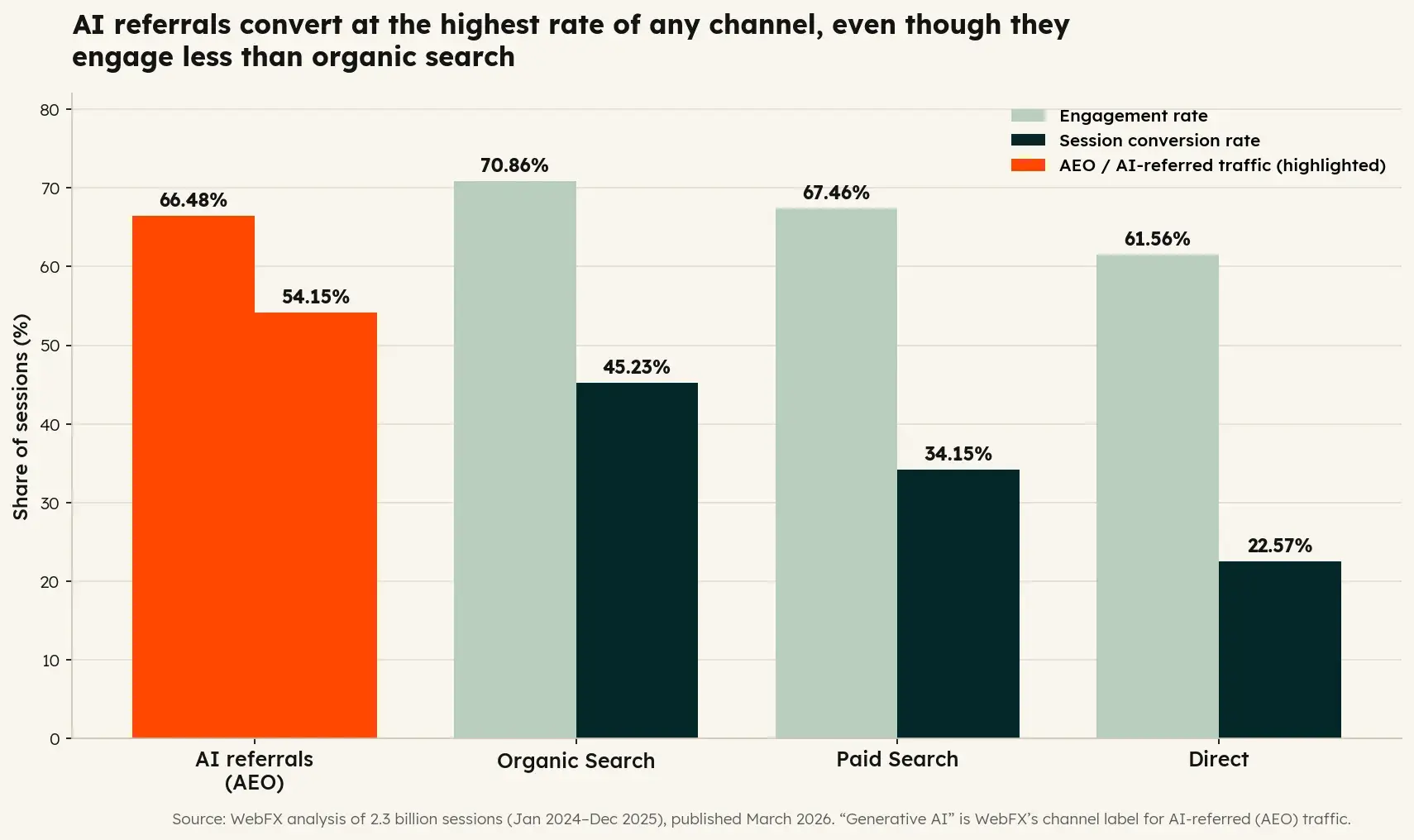
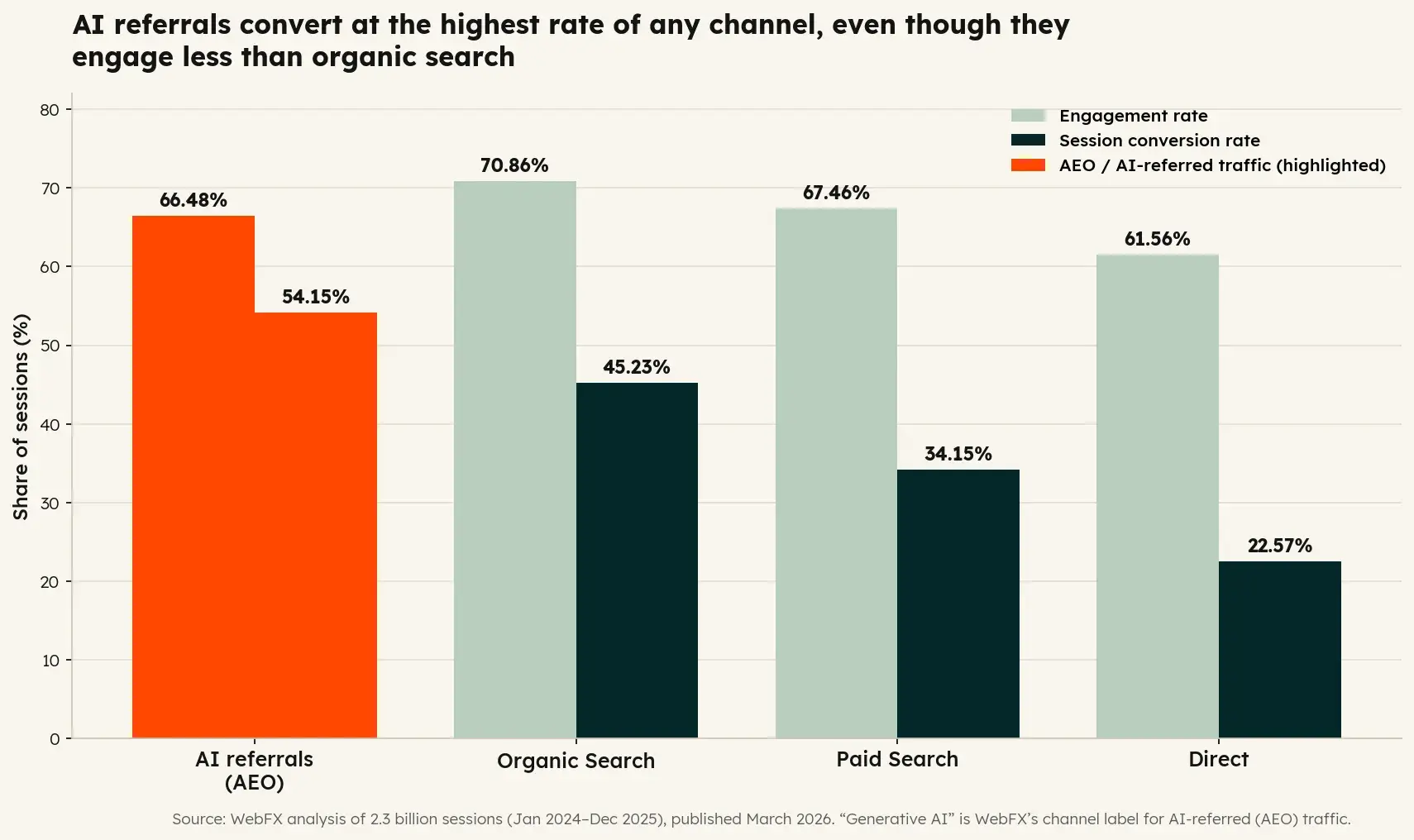
This accelerated journey directly impacts conversion metrics. A March 2026 analysis by WebFX, examining 2.3 billion sessions, found that visitors referred by AI converted approximately 1.2 times higher than those from organic search, outperforming all other free traffic channels. This suggests a fundamental shift in how users are discovering and engaging with online content, prioritizing efficiency and direct answers.
Benchmarking AEO Visitor Intent Against Other Channels
To effectively leverage AEO, it is crucial to understand how to measure and compare the intent of AI-referred visitors against established channels like organic search, paid advertising, and social media. Intent is not a single metric but rather a pattern of behavior that can be observed across engagement metrics, source-specific actions, and downstream conversion activities.
Key Intent Signals in GA4
Google Analytics 4 (GA4) provides several signals that can help differentiate high-intent AEO traffic from other sources. These include:
- Engagement Rate: A higher engagement rate indicates that visitors are interacting meaningfully with the content after arriving.
- Pages Per Session: Visitors with higher intent are more likely to explore multiple pages on a site, seeking comprehensive information.
- Average Session Duration: Longer session durations suggest that visitors are deeply engaged with the content and are actively researching.
- Key Event Completions: The completion of specific, high-value actions (e.g., downloading a resource, requesting a demo) is a strong indicator of intent.
When analyzed collectively, these signals paint a clearer picture of a visitor’s purpose. AEO traffic, having been pre-qualified by the answer engine, tends to exhibit stronger performance across these metrics compared to the more varied intent found in organic search results. Incorporating metrics like returning-user rate and scroll depth further refines this analysis, helping to distinguish between genuinely interested buyers and casual browsers.
Identifying AEO Traffic in GA4
Google introduced an "AI Assistant" channel in GA4 in May 2026, which automatically categorizes traffic from AI assistants. However, early visibility may vary, and some AEO-referred visits might still appear under Referral, Unassigned, or Direct traffic categories.
A useful pro-tip for identifying ChatGPT-referred traffic involves looking for the utm_source=chatgpt.com parameter, which OpenAI reportedly adds to referral URLs. This UTM parameter can preserve attribution even when referral data is unreliable, provided it survives redirects and landing page processing.
To effectively benchmark AEO traffic, three primary methods can be employed within GA4:
- Spot-check with Session Source / Medium: A quick diagnostic can involve examining the Session Source / Medium report to identify potential AI-referred traffic. This provides an immediate gauge of volume.
- Build a Custom Channel Group: For more robust tracking, a custom channel group can be configured using regular expressions. This workaround is particularly useful when the native AI Assistant channel is unavailable or incomplete, allowing for the capture of additional source patterns. This typically requires Editor or Administrator access to the GA4 property.
- Utilize the Native AI Assistant Channel: If available and accurately categorizing traffic, the native AI Assistant channel offers the lowest maintenance option for identifying AEO-referred sessions.
It is important to acknowledge that these methods may undercount true answer engine influence. Visits from in-app browsers, copied links, or privacy-restricted environments may lack referrer headers and could be classified as Direct traffic, as noted by Search Engine Journal. Therefore, the native AI Assistant channel should be viewed as a cleaner signal rather than a comprehensive count.
Regardless of the method used, the comparison process remains consistent: align AI Search or AI Assistant traffic with Organic Search, Paid Search, and Organic Social. Analyze the same engagement signals over a comparable date range and use a primary conversion goal for headline benchmarks, supplemented by secondary key events that reflect different stages of the funnel.
Condensed Search Paths and Conversion Readiness
The concept of "query fan-out" directly translates to higher conversion readiness. While multiple touchpoints were traditionally considered necessary for lead nurturing, AI answer engines now consolidate much of this initial research. This compression means that visitors arrive at a website further along the buyer’s journey, exhibiting greater readiness to convert. The reduction in the number of sessions required to reach a conversion point signifies higher readiness, not necessarily weaker engagement.
Measuring AEO Visitor Quality in Your CRM
While GA4 provides valuable insights into acquisition and engagement, a Customer Relationship Management (CRM) system is essential for tracking the progression of AEO visitors from initial session to closed deal, and for connecting this traffic directly to revenue.
End-to-End Tracking with HubSpot Smart CRM
HubSpot Smart CRM offers a comprehensive solution for tracking visitor activity from their first anonymous visit through to becoming a converted contact and ultimately a closed deal. The CRM associates new contact records with earlier anonymous activity, ensuring that the "Original Traffic Source" accurately reflects the visitor’s initial point of entry, even if that was via an AI answer engine. Deals automatically inherit this attribution, drawing from the earliest recorded activity of an associated contact.
Crucially, HubSpot classifies AI Referrals as a distinct traffic source. When a visitor clicks a link cited within an AI answer engine response (from platforms like ChatGPT, Claude, Perplexity, or Gemini), HubSpot automatically tags that session as "AI Referrals" without requiring custom configuration. This end-to-end tracking capability allows businesses to connect AI-referred traffic to tangible outcomes, such as closed-won deals, a link that GA4 often cannot complete on its own.
Quantifying the AEO Visitor Advantage with Intent Scoring
Intent scoring provides a powerful mechanism for quantifying the advantage of AEO visitors. By assigning point values to behaviors that indicate serious evaluation – such as clearing median engagement time, achieving target scroll depth, visiting pricing or comparison pages, and completing key events – a composite intent score can be generated for each session. Averaging these scores by channel allows for a direct comparison.
This approach offers two key benefits over raw conversion rates:

- Pre-Conversion Intent Measurement: Intent scoring captures a visitor’s level of engagement and seriousness before they convert, making it possible to evaluate channels even when their traffic volume is too low for a stable conversion rate.
- Standardized Evaluation: By applying the same rubric to all sources, intent scoring transforms the claim of "AEO visitors are higher intent" into an auditable, data-driven assertion.
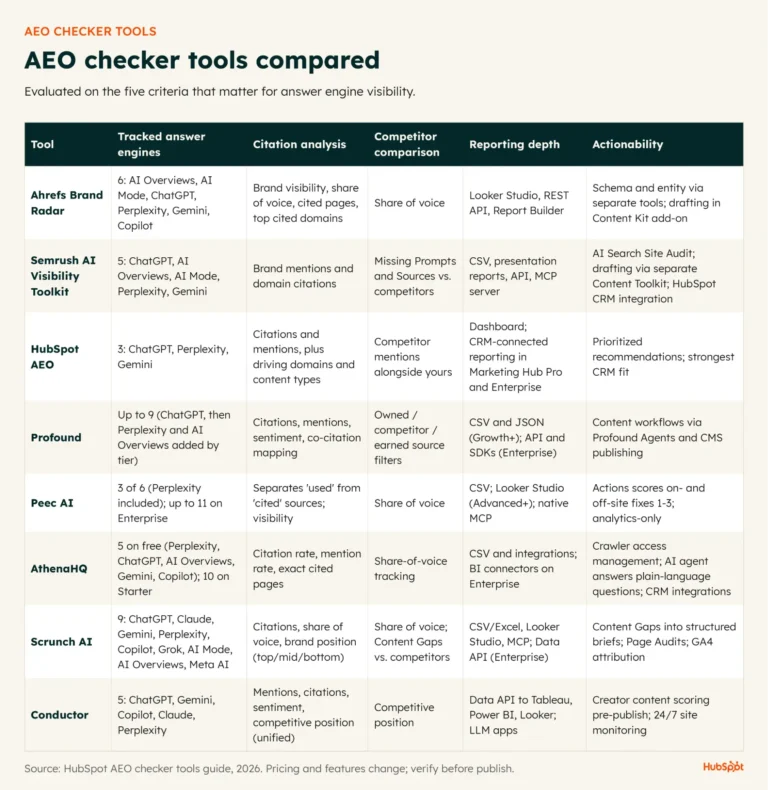
HubSpot’s AEO tools further enhance this by tracking brand visibility across various answer engines. This data, when paired with channel intent scores, reveals which AI-cited pages are attracting the highest-scoring visitors, directly linking AI visibility to traffic quality.
Key Metrics for Proving AEO’s Impact
Demonstrating the value of AEO to stakeholders requires a clear articulation of the metrics that prove its efficacy. The evidence is already present in GA4 and CRM data, but it must be synthesized into a compelling narrative.
Optimizing for Quality Over Volume
Given that AEO typically generates lower traffic volumes than established channels like organic search or paid advertising, the strategic focus must shift to optimizing for visitor quality. Three key strategies can achieve this:
- Anticipate Query Fan-Out: Content strategies should address not only the primary user question but also the anticipated sub-queries that AI answer engines are likely to explore. This ensures that pages appear prominently in citations by covering the full spectrum of related user inquiries.
- Write for Buyer Prompts, Not Generic Queries: AEO optimization involves tailoring content to the more conversational, decision-oriented prompts characteristic of AI interactions, rather than solely focusing on traditional, broad search queries. For instance, instead of optimizing for "best CRM," content should target prompts like "best CRM for a 10-person sales team that already uses HubSpot."
- Tie Cited Pages to Revenue: Not all content that gets cited by AI will directly drive conversions. It is essential to track each AEO-driven page’s journey through the sales funnel to closed-won deals. This allows for the identification and prioritization of topics that not only attract traffic but also generate tangible revenue.
Demonstrating ROI Through Channel Comparison Reporting
To effectively showcase AEO’s return on investment, a comprehensive channel comparison report is essential. This report should:
- Utilize the same date range and a singular key event for consistent comparison.
- Present the following headline metrics for leadership audiences:
- Conversion Rate: The primary indicator of effectiveness.
- Average Deal Value: Highlighting the financial impact of AEO traffic.
- Customer Lifetime Value (CLV): Indicating the long-term value of AEO-acquired customers.
- Detail the four GA4 engagement signals that feed the intent score:
- Average Engagement Time
- Engaged Sessions per Active User
- Views per Session
- Key Event Completions
- Include two critical proof-past-the-session pairs:
- Original Traffic Source to Deal Source: Verifying attribution continuity.
- Contact Source to Deal Source: Confirming the link between initial engagement and revenue.
This side-by-side reporting, comparing AI Search against Organic Search, Paid Search, and Organic Social, provides a clear and defensible case for AEO’s strategic importance.
Building a Robust Channel Comparison Framework for AEO
The integrity of any channel comparison hinges on a well-structured and meticulously maintained framework. Three pillars support this framework: clear ownership, shared documentation, and meticulous data handling.
Assigning Ownership
To prevent fragmentation and ensure accountability, explicit ownership must be assigned to each component of the AEO strategy and its measurement:
- Content Strategy: Responsibility for content creation and optimization for AI answer engines.
- Technical SEO: Oversight of website structure, crawlability, and technical factors influencing AI indexing.
- Analytics & Reporting: Management of GA4 configuration, custom channel groupings, and the generation of comparison reports.
- Sales & CRM: Ensuring accurate lead routing, attribution tracking within the CRM, and follow-up processes.
Comprehensive Documentation
To foster alignment across marketing, analytics, and sales teams, a single, definitive source of documentation is crucial. This documentation should clearly define:
- AEO Traffic Definition: Establishing a universally understood definition of what constitutes AEO traffic.
- Key Answer Engine Domains: Listing the specific AI platforms being monitored.
- GA4 Channel Configuration: Detailing the setup for identifying and categorizing AEO traffic.
- CRM Attribution Rules: Outlining how AI-referred traffic is tagged and tracked within the CRM.
- Intent Scoring Methodology: Documenting the specific metrics and point values used for intent scoring.
- Reporting Cadence and Format: Specifying how and when channel comparison reports will be generated and shared.
Regular quality assurance (QA) checks of the capture path, including verifying that new answer engine domains are recognized and that AI Referrals are correctly logged in the CRM, are essential. Channel definitions should be updated as new AI platforms emerge, and intent score weights should be revisited if engagement patterns evolve.
Privacy, Consent, and Data Retention
Compliance with data privacy regulations is paramount. Key considerations include:
- Consent Management: Ensuring that user consent is obtained for data collection and processing, aligning with regulations like GDPR and CCPA.
- Data Retention Policies: Establishing clear policies for how long user data is stored, in accordance with legal requirements and business needs.
It is critical to consult with legal counsel to ensure full compliance with all applicable jurisdictional laws regarding data privacy and handling.
Embracing the Future: Starting to Prove AEO Visitor Quality Today
The path to proving AEO visitor quality begins with implementing a structured framework. This can be achieved in five key steps, building upon the principles outlined above:
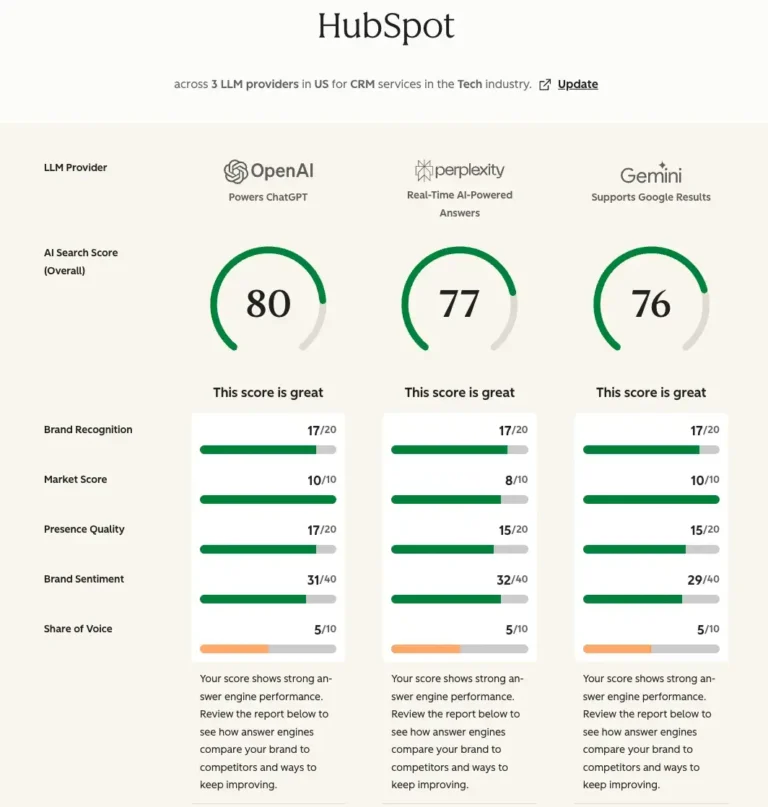
- Establish a Baseline Visibility Read: Utilize tools like the AEO Grader to understand how a brand currently appears across major answer engines. This provides a foundational understanding of AI visibility.
- Configure GA4 for AI Traffic Identification: Implement either a custom channel group or leverage the native AI Assistant channel to accurately categorize AEO traffic.
- Integrate CRM Attribution: Ensure that the CRM is configured to capture and attribute AI-referred traffic accurately, linking it to contact and deal records.
- Develop an Intent Scoring Model: Define and implement a scoring system that quantifies visitor intent based on engagement signals.
- Construct a Channel Comparison Report: Consolidate data from GA4 and the CRM into a comprehensive report that compares AEO performance against other channels on key metrics.
By following this sequence, businesses can begin to transform scattered analytics data into a defensible channel comparison, validating the strategic importance of AEO. The initial visibility assessment provides a critical starting point, identifying areas for improvement before diving deep into performance metrics.
Frequently Asked Questions About AEO Visitor Intent
How do I prove AEO visitors have higher intent than organic search traffic?
Compare key engagement signals—average engagement time, engaged sessions per active user, views per session, and key event completions—across both channels within the same date range and for the same key event. AEO traffic typically clusters at the higher end of these metrics, indicating more purposeful engagement, while organic search often presents a broader mix of user intents. For a direct link to revenue, multi-touch revenue attribution tools can credit each touchpoint, including AEO, to closed deals once AEO is isolated as a source.
What engagement metrics best demonstrate AEO visitor quality?
The four core GA4 signals that most effectively demonstrate AEO visitor quality are average engagement time, engaged sessions per active user, views per session, and key event completions. These metrics collectively illustrate whether a visitor was actively evaluating content or simply making a cursory visit.
How does query fan-out improve visitor quality compared to traditional search?
Traditional search necessitates multiple queries and sessions for users to complete their research. Query fan-out, however, consolidates these sub-searches within a single AI exchange, delivering a synthesized answer. This means a user who previously required five queries to weigh options receives one resolved response. By the time they click through to a website, the foundational research and comparison work is largely complete, placing them further along the buyer journey. This compression explains why fewer sessions to conversion often signifies higher readiness.
How often should I refresh my channel comparison analysis?
The capture path should be QA’d quarterly. This involves confirming that the AI Search channel continues to identify new answer engine domains and that AI-referred visits are consistently registered in the CRM under the appropriate source. Channel definitions should be updated whenever a new answer engine gains prominence, and intent score weights may need recalibration if engagement patterns shift.
What if my AEO traffic volume is lower than other channels?
Lower volume is an expected characteristic of AEO, especially compared to more established channels like organic or paid search. The strength of AEO lies not in its raw session count but in the quality of the traffic it delivers. The focus should therefore be on per-channel intent scores. These scores capture pre-conversion intent, enabling the evaluation of a channel’s effectiveness even with limited volume. A high-score, low-volume channel is not underperforming but rather represents an underexploited opportunity.
About the Author