The landscape of digital marketing is undergoing a seismic shift, driven by the rapid integration of artificial intelligence into the consumer research journey. As AI-powered chatbots and answer engines like ChatGPT, Gemini, and Perplexity become the first point of contact for many buyers, businesses are facing a critical imperative: to optimize their presence within these new information ecosystems. This evolving challenge has led to the emergence of Answer Engine Optimization (AEO) tools, with HubSpot AEO and Scrunch standing out as prominent players. Understanding their distinct capabilities is crucial for marketing leaders, SEO strategists, content teams, and RevOps professionals seeking to navigate this new frontier effectively.
At its core, the decision between HubSpot AEO and Scrunch hinges on workflow integration and the depth of specialized features. HubSpot AEO presents itself as an insight-to-execution platform, meticulously designed to bridge the gap between AI visibility data and direct integration with customer relationship management (CRM) systems and existing content workflows. In contrast, Scrunch positions itself as a focused monitoring and benchmarking tool, excelling in multi-engine tracking and providing granular competitive share-of-voice analysis. The optimal choice, therefore, depends on whether a unified, end-to-end platform is desired or if a dedicated data feeder for an established workflow is more appropriate.
The underlying catalyst for this market evolution is the undeniable trend of AI-generated answers intercepting potential customers before they even reach a company’s website. HubSpot’s own data paints a stark picture: a reported 27% year-over-year decline in organic traffic for its customers between the 2025 and 2026 fiscal years, juxtaposed with a tripling of AI referral traffic during the same period. This significant shift underscores the potential for brands to miss crucial early-funnel opportunities if they fail to monitor and adapt to their AI visibility.
This comprehensive comparison aims to serve as a decision guide, dissecting each tool’s strengths, weaknesses, and ideal use cases. It is structured to assist marketing leaders and their teams in making an informed decision that aligns with their specific workflow, existing technology stack, and reporting requirements.
TL;DR: HubSpot AEO vs. Scrunch in One Minute
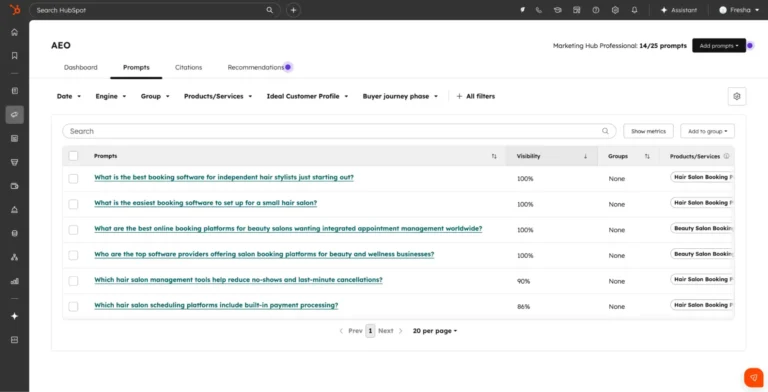
HubSpot AEO is engineered for teams aiming to close the AI visibility gap efficiently, enabling content publication without necessitating a departure from their current operational environment. It diligently tracks brand appearances across ChatGPT, Gemini, and Perplexity, surfaces actionable recommendations, and, for Marketing Hub Pro and Enterprise customers, seamlessly connects these insights to their established content tools and CRM data. Priced at $50 per month as a standalone solution, it is also included at no additional cost within HubSpot’s Marketing Hub Pro and Enterprise plans.
Scrunch is best suited for teams requiring comprehensive AI engine benchmarking and who prefer not to alter their existing content production infrastructure. Its primary advantage lies in its ability to monitor a broad spectrum of AI engines, offering prompt-level visibility, sentiment analysis, and competitive share-of-voice data.
The fundamental trade-off lies in the speed of value realization. HubSpot AEO offers a shorter time-to-value for existing HubSpot users due to its native CRM integration and built-in content tooling. Scrunch, conversely, provides deeper, standalone benchmarking capabilities across a wider array of engines, making it a compelling option for organizations with complex, multi-vendor tech stacks, particularly at the enterprise level.
HubSpot AEO vs. Scrunch at a Glance
To provide a clear overview, the following table maps each tool against the typical stages of an AEO workflow. This allows for a quick assessment of where each platform contributes value and where supplementary solutions might be required.
| Workflow Stage | HubSpot AEO | Scrunch |
|---|---|---|
| Research / Prompt Strategy | CRM-informed prompt suggestions based on your industries, competitors, and customer segments. | Manually configured custom prompts; persona segmentation available on paid plans. |
| AI Engine Coverage | ChatGPT (GPT-5.2), Gemini, Perplexity (3 engines, standalone). | Core: ChatGPT, Perplexity, Google AI Overviews, Copilot (4 engines); Enterprise: up to 9 engines. |
| Content Production | Recommendations link directly to HubSpot’s Content Hub and Blog tool (Marketing Hub Pro/Enterprise); built-in tooling. | No native content generation; recommendations surface gaps, execution handled externally. |
| Optimization | Prioritized recommendations (create new page, fix technical gap, publish social post, earn third-party citations). | Site audit, content gap analysis, schema/structured data guidance; research-oriented optimization workflow. |
| Distribution/Collaboration | Native HubSpot workflows; team acts on recommendations within the same platform for social, email, landing pages. | No native distribution; data exports and API available for external workflows. |
| Measurement / Reporting | Brand visibility score, share of voice, sentiment, citation analysis; native Marketing Hub reporting. | Prompt-level visibility, sentiment, competitive benchmarking; GA4 integration; API for custom dashboards. |
| Integrations | Native HubSpot Smart CRM, Content Hub, Marketing Hub, Breeze Assistant. | GA4, Google Search Console, Looker Studio, Tableau, Power BI, Shopify, Webflow; CDN integrations at Enterprise. |
| Pricing Posture | $50/month standalone; included in Marketing Hub Pro ($800/month) and Enterprise. | Core: $250/month (annual) / $300 monthly; Enterprise: custom. |
| Free Trial | 28-day free trial, no credit card required. | 7-day free trial. |
| Governance / Security | HubSpot platform security; SSO and RBAC available within Marketing Hub Enterprise. | SOC 2 Type II; SAML/OIDC SSO; RBAC; Enterprise Data API. |
Legend: "Included" denotes native functionality. "External" implies the need for separate tools. "Enterprise" signifies features requiring custom pricing.
The "unified platform advantage" is particularly pronounced for teams already invested in HubSpot. The inherent connectivity between their CRM, content tools, and reporting streamlines operations. HubSpot AEO leverages existing customer segments to suggest relevant prompts, and recommendations are directly integrated into workflows for social media, email, and landing page creation. Conversely, while Scrunch provides robust monitoring data, the subsequent execution requires an external system, potentially increasing coordination overhead for content teams.
Research and Prompt Strategy: The Divergence Begins
The initial divergence between HubSpot AEO and Scrunch becomes apparent in the research and prompt strategy phase. HubSpot AEO automates prompt suggestion by drawing directly from the company’s CRM data. This includes the firm’s profile, tracked competitors, and pre-defined customer segments. For instance, a B2B SaaS company targeting HR departments will receive different prompt suggestions than a professional services firm. While custom prompts can be added at any time, the system operates on a credit-based system for prompt tracking, with the option to purchase additional credits.
Scrunch, on the other hand, requires user-configured prompts. The platform does not inherently understand a company’s business context; users must define the questions, segment them by persona, and map them to specific funnel stages. This approach is highly effective for teams with a well-established prompt taxonomy and a clear understanding of their buyers’ inquiries. However, for organizations new to AEO, this can represent a significant initial setup burden.
A valuable tip for those building an AEO prompt library from scratch is to utilize HubSpot’s free AEO Grader. This tool provides a one-time snapshot of current visibility across ChatGPT, Perplexity, and Gemini, serving as an excellent starting point before committing to ongoing tracking.
Content Production and Optimization: From Insight to Action
The most significant differentiation between the two tools lies in their approach to content production and optimization. HubSpot AEO is fundamentally designed to facilitate a seamless transition from diagnosis to execution, all within a single platform. Its recommendations are not merely suggestions but are prioritized and action-specific. Instead of a generic directive like "improve your content," users receive concrete next steps such as creating a new post, rectifying a technical page issue, publishing a social media update, or securing a third-party citation. For Marketing Hub Pro and Enterprise customers, these recommendations directly link to HubSpot’s integrated content tools, enabling writers, editors, and strategists to work within their familiar environment.
Scrunch, while providing valuable visibility gaps and site audit data, necessitates that content creation and optimization occur outside its platform. It functions primarily as a monitoring and analytics layer, rather than an execution engine. Teams utilizing Scrunch must independently manage the workflow between generating insights and publishing content.
What distinguishes HubSpot AEO is its ability to move beyond mere identification. Its recommendations specify what content needs to be built and articulate the rationale behind prioritization decisions. For content teams managing numerous topics and competing priorities, HubSpot AEO transforms AEO from a reporting exercise into a tangible production queue.
Scrunch’s strength lies in its thorough site audit functionality and the depth of its diagnostic data, offering insights into why a brand might be absent from a particular AI answer, a feature more developed than in many competing tools. For organizations with established content operations, Scrunch’s gap data can effectively feed into their existing workflows.
Distribution and Collaboration: Streamlining Content Deployment
HubSpot AEO’s advantage in distribution stems from its native integration with the broader HubSpot platform. Recommendations that pertain to social posts, landing pages, or blog content are directly linked to the tools already used by the team for publishing and distribution, eliminating the need for context switching when acting on AEO insights. For Marketing Hub Pro or Enterprise users, this means AEO recommendations can be seamlessly converted into tasks, drafts, or published content within the same workflow used for all other marketing activities.
In contrast, Scrunch lacks native distribution capabilities. The platform’s focus is on the monitoring and reporting layer, rather than facilitating content publication. Teams using Scrunch typically maintain a separate content workflow (using tools like Notion, Asana, Contentful, or Webflow) and leverage Scrunch’s insights to prioritize their existing backlog.
For teams evaluating Scrunch as a standalone solution, it is imperative to factor in the additional cost and coordination overhead associated with maintaining a separate content workflow. The true total cost encompasses monitoring, production, publishing, and reporting.
Measurement and Reporting: Integrating AEO into the Analytics Ecosystem
Both HubSpot AEO and Scrunch provide core AEO metrics, including brand visibility scores, share of voice, sentiment, and citation analysis. The key difference lies in how these metrics integrate with a company’s broader reporting infrastructure.
HubSpot AEO’s reporting is embedded within the HubSpot platform. For Marketing Hub Pro and Enterprise customers, AI referral traffic data is displayed natively alongside other marketing analytics. This allows for the correlation of AEO visibility trends with lead volume, contact attribution, and campaign performance without the need for custom dashboard creation.
Scrunch’s reporting strengths are its granularity and portability. Its integration with Google Analytics 4 (GA4) is a notable feature, identifying specific AI crawlers visiting a website and their interaction patterns with content. This offers a level of technical detail often absent in traditional analytics tools. Furthermore, Scrunch integrates with Looker Studio, Tableau, and Power BI, and offers an enterprise-tier Data API, making it attractive to analytics-focused teams with established business intelligence infrastructure.
For teams with complex BI stacks seeking control over their reporting layer, Scrunch’s API and analytics integrations are ideal. Conversely, teams desiring AEO data within the context of their overall marketing performance will benefit from HubSpot’s native AEO reporting.
Integrations and Ecosystem: A Tale of Two Approaches
HubSpot AEO’s integration strategy is intrinsically linked to its position within the HubSpot customer platform. Rather than connecting to external systems, it inherits connections to tools already present in the HubSpot stack, such as Smart CRM, Marketing Hub, Content Hub, and Breeze Assistant. This native integration is a significant advantage for existing HubSpot users, as it eliminates the need for additional connector setup, data syncing, or managing separate logins.
For organizations not utilizing HubSpot, the integration landscape for AEO is more constrained. As a standalone product, it does not natively connect with Salesforce or other competing CRM platforms, nor does it integrate with third-party content platforms. While AEO tracking and recommendations are available, the CRM-powered intelligence requires a HubSpot CRM subscription to be fully realized.
Scrunch adopts a contrasting approach, designed to integrate into an existing technology stack as an analytics layer. Its native integrations include GA4, Google Search Console, Looker Studio, Tableau, Power BI, Shopify, and Webflow. At the enterprise tier, CDN-level integrations with Cloudflare, Vercel, and Akamai enable the Agent Experience Platform (AXP), which delivers AI-optimized content to AI crawlers without negatively impacting the human visitor experience. A Data API is also available at the enterprise level for custom data pipeline development.
Data Coverage and Engines: The Breadth of AI Visibility
The utility of an AI visibility score is directly proportional to the engines being monitored. As of mid-2026, the dominant AI answer engines for most B2B and B2C buyers include ChatGPT, Google Gemini, and Perplexity. However, platforms like Claude, Google AI Mode, Microsoft Copilot, and Meta AI are experiencing rapid growth, and their prevalence varies significantly by industry and audience. A tool that tracks only a limited number of engines may fail to identify crucial visibility gaps or might report strong performance that doesn’t accurately reflect where a brand’s target buyers are actively searching.
HubSpot AEO monitors three engines across all its plans: ChatGPT, Gemini, and Perplexity. For many B2B SaaS and mid-market companies, these three engines cover the majority of high-intent AI search activity. However, this means that engines such as Claude, Microsoft Copilot, Google AI Mode, and Meta AI are not currently tracked. This can represent a significant gap for organizations whose enterprise buyers rely on Microsoft Copilot or where Claude is a material visibility surface.
Scrunch offers broader engine coverage, though the extent of this coverage is dependent on the chosen plan tier. The Core plan includes four engines: ChatGPT, Perplexity, Google AI Overviews, and Microsoft Copilot. The Enterprise plan unlocks monitoring for up to nine engines, including Claude, Gemini, Meta AI, Google AI Mode, and Grok. It is important to note that the widely cited "nine-engine coverage" is an Enterprise-tier feature, not available at entry-level pricing.
The impact of engine coverage on editorial priorities is direct. The visibility gaps that surface on a dashboard will shape content prioritization. A team monitoring ChatGPT, Gemini, and Perplexity may identify different clusters of gaps than a team tracking Copilot and AI Mode. Before committing to a tool, it is advisable to audit which AI engines are most actively used by your target buyers. Industry-specific patterns emerge: financial services buyers often favor Copilot and Gemini, tech buyers heavily utilize ChatGPT and Perplexity, and consumer audiences are increasingly engaging with Meta AI.
A practical tip for assessing trends is to use HubSpot’s free AI Search Sensor. This tool monitors industry-wide AI visibility trends, offering insights into which engines are gaining traction within a specific category before significant investment in ongoing tracking is made. Both tools provide recurring prompt execution and trend data over time, crucial for understanding visibility improvements and the impact of content updates on citations. Daily refresh cadences enable editorial teams to adapt quickly to shifts in the competitive landscape or AI model updates.
Pricing and Value: A Holistic Cost Perspective
The pricing structures of HubSpot AEO and Scrunch offer different value propositions.
| Feature | HubSpot AEO (Standalone) | HubSpot AEO (Marketing Hub Pro) | Scrunch Core | Scrunch Enterprise |
|---|---|---|---|---|
| Price | $50/month ($45 annual) | Included ($800+/month) | $250/month (annual)/$300 (monthly) | Custom |
| Prompts | 25 (buy more) | Expanded | 125 custom prompts | Custom |
| Engines | 3 (ChatGPT, Gemini, Perplexity) | 3 (same) | 4 engines | Up to 9 engines |
| Users/Seats | N/A | Based on Marketing Hub tier | 5 seats | Custom |
| Free Trial | 28 days, no credit card | N/A (included) | 7 days | N/A |
| Content Tooling | Recommendations only | Full HubSpot content tools | None | None |
| CRM Integration | Native (HubSpot CRM) | Native (HubSpot Smart CRM) | None | None |
When considering the total cost of execution, the prompt-level price comparison can be misleading. With Scrunch, the monitoring cost is only one component. Organizations still require separate tools for content production, publishing workflows, a content management system (CMS), and potentially a distinct analytics layer.
HubSpot AEO, particularly when bundled within Marketing Hub Pro, offers a more integrated infrastructure. For teams that would otherwise incur separate costs for content tools, CRM, and analytics, the bundled value of Marketing Hub Pro can significantly reduce the overall workflow expenditure. For smaller teams or those exploring AEO as a nascent channel, HubSpot AEO provides an accessible entry point, further enhanced by its 28-day free trial without requiring a credit card.
Which Should You Choose Based on Your Team?
Choose HubSpot AEO if you need unified execution.
HubSpot AEO is the optimal choice for organizations prioritizing the seamless integration of AI visibility data with content action, without introducing additional systems into their existing stack. It is particularly beneficial for teams that:
- Are already invested in the HubSpot ecosystem.
- Seek to streamline AEO insights directly into content creation and publishing workflows.
- Value CRM-driven prompt suggestions to ensure relevance to customer segments.
- Require a unified platform for marketing, sales, and service operations.
- Prefer a clear path from AI visibility monitoring to actionable content creation.
Consider starting your free 28-day trial of HubSpot AEO, which includes 25 prompts across ChatGPT, Gemini, and Perplexity, with no credit card required.
Choose Scrunch if you need focused competitor benchmarks.
Scrunch is the more robust option when the primary requirement is deep, multi-engine competitive benchmarking, especially for teams with an established content production and publishing workflow they wish to maintain. It is best suited for teams that:
- Require granular monitoring across a wider array of AI engines, including those not covered by HubSpot AEO.
- Possess a well-defined prompt strategy and existing content production tools.
- Need sophisticated competitive analysis and share-of-voice data.
- Have a complex, multi-vendor tech stack and prefer specialized tools.
- Are comfortable integrating data from a monitoring tool into separate execution workflows.
When a Hybrid Stack Makes Sense
Some organizations opt to run both HubSpot AEO and Scrunch concurrently. This approach leverages HubSpot AEO for day-to-day, recommendation-driven execution and Scrunch for broader benchmarking across engines not covered by HubSpot. This hybrid model can be practical when:
- Specific AI engines not covered by HubSpot AEO are critical to buyer journeys.
- Comprehensive competitive intelligence across a maximum number of engines is a strategic imperative.
- Existing workflows and budgets can accommodate the integration of two distinct platforms.
However, for many teams, a hybrid stack can introduce unnecessary coordination overhead that outweighs the marginal gains in coverage. The recommended approach is to start with the tool that best aligns with primary workflow needs, validate AEO as a channel, and then consider expanding coverage as the strategy matures.
Alternatives to HubSpot AEO and Scrunch
The AEO tool category has seen rapid expansion in recent years. Depending on workflow, stack, and budget, several adjacent tools warrant evaluation:
- Surfer SEO: While primarily an SEO tool, Surfer SEO has incorporated AI content features and is exploring AEO capabilities.
- Semrush: A comprehensive SEO suite, Semrush is actively developing its AI content and visibility tracking features.
- MarketMuse: Known for its AI-powered content intelligence, MarketMuse is expanding its capabilities to address AI answer engines.
- Content Intelligence Platforms: Tools like Clearscope and Frase offer AI-driven content optimization and may evolve to include AEO functionalities.
When evaluating any tool, it’s crucial to answer three key questions: 1) Where is the most significant workflow gap (monitoring, content production, or reporting)? 2) Which AI engines are demonstrably used by your buyers? 3) What does your existing stack already cover, and what would be net-new? For those uncertain, free assessments like the AEO Grader offer a valuable baseline of current AI visibility.
How AEO Differs from SEO
For those new to the discipline, Answer Engine Optimization (AEO) can be understood in relation to traditional Search Engine Optimization (SEO). SEO focuses on improving content rankings in traditional search engine results pages (SERPs), primarily on Google and Bing, by optimizing for keywords, backlinks, and technical site health. The objective is to drive clicks to a website.
AEO, conversely, aims to improve a brand’s presence within AI answer engines like ChatGPT, Gemini, and Perplexity. Instead of ranking on a page of links, the goal is to be featured directly within the AI’s generated answer. AEO emphasizes structured content, entity authority, citation signals, and the accuracy of information AI models use to describe a brand. AEO is not a replacement for SEO but a complementary discipline, forming part of a modern, holistic search visibility strategy.
The buyers who engage with AI search still use traditional search engines, and vice versa. A strategy that addresses both channels captures a more comprehensive discovery journey. Many fundamental principles overlap: high-quality, structured content, strong E-E-A-T (Experience, Expertise, Authoritativeness, Trustworthiness) signals, and authoritative third-party coverage benefit a brand in both traditional and AI search.
Practical differences emerge in measurement (rank positions versus visibility scores and share of voice), content format (keyword-optimized copy versus answer-first, structured, citation-ready content), and the signals that carry the most weight (backlinks and technical SEO versus entity authority, source credibility, and structured data).
Teams new to AEO can utilize the free AEO Grader for an initial assessment of their AI visibility. For a deeper understanding, HubSpot’s guide to answer engine optimization delves into the fundamentals, AEO-SEO integration, and best practices.
Frequently Asked Questions About HubSpot AEO vs. Scrunch
Do I need HubSpot Marketing Hub to use HubSpot AEO?
No, HubSpot AEO is available as a standalone product for $50 per month (or $45 monthly billed annually). It allows tracking of 25 prompts across ChatGPT, Gemini, and Perplexity, providing access to brand visibility scores, citation analysis, and prioritized recommendations without requiring any other HubSpot subscription. However, advanced features like CRM-informed prompt suggestions and direct integration with content tools necessitate Marketing Hub Pro or Enterprise, which includes AEO at no additional cost. Starting with the standalone plan is a low-risk way to evaluate the tool, with the option to upgrade as the AEO practice matures.
Can I run HubSpot AEO and Scrunch together?
Yes, there are no technical conflicts, and some teams operate both tools concurrently. A common strategy involves using HubSpot AEO for day-to-day execution driven by recommendations and Scrunch as a broader benchmarking layer for engines not covered by HubSpot (e.g., Microsoft Copilot or Claude). The decision to adopt a hybrid stack depends on the materiality of these additional engines in the buyer’s journey and whether the added coverage justifies the combined cost. If the engines covered by HubSpot AEO represent the majority of high-intent AI search activity, a hybrid approach may not be necessary.
How quickly will we see impact after implementation?
With HubSpot AEO, a baseline visibility report is available within the first session, with prompt-level data accessible from the trial’s commencement. Measurable impact on AI answers, driven by content creation and optimization based on recommendations, typically becomes apparent within 4-8 weeks, depending on publishing frequency and domain authority. For Scrunch, establishing a monitoring baseline is similarly swift, but the timeline for content-driven impact relies on the efficiency of the existing content workflow. It is important to note that AEO impact is cumulative and develops over time as a library of citation-worthy, answer-first content is built.
Which AI engines should we prioritize first?
It is advisable to prioritize the three engines with the highest buyer intent in your category: ChatGPT, Gemini, and Perplexity. These engines collectively account for the majority of high-intent AI search activity among most B2B and B2C buyers as of mid-2026. Once a baseline is established and an optimization rhythm is in place, consider layering in additional engines tailored to specific audiences. For instance, enterprise buyers in financial and professional services often utilize Microsoft Copilot more extensively, while consumer and SMB audiences are increasingly active on Meta AI. Utilizing HubSpot’s AI Search Sensor can provide valuable insights into engine-level trends within your industry before expanding tracking efforts.
How should we structure content for AI citations?
AI engines favor content that directly addresses buyer questions, is structured for readability (using clear headings, concise paragraphs, and defined terms), originates from authoritative sources, and is supported by third-party citations. Practically, this involves leading with the direct answer, followed by context. It also means employing structured data and schema markup where appropriate, building E-E-A-T signals through expert bylines and sourcing, and actively pursuing third-party mentions and links from reputable domains. Detailed guidance on content structuring, entity building, and AEO-SEO integration can be found in comprehensive guides on answer engine optimization.
About the Author