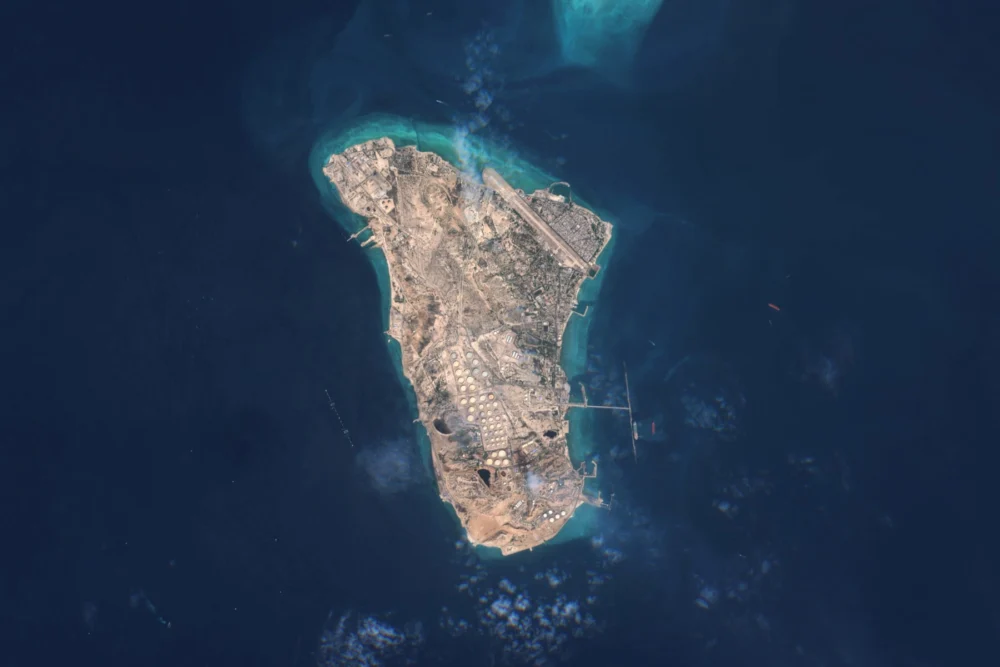
Kharg Island, a small yet supremely strategically vital strip of coral land in the northern Persian Gulf, has remained remarkably untouched by the escalating military actions of U.S. and Israeli forces, even as the broader Middle East conflict enters its second tumultuous week. This unassuming island, situated approximately 15 miles off the coast of mainland Iran, stands as the unequivocal centerpiece of the Islamic Republic’s vast oil industry, processing an estimated 90% of the nation’s crude exports before they embark on their journey through the critically important Strait of Hormuz. Its immense loading capacity, reportedly around 7 million barrels per day, underscores its indispensable role in Iran’s economy and, by extension, its geopolitical leverage.
The ongoing regional crisis, marked by a fresh wave of U.S. and Israeli strikes across Iran over the weekend, has seen crude futures climb to their highest levels since mid-2022. These targeted attacks, which struck several Iranian fuel sites, including significant oil storage depots like the Shahran facility in Tehran, signal a new, more aggressive phase of the war now entering its tenth day. Despite this intensification, Kharg Island, Iran’s economic jugular, has so far been spared direct military engagement, a fact that highlights the intricate web of geopolitical calculations, military risks, and severe global energy market repercussions that a direct assault on the island would undoubtedly unleash.
The Strategic Imperative of Kharg Island
Kharg Island’s geography dictates its destiny. Its location provides a natural deep-water port, ideal for accommodating supertankers, and its proximity to Iran’s mainland oil fields minimizes pipeline infrastructure costs. For decades, it has served as the primary nexus for Iran’s crude oil exports, a function that has only grown in importance as international sanctions have tightened around the Islamic Republic. The island is not merely a loading facility; it represents the logistical linchpin of Iran’s oil-dependent economy, a critical conduit for hard currency generation, and a strategic asset whose control could profoundly impact the country’s ability to finance its government and regional activities.
The Strait of Hormuz, through which roughly 20% of the world’s oil and gas passes in typical times, has seen shipping traffic all but halt since the conflict ignited late last month. This disruption alone has sent shockwaves through global energy markets. The potential targeting of Kharg Island would not only compound this crisis but fundamentally alter the calculus for Iran, effectively severing its primary means of oil export, regardless of the Strait’s operational status. International benchmark Brent crude futures, with May delivery, traded 11.5% higher at $103.40 per barrel on Monday, paring earlier gains, while U.S. West Texas Intermediate futures, with April delivery, were last seen 12% higher at $101.88, demonstrating the market’s acute sensitivity to Middle Eastern instability.
Military Calculus and Reluctance to Engage
Despite Kharg Island’s undeniable economic importance and its potential as a target, analysts suggest that any attempt to seize it would necessitate a significant ground troop operation, a course of action the U.S. administration appears deeply reluctant to undertake. Petras Katinas, a research fellow in climate, energy, and defense at RUSI, a prominent London-based defense think tank, emphasized the strategic leverage such a move would provide. "Seizing the island would cut off Iran’s oil lifeline," Katinas told CNBC, underscoring its essential nature for the regime. He elaborated, "Of course, with shipping via the Strait of Hormuz now stopped, they cannot sell oil anyway, but looking ahead, seizure would give the U.S. leverage during negotiations, no matter which regime is in power after the military operation ends."
However, Katinas quickly tempered this assessment, noting, "Yet, seizure would require a ground troop operation, which this administration seems hesitant to undertake. At least for now." The memory of protracted ground conflicts in the Middle East, particularly in Iraq and Afghanistan, looms large in Washington, shaping a clear aversion to deploying large-scale conventional forces in another potentially open-ended engagement. The logistical complexities, the high probability of casualties, and the unpredictable nature of an Iranian response all contribute to this strategic reticence.
Fraught with Risk: Economic and Military Implications
The economic implications of seizing Kharg Island would be immediate and severe for Iran. Tamas Varga, an oil analyst at brokerage PVM, highlighted this potential impact: "If President Trump were to decide to seize this pivotal hub, it would deal a significant blow to the Iranian regime, as it would deprive them of a critical source of revenue." Varga drew a parallel to the U.S. intervention in Venezuela at the beginning of the year, where Washington effectively took control of the country’s oil sector, suggesting a similar playbook could be considered for Iran.
However, Varga also pointed to the inherent complexities and risks. While a U.S. occupation might theoretically suggest a resumption of Iranian oil exports — albeit under U.S. supervision and contingent on the Strait reopening — the island would remain highly vulnerable. "It would at the same time remain vulnerable to drone attacks from within Iran," he warned, adding that "an eventual U.S. occupation of the island would further complicate an already complex situation." Iran possesses a considerable arsenal of drones and ballistic missiles capable of reaching Kharg Island from mainland positions, making any long-term occupation a hazardous and costly endeavor.

Marc Gustafson, former head of the White House Situation Room and senior director of analysis at Eurasia Group, echoed these warnings, categorizing any such operation as "fraught with risk." Gustafson, who served under Presidents Trump, Joe Biden, and Barack Obama, outlined several potential motivations for a U.S. president to consider seizing Kharg, including the opportunity for a "big PR win," providing U.S. troops with a natural barrier from mainland Iran, and maximizing leverage over the Iranian regime.
However, the downsides, as Gustafson detailed in a LinkedIn post, are substantial:
- Ground Troops Required: The need for U.S. forces on the ground, triggering significant political and military costs.
- Sustained Target: Kharg Island would likely become a multiweek target for Iranian drone attacks, straining U.S. defenses and potentially leading to ongoing skirmishes.
- Oil Price Spike: A direct attack or occupation would undoubtedly push oil prices even higher, potentially exacerbating global inflation and triggering economic instability.
- Iranian Self-Sabotage: Tehran might consider an act of self-sabotage, destroying the critical oil pipeline that feeds the island to deny its infrastructure to an occupying force, further complicating any future U.S.-supervised operations.
Historical Precedents and Strategic Parallels
The vulnerability and strategic importance of Kharg Island are not new revelations. During the Iran-Iraq War (1980-1988), Kharg was a frequent target of Iraqi air and missile strikes, with extensive damage inflicted on its loading facilities and storage tanks. Iran, despite the attacks, maintained its export capacity through ingenious repairs and diversion tactics, highlighting the resilience of its oil infrastructure but also the persistent threat it faces in times of conflict. The historical context underscores that while challenging, attacks on Kharg Island are not unprecedented, and Iran has developed strategies to cope with such disruptions.
The comparison to Venezuela, as made by Tamas Varga and Jan van Eck, CEO of VanEck Funds, provides a contemporary strategic parallel. Van Eck, speaking on CNBC’s "Power Lunch," stated, "There is one concept or one dimension of this that no one seemingly has mentioned, which is Kharg Island. It’s where 90% of Iran’s oil gets exported out of — that is a choke point. And if you think that Trump just follows the same playbook that he did in Venezuela. What did he do? He cut off their oil exports, their hard currency, and I think he is going to want that leverage point going forward." This analogy suggests a strategy focused on economic strangulation rather than direct military confrontation, aiming to deprive the regime of its financial lifeblood as a means of exerting pressure.
Broader Impact and Global Energy Market Instability
The ongoing Middle East conflict, with the Strait of Hormuz effectively closed to normal shipping traffic, has already had a profound impact on global energy markets. The cessation of approximately 20% of the world’s oil and gas transit through this vital maritime corridor has tightened supply, pushing prices upwards and creating significant uncertainty for consumers and businesses worldwide. While the U.S. and other major oil-consuming nations possess strategic petroleum reserves, their release offers only temporary relief and cannot fundamentally alter a sustained disruption in supply.
A direct military intervention targeting Kharg Island would undoubtedly amplify this instability. Beyond the immediate price spike, it would introduce a new level of geopolitical risk, potentially drawing in other regional and international actors. The global economy, still grappling with post-pandemic recovery and inflationary pressures, is ill-equipped to absorb a prolonged period of extremely high and volatile oil prices. Such a scenario could trigger a significant global recession, impacting trade, investment, and living standards across continents.
Furthermore, the environmental consequences of a large-scale attack on Kharg’s oil facilities, including potential spills in the ecologically sensitive Persian Gulf, could be catastrophic. The long-term cleanup and rehabilitation efforts would be immense, adding another layer of complexity to an already dire situation.
The Unfolding Dilemma and Future Outlook
The dilemma surrounding Kharg Island embodies the broader strategic quandary facing the U.S. and its allies in the Middle East. On one hand, the island represents a clear strategic target, offering immense leverage against the Iranian regime. On the other hand, the risks associated with a direct military operation — including the need for ground troops, the high probability of a protracted conflict, severe economic repercussions, and the potential for a wider regional conflagration — are daunting.
As the Middle East conflict continues its volatile trajectory, the untouched status of Kharg Island remains a testament to these intricate calculations. While the current U.S. administration appears to favor a strategy of targeted strikes and economic pressure, the option of direct engagement with Iran’s most critical oil asset lingers as a potent, albeit dangerous, card that could be played. The global energy markets, and indeed the world, will continue to watch with bated breath, understanding that any shift in this delicate balance could have far-reaching and potentially catastrophic consequences.
About the Author