The digital marketing sphere is undergoing a seismic shift, with artificial intelligence fundamentally altering how consumers discover and interact with brands. Before potential customers even land on a company’s website, their initial perceptions are being shaped by AI-powered answer engines like ChatGPT, Perplexity, and Google’s AI Mode. This burgeoning reality underscores the critical importance of Answer Engine Optimization (AEO), a discipline focused on ensuring brands are accurately and favorably represented in these AI-generated responses. Two prominent platforms emerging in this space, Scrunch and Peec AI, offer distinct approaches to tackling the complexities of AEO, each catering to different organizational needs and strategic priorities.
The urgency for AEO stems from a fundamental change in the information discovery paradigm. Traditional Search Engine Optimization (SEO) focused on ranking within lists of links. AEO, however, prioritizes inclusion, attribution, and framing within AI-generated summaries and direct answers. Failure to understand and optimize for this new frontier means brands risk being invisible or misrepresented to a growing segment of their audience at the crucial top-of-funnel stage.
Both Scrunch and Peec AI position themselves as solutions for AEO challenges, aiming to track brand visibility across various AI engines. However, their underlying methodologies, feature sets, and target user profiles diverge significantly, prompting a detailed comparison for businesses seeking to implement effective AEO strategies.
Understanding the AEO Landscape: Key Terminology
Before delving into the specifics of Scrunch and Peec AI, it is essential to establish a common understanding of AEO terminology:
- AEO (Answer Engine Optimization): The practice of optimizing content and brand presence to ensure AI systems accurately include, cite, and frame a brand when responding to relevant queries.
- AI Visibility: A metric indicating how frequently and favorably an AI system mentions or cites a brand in its answers. This differs from traditional SEO rank, focusing on inclusion and context.
- AI Overview: Google’s AI-generated summary appearing at the top of some search results, requiring a distinct optimization approach from traditional "ten blue links."
- Entity: A clearly defined concept (brand, person, product) that AI systems can reliably identify and reference, crucial for accurate and consistent citation.
- Citation: The mechanism by which an AI system attributes a claim to a specific source, often leading to referral traffic and brand visibility.
Strategic Alignment: Who Should Choose Which Platform?
The decision between Scrunch and Peec AI hinges on an organization’s specific workflow, technical maturity, and desired outcomes from AEO.
Scrunch appears to be best suited for larger enterprises and marketing leaders seeking to integrate AI visibility into broader digital experience platforms (DXPs) and existing marketing technology stacks. Its emphasis on brand narrative and descriptor analysis makes it a strong contender for PR and brand managers tasked with monitoring how AI engines characterize their brand. For CMOs or VPs of Marketing who need to articulate AI visibility as part of a board-level narrative and desire integration with DXPs like Sitecore, Scrunch’s architecture offers a more comprehensive, albeit potentially more complex, solution.
Peec AI, conversely, positions itself as a more agile and purpose-built solution, particularly for SEO leads and content strategists. Its strength lies in providing granular, daily tracking of prompt-level performance across a broad range of answer engines. For teams requiring client-ready reporting without extensive design work, or those focused on operational response cycles in competitive or fast-moving markets, Peec AI offers a more streamlined and immediate path to actionable insights. The platform’s flexible pricing and unlimited user model also make it an attractive option for smaller teams or those with rapidly expanding stakeholder groups.
For RevOps or marketing operations leads focused on data integration and attribution reporting, both platforms offer pathways. Peec AI’s Advanced plan and Scrunch’s native Looker integration provide robust options for clean data exports and BI tool connectivity. However, for teams new to AEO and validating its budget impact, Peec AI’s Starter tier presents a lower-risk entry point with its affordable pricing and unlimited user access.
Features and Pricing: A Comparative Analysis
A detailed feature and pricing comparison reveals key differentiators:
Side-by-Side Feature Comparison
| Feature | Scrunch | Peec AI |
|---|---|---|
| Core Focus | Brand narrative, descriptor analysis, DXP integration | Prompt-level tracking, multi-engine coverage, operational reporting |
| Update Cadence | Weekly export model | Daily tracking |
| Prompt Library | Default library skews towards brand-name queries | Allows custom prompt library creation, supports non-branded category prompts |
| Analysis Scope | Analyzes individual pages | Site-wide analysis capabilities implied, focus on content architecture impact |
| User Licensing | Per-user fee on lower tiers, scaling costs | Unlimited users across all tiers |
| Integrations | Native Looker Studio integration, Sitecore integration | API access, Looker Studio connector (Advanced plan), MCP integration (Enterprise) |
| Data Collection | Methodology details often opaque; potential for API-based sampling or front-end monitoring | Methodology details often opaque; potential for API-based sampling or front-end monitoring |
| Reporting | Praised for client-readiness without design work | Clean and scannable dashboard for internal review |
| Unique Offering | Agent Experience Platform (AXP) for AI-readable content layer | Unlimited user model |
Pricing at a Glance
Scrunch:
- Starter Tier: Typically priced per user, with a base number of included users (e.g., 3). Costs can escalate quickly for larger teams.
- Growth Tier: Offers expanded features and user allowances, with continued per-user scaling.
- Enterprise Tier: Custom pricing, often including advanced features and dedicated support.
Peec AI:
- Starter Tier: Approximately $95/month, includes unlimited users and daily tracking.
- Pro Tier: Offers enhanced features and potentially more advanced analytics, still with unlimited users.
- Enterprise Tier: Custom pricing for advanced integrations and support.
What We Like: Peec AI’s unlimited-user model across all tiers is a significant differentiator, providing cost predictability for growing teams and agencies managing multiple stakeholders. This contrasts with Scrunch’s per-user fee structure on lower tiers, which can quickly increase the total cost of ownership for teams with more than a few collaborators.
Key Differences Worth Flagging
- Branded versus Non-Branded Prompts: Scrunch’s default prompt library leans towards brand-name queries. Peec AI’s ability to build custom prompt libraries from scratch is crucial for tracking non-branded category prompts where a brand might appear without direct mention—a common pitfall in AEO.
- Sitewide versus Page Analysis: Scrunch’s focus on individual page analysis can create gaps for understanding how an entire content architecture influences AI citation patterns. Tools offering sitewide analysis, like some enterprise solutions, may provide a more holistic view.
- Update Cadence: Peec AI’s daily tracking is vital for dynamic markets where weekly snapshots can miss significant shifts. Scrunch’s weekly export model is suitable for strategic monitoring but less so for immediate operational adjustments.
Tracking and Accuracy: Methodologies and Metrics
The core of any AEO platform lies in its data collection methodology. The industry broadly recognizes two primary approaches:
- API-based Sampling: This method queries AI engines through their developer APIs. While efficient, API responses may differ from consumer-facing interfaces, potentially omitting citations or presenting content differently. Concerns have been raised by practitioners regarding the accuracy and completeness of API-driven data.
- Front-end Monitoring: This approach directly replicates user experience by querying AI engines through their consumer interfaces. It yields more realistic citation and framing data but is more resource-intensive for platform providers.
Both Scrunch and Peec AI have been relatively guarded about their precise methodologies. This opacity itself warrants a direct inquiry from potential buyers. Key questions include: "How do you collect this data? Is it API-based or front-end? How do you account for personalization variance?"
Personalization variance is a significant caveat in AEO. AI engines tailor responses based on user history, location, and session context. Tools operating from shared infrastructure may produce readings that differ from what individual audience members see. Therefore, AI visibility scores should be treated as directional signals rather than exact metrics.
Peec AI’s daily cadence offers a reduced risk of missing shifts compared to Scrunch’s weekly export model, which is better suited for strategic narrative monitoring than operational responses. Consistency in benchmarking is also paramount. Different engine selections, query phrasing, and measurement methodologies will yield varying scores. The objective is not to find a single "true" number but to track a brand’s trend over time within a consistent tool.
Exports and Seats: Data Accessibility and Cost Implications
The ease with which data can be extracted and integrated into existing workflows is as critical as its collection.
Export Options
- Peec AI: Offers CSV exports on all paid plans, Looker Studio integration on its Advanced plan, and API access at the Enterprise level. It also includes MCP integration for advanced workflow automation.
- Scrunch (Sitecore): Provides CSV exports, native Looker Studio integration, and API access typically at higher tiers.
Scrunch’s native Looker Studio integration has been positively noted for its ease of use in sharing AI referral data. While Peec AI’s Advanced plan now matches this capability, Scrunch’s historical advantage in this area is notable for Looker Studio-centric reporting stacks.
Sharing for Executives and Clients
Both platforms provide dashboards that can be shared to communicate results to leadership and clients. Scrunch’s reports have been specifically praised for their client-readiness, requiring minimal design adjustments. Peec AI’s dashboard offers a clean, scannable interface suitable for internal stakeholder reviews.
For executive reporting, the narrative layer connecting metrics like share of voice, sentiment, and citation authority is more critical than the export format itself. Neither tool automates this narrative, leaving it as a crucial task for the marketing team.
![Scrunch vs. Peec AI: Which tool fits your AEO strategy? [2026]](https://53.fs1.hubspotusercontent-na1.net/hubfs/53/Over%2080%25%20of%20customers%20report%20that%20receiving%20value%20during%20a%20service%20experience%20makes%20them%20more%20likely%20to%20repurchase%2c%20even%20when%20given%20the%20option%20to%20switch%20to%20a%20competitor.%20(600%20x%20300%20px)%20(5%20(1).png)
Seating and Licensing: Total Cost of Ownership
This is a significant point of divergence, especially for mid-sized teams. Peec AI’s unlimited user model across all tiers means a 10-person team pays the same as a 2-person team. Scrunch’s Starter plan typically includes a limited number of user licenses, with per-user scaling on higher tiers. This can significantly increase the total monthly cost for larger marketing departments or agencies managing multiple brands. Agency-specific pricing models are available from both vendors, requiring direct verification of current terms.
Use Cases and Platform Fit
Matching a primary use case to the most suitable platform is a strategic approach to selection:
PR and Brand Narrative Teams
Best Fit: Scrunch. For teams whose primary goal is to understand "How is AI describing our brand – what words, what framing, what sentiment?", Scrunch’s brand descriptor and narrative tracking are highly developed. Independent reviews often highlight its precision in sentiment tracking and competitive characterization, making it ideal for maintaining message consistency across AI ecosystems.
Multi-Engine Monitoring
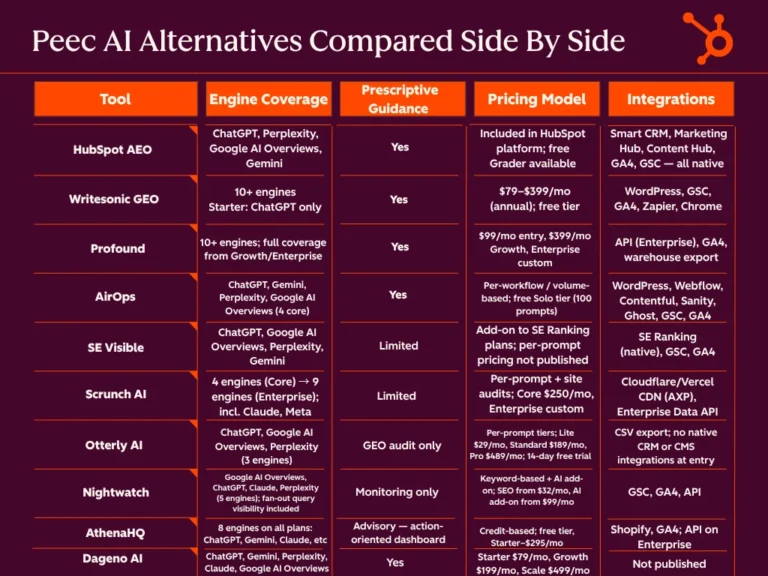
Best Fit: Peec AI for self-serve teams; enterprise platforms like Profound for broader coverage. Peec AI covers key engines like ChatGPT, Perplexity, and Google AI Mode, with expansion plans. For deeper dives into specific engine capabilities, dedicated guides are available.
Content Optimization and Gap Analysis
Partial Fit for Both; Full Optimization Elsewhere. Both Scrunch and Peec AI identify content gaps where competitors are cited and the brand is not. However, neither tool fully automates the loop from gap identification to content brief generation to the extent of specialized optimization platforms like Profound or ZipTie. Teams prioritizing workflow automation in content optimization may need to supplement these tools or consider dedicated platforms.
Competitive and Source Gap Analysis
Best Fit: Peec AI for structured competitive benchmarking; Scrunch for narrative comparison. Peec AI’s share-of-voice analysis provides clear competitive positioning data. Scrunch’s competitor language comparison aids PR teams in understanding shifts in competitive AI framing.
Decision Framework: Monitoring vs. Optimization vs. Activation
Both Scrunch and Peec AI primarily operate in the monitoring category, offering some optimization signals. Teams requiring the full loop—from visibility data to published content to attributed outcomes—will likely need a stack that integrates these tools with optimization and activation layers.
Risks and Caveats: Navigating the AEO Minefield
The AXP Question: Scrunch’s Agent Experience Platform
Scrunch’s Agent Experience Platform (AXP) is a unique, yet debated, feature. AXP reformats existing site content into an AI-readable layer served to AI crawlers at the network edge, without altering the human-facing experience. The intended benefit is to improve AI systems’ ability to accurately read and cite content.
However, AXP faces scrutiny due to:
- Lack of Independent Evidence: As of recent assessments, there is limited peer-reviewed or third-party validated evidence demonstrating AXP’s significant impact on AI visibility scores. Comparative tracking data has shown Scrunch’s own brand visibility in AI search to be lower than some competitors.
- Technical Complexity: AXP introduces infrastructure overhead and a potential point of failure, requiring careful evaluation by technically conservative IT or legal teams.
While AXP represents an interesting hypothesis, teams prioritizing proven optimization approaches may lean towards established methods like content structure, semantic relevance, schema markup, and earned authority, which carry less compliance ambiguity.
General Caveats for All AEO Tools
- Personalization Variance: AI engines personalize results, making absolute scores directional estimates rather than precise measurements.
- Prompt Over-fitting: Designing prompts solely around branded queries can inflate scores without reflecting real customer discovery. A balanced prompt library is essential.
- Global Index Reliance: AI engines operate differently across regions. US English prompt performance may not translate globally.
- Cross-Tool Comparisons: Methodological differences make comparing scores across tools unreliable. Tracking trends within a single, consistent tool is paramount.
AEO Checklist for Buyers
A comprehensive checklist can help buyers navigate vendor demos and uncover critical workflow and methodology questions:
- Map Buyer Journey to Prompt Types: Identify questions asked at awareness, consideration, and decision stages.
- Apply Branded vs. Non-Branded Filters: Ensure a substantial portion of non-branded prompts for category authority.
- Segment Prompts by Persona and Journey Stage: Enable rollup reporting and pipeline connection.
- Choose Prompt Tagging Conventions Early: Agree on taxonomy before onboarding for seamless BI tool integration.
- Inquire About Data Collection Methodology: Understand API vs. front-end monitoring and personalization handling.
- Validate with Spot-Checks: Compare manual prompt results with tool reports for directional alignment.
- Map Export Requirements Before Purchase: Confirm which tiers unlock necessary integrations (Looker Studio, API, MCP).
- Set and Adhere to a Reporting Cadence: Weekly for operational briefs, monthly for trends, quarterly for audits.
- Identify One Content Improvement to Test Per Cycle: Link visibility data to actionable content changes and track impact.
- Connect Visibility to Source Authority: Identify cited third-party domains for PR and content activation signals.
From Insights to Outcomes with a Connected Stack
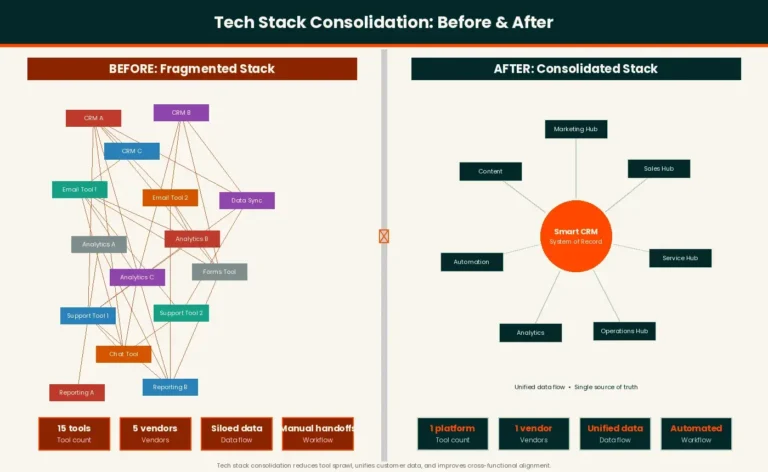
The true value of AEO data emerges when it integrates with content creation, campaign execution, and revenue tracking systems. A disconnected monitoring tool becomes a mere dashboard. A connected approach, such as leveraging HubSpot’s integrated suite, transforms AEO insights into a systematic competitive advantage.
The AEO-Outcomes Loop:
- AEO Insights (Scrunch or Peec AI): Identify winning, losing, or absent prompts; note competitor framing and sentiment shifts.
- Content Briefs (HubSpot Content Hub): Translate gap data into actionable briefs. HubSpot’s AI tools assist in generating drafts grounded in brand voice.
- Activation (HubSpot Marketing Hub): Distribute content across channels using automation. Leverage AEO citation data to identify target publications for earned media.
- Attribution (HubSpot Smart CRM): Track AI-referred traffic, pipeline, and revenue, linking deals to content touchpoints.
- Iteration (HubSpot’s AI Tools): Analyze CRM and engagement data to identify patterns for continuous AEO improvement.
This loop—Insights, Briefs, Activation, Attribution, Iteration—enables teams to move beyond tracking metrics to achieving tangible business outcomes from AI search.
Frequently Asked Questions About Scrunch vs. Peec AI
Which is better for multi-engine tracking and competitor benchmarking?
Peec AI generally offers a more robust, self-serve solution for multi-engine tracking and competitive benchmarking due to its pricing structure and focus on prompt-level analytics. Scrunch excels more in brand narrative analysis.
How should I choose and tag prompts for accurate AEO tracking?
Map your buyer journey, create both branded and non-branded prompts for each stage, and tag them meticulously with persona, journey stage, and competitive relevance before onboarding.
Can I export data and integrate with my existing reporting stack?
Both offer CSV exports. Looker Studio integration is native to Scrunch and available on Peec AI’s Advanced plan. API access is typically at higher tiers for both.
What risks should I avoid when optimizing for AI visibility?
Avoid prompt over-fitting, AXP or cloaking-style approaches without legal review, over-reliance on any single tool’s absolute score, and treating visibility as an end goal without connecting it to source authority and earned media.
How do I connect AI visibility to content and revenue outcomes?
Implement UTM tagging for AI-referred traffic, connect this data to your CRM, use citation data to drive PR and content efforts, and monitor the entire funnel from content investment to pipeline influence.
The evolving landscape of AI-driven search demands a strategic approach to AEO. By understanding the distinct strengths and weaknesses of platforms like Scrunch and Peec AI, and by integrating these insights into a broader marketing technology stack, businesses can effectively navigate this new frontier and secure a competitive advantage in the age of intelligent discovery.
About the Author