The rise of artificial intelligence in search has introduced a new frontier for brand visibility, often characterized by an unsettling paradox: brands appear frequently in AI-generated answers, yet this presence rarely translates into tangible traffic or conversions. The core of this disconnect lies in the nuanced difference between an "AEO mention" and an "AEO citation." Understanding this distinction is paramount for marketers and businesses aiming to accurately measure and strategically enhance their presence in the burgeoning world of AI-powered search. Failing to differentiate between these two forms of AI-generated visibility means a significant portion of a brand’s AI performance remains unaccounted for, potentially leading to misguided strategies and missed opportunities.
This comprehensive guide delves into the intricacies of AEO mentions versus citations, exploring their prevalence across major AI engines, their individual impact on brand growth, and the methodologies for accurate measurement. It provides actionable insights on bridging the gap between mere brand acknowledgment and demonstrable, trackable influence within AI-generated responses, offering a framework for robust AI referral traffic tracking in analytics platforms like Google Analytics 4 (GA4) and HubSpot.
Understanding the Pillars of AI Search Visibility: Mentions vs. Citations
Answer Engine Optimization (AEO) is the strategic discipline focused on ensuring content is discoverable and utilized within AI-generated search responses. This represents a significant evolution from traditional search engine optimization (SEO), reflecting a fundamental shift from presenting a list of links to synthesizing direct answers. The distinction between an AEO mention and an AEO citation is critical to this new paradigm:
An AEO Mention occurs when an AI engine references a brand, product, or piece of content within its generated answer without providing a direct link back to a specific source. While this grants the brand recognition and reinforces its association with a particular topic in the AI’s knowledge base, it offers no direct pathway for users to access further information or engage with the brand. The brand name appears, but the user cannot click through to learn more.
An AEO Citation, conversely, is a more impactful form of visibility. It occurs when the AI engine attributes its answer, in whole or in part, to a specific page from a brand’s domain. This attribution can manifest in various ways, such as a footnote number, a source card, a linked URL presented alongside or beneath the summary, or a "Learn more" prompt. Crucially, AEO citations provide a direct link for users to explore the source material, enabling measurable traffic and conversion attribution.
The practical implications of this distinction are profound. Mentions contribute to brand recall and entity recognition, signaling to AI models that a brand is relevant to a given topic. Citations, on the other hand, drive measurable visibility, referral traffic, and provide a clear path for attribution in analytics. Both are valuable, but they serve fundamentally different strategic purposes and require distinct approaches for cultivation and measurement.
The Varied Landscape: Where Mentions and Citations Appear Across AI Engines
The manifestation of AEO mentions and citations differs significantly across the leading AI search platforms, necessitating a nuanced understanding for effective tracking and strategy:
Google AI Overviews: These prominent AI-generated summaries appear at the top of Google search results. When a brand is cited, it typically receives a dedicated "card" displaying a linked source below or alongside the summary. A mention occurs when the brand’s name is present in the summary text itself but without an accompanying source card. Recent analyses, such as research from The Digital Bloom, indicate a notable shift in citation overlap with traditional organic rankings. Data suggests that between mid-2025 and early 2026, citation overlap in AI Overviews decreased significantly, falling from approximately 76% to between 17% and 54%. This trend underscores that visibility within Google’s AI Overviews is increasingly becoming a distinct layer of search presence, requiring dedicated AEO strategies beyond traditional SEO.
ChatGPT and ChatGPT Search: When utilizing its web browsing capabilities, ChatGPT often incorporates source references as numbered footnotes linked to specific claims within its answers. Brand mentions can appear anywhere in the narrative text. Citations are clearly identifiable as numbered references that users can expand for more detail. Currently, ChatGPT remains a dominant driver of AI referral traffic across many sectors, although its market share is subject to change as other platforms evolve.
Perplexity: This AI-powered search engine is inherently citation-centric. Perplexity endeavors to provide numbered sources alongside nearly every assertion made in its answers. For brands, this design principle creates a clear visual distinction between simply being mentioned in the answer text and being explicitly listed in the accompanying source panel.
Microsoft Copilot: Copilot integrates Bing search results, presenting citations as directly linked references within its generated answers. Its distinct source pool and ranking signals warrant separate monitoring from Google AI Overviews, providing a different lens on AI search performance.
For those conducting manual checks, it is imperative to meticulously note two distinct data points for each query: first, whether the brand name appears within the generated answer text (a mention), and second, whether a linked source from the brand’s domain is attached to the answer (a citation).
The Strategic Imperative: Why Mentions and Citations Drive Growth
The divergence between an AI mention and an AI citation represents more than just a technical difference; it signifies a crucial gap in trust and potential revenue.
AEO Mentions: Building Brand Authority: Mentions play a vital role in reinforcing entity recognition. When an AI engine consistently features a brand in relation to specific topics, it strengthens the association between the brand and those concepts within the AI’s model. Over time, this sustained association can elevate the probability of the brand being cited in future responses. Research indicates a correlation between traditional search rankings and AI citation probability; pages ranking first in organic search exhibit a significantly higher likelihood (33.07%) of being cited in AI Overviews compared to those ranking tenth (13.04%). While AI visibility and traditional SEO are not identical, they remain interconnected.
AEO Citations: Driving Measurable Outcomes: Citations are the cornerstone of measurable AI visibility. AI referral traffic originating from cited sources is directly trackable in analytics platforms like GA4 as a referral session. In contrast, a mere mention generates no such session data, rendering it invisible in standard attribution reports. This attribution gap means that relying solely on GA4 data can lead to an underestimation of a brand’s true AI search presence and an overestimation of unexplained brand awareness.
Furthermore, the conversion potential of AI-sourced traffic is compelling. Studies have indicated that traffic originating from AI-generated answers exhibits a significantly higher conversion rate than standard organic traffic. This elevated performance is attributed to the user’s journey; individuals clicking through from a cited AI source have typically progressed further in their research, having already absorbed a synthesized answer and actively sought more in-depth information. This indicates a distinct and often higher level of user intent.
The synergy of both mentions and citations provides a holistic view of a brand’s AI search footprint. "Share of model," a metric reflecting brand appearance frequency across a defined query set, encompasses both. "Citation rate," however, quantifies the proportion of that presence that is attributable and actionable, translating into tangible business impact.
Methodologies for Accurate Measurement: Quantifying AEO Mentions and Citations
Accurately measuring AEO visibility necessitates a manual or semi-automated query process, as no analytics platform inherently extracts AI answer content. A systematic approach involves the following steps:
Step 1: Establish a Fixed Query Set: Curate a list of 20 to 50 search queries that represent your brand’s core topical areas. This set should include branded queries (your company name paired with a relevant category), unbranded category queries, and comparative queries where your brand might be positioned alongside competitors. Maintaining this set consistently is crucial for tracking changes and trends over time.
Step 2: Execute Queries on a Recurring Schedule: Implement a regular cadence for running your entire query set across each AI engine you are monitoring. A weekly schedule is generally recommended for most teams. This consistent execution is the only way to build meaningful trend lines. One-off checks offer only a static snapshot, while recurring checks provide actionable signals.
Step 3: Log Mentions and Citations Separately: For each executed query, meticulously record two key pieces of information: (a) whether your brand appeared in the answer text (mention: yes/no), and (b) whether a linked source from your domain was included (citation: yes/no). Also, log the specific AI engine that generated the answer. A simple spreadsheet is sufficient for this data logging at this scale.
Step 4: Calculate Your Rates:
- Mention Rate: This is calculated as the percentage of queries in your set that included a brand mention.
- Citation Rate: This is calculated as the percentage of queries that included a linked source from your domain.
Tracking both rates weekly and observing their divergence is critical. A rising mention rate without a corresponding increase in citation rate often indicates that AI engines recognize your brand but lack sufficient content signals to attribute specific pages.
Step 5: Segment Data by Engine and Topic Cluster: Different AI engines cite sources at varying rates, and their behavior can differ significantly (e.g., Perplexity versus Google AI Overviews). Segmenting your data by engine and by topical cluster helps identify specific areas where opportunities for improvement or potential gaps exist.
Pro Tip: To gain a competitive edge, run your own queries alongside a small set of direct competitors within the same session. This simultaneous execution ensures you are capturing comparable engine behavior within the same temporal snapshot, facilitating more accurate competitive benchmarking.
Tracking AI Referrals and Attribution: A Deep Dive into GA4 and HubSpot
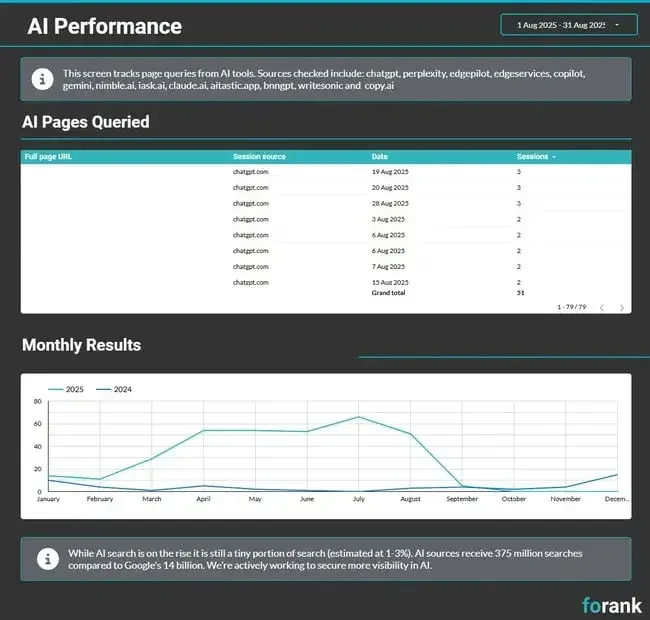
When a user clicks a citation link within an AI engine and lands on your website, that session should ideally be classified as a referral in GA4. However, a significant percentage of these sessions are often misclassified. Research from MeasureU has highlighted that approximately 22% of ChatGPT sessions are categorized as "(not set)" in default GA4 configurations, effectively disappearing into direct or unassigned traffic.
Accurate AI Referral Capture in GA4:
To ensure accurate tracking, it is essential to create a custom channel group that specifically includes major AI referral sources. Key domains to incorporate are chatgpt.com, chat.openai.com, perplexity.ai, bing.com (for Copilot sessions), claude.ai, and gemini.google.com. Grouping these under a custom channel, such as "AI Search" or "AI Referral," allows for the isolation of AI-sourced sessions within GA4’s Explorations and Conversions reports, eliminating the need for constant manual filtering by domain.
Furthermore, implementing a regular expression (regex) filter within your default channel grouping can capture sessions originating from these domains that may not be automatically categorized. A consolidated regex pattern encompassing all major AI referral domains offers the most robust solution for accurate classification. HubSpot’s GA4 analytics guide provides detailed instructions for correct configuration.
Accurate AI Referral Capture in HubSpot:
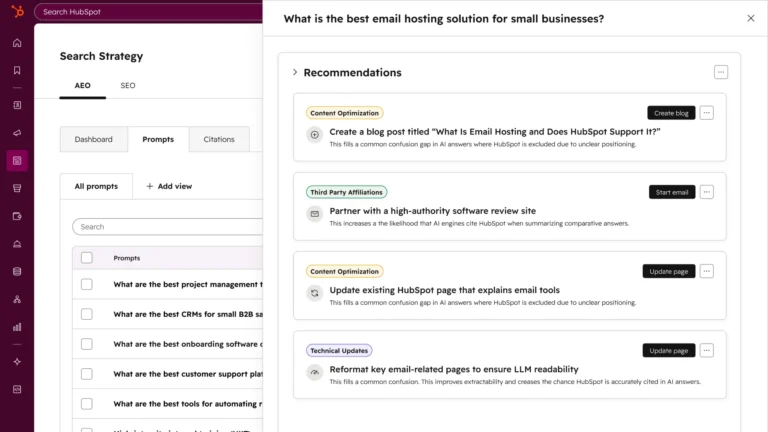
To directly connect AI referral visibility to pipeline and revenue, establishing specific contact properties is crucial. This includes an "AI Source" property (indicating the specific engine that drove the initial visit) and an "AI Referral Smart List" that dynamically updates based on UTM parameters or referral domain. Implementing a workflow to tag contacts entering via an AI referral source enables HubSpot’s marketing automation to trigger internal notifications or enroll contacts into targeted nurture sequences.
Once this pipeline is established, HubSpot’s Smart CRM can be leveraged to track AI-sourced contacts through the sales funnel, associate them with active deals, and report on the contribution of AI search to revenue within your attribution reports. This integration effectively closes the loop between AI visibility and demonstrable business impact. GA4 excels at tracking AI referral sessions, engagement, and conversion behavior, while HubSpot reporting workflows connect these visibility signals to broader attribution and pipeline management, providing a comprehensive view from AI citation to revenue generation.
Transforming Mentions into Measurable Citations: A Strategic Roadmap
Converting AEO mentions into impactful citations requires sustained effort across five key strategic areas, none of which are one-time fixes:
1. Clarify Your Entity Across the Digital Footprint: AI engines construct their understanding of your brand from a multitude of signals scattered across the web. Inconsistencies in how your brand name, product names, descriptions, and category associations are presented across your website, social media profiles, third-party listings, and press coverage can hinder the AI’s ability to build a clear entity model.
Begin by auditing the language used on your most authoritative pages, including your homepage, About page, and product pages. Ensure consistent terminology is employed to describe your brand, its operational category, and the problems it addresses. This uniformity aids AI engines in associating your entity with specific topics. Employing "semantic triples" – explicit statements like "[Brand] is a [category] platform that helps [audience] [achieve outcome]" – clarifies the relationships between your brand, its category, and the solutions it offers, enabling more reliable surfacing in topic-related AI answers.
2. Structure Content for Direct Answers: Most AI engines prioritize content that directly addresses the user’s query when selecting citations. If your content buries its core claims deep within introductory paragraphs, context-setting, or caveats, its likelihood of being surfaced as a citation diminishes.
Structure your content so that the most direct answer to the implied question appears at or near the top of each section, followed by supporting details. This mirrors the AI’s synthesis process, as it seeks clear, extractable statements for inclusion in summaries. Employing short paragraphs, clear subheadings, and direct declarative sentences enhances this process. Consider the precise questions your target audience might pose to AI engines and craft sections that explicitly answer each one before elaborating.
3. Implement Validated Schema Markup: Structured data provides explicit signals to both traditional search engines and AI systems about the nature of your content and the relationships between its components. Implementing schema markup for articles, FAQs, how-to guides, products, and organizations offers crucial relationship data that supplements the textual content of your pages.
For content teams, prioritizing schema types such as Article (for blog content), FAQPage (for FAQ sections), HowTo (for instructional content), and Organization (for your brand entity) is highly recommended. The key is accurate and validated implementation; broken schema or markup that misrepresents the visible page content can negatively impact trust signals.
4. Integrate E-E-A-T Signals: Google’s E-E-A-T framework (Experience, Expertise, Authoritativeness, Trustworthiness) is designed to evaluate content quality for traditional search but is equally influential for AI engines when selecting sources. AI models assess the same credibility signals. Recent Google E-E-A-T updates emphasize the significance of surface-level credibility markers.
Practical E-E-A-T signals include clear author bylines with linked credentials, original research or data produced by the page itself, named contributors with verifiable expertise, citations from authoritative external sources, and a publication/update date that indicates recency. A blog post last updated in 2022 without a named author faces a significant challenge in earning citations in 2026 compared to a regularly updated piece authored by an expert, featuring external citations, and incorporating original examples.
5. Refresh and Monitor Content Frequently: AI engines do not maintain a static view of content. Their training data and real-time retrieval pools are continuously updated. A page that earns citations one quarter may lose them the next if a competitor publishes more recent, authoritative, or directly responsive content.
Integrate a content refresh cadence into your editorial workflow. For any page that garners significant AI citations, schedule a review every three to six months. Verify the currency of statistics, examples, and recommendations. Update the publication date when substantive changes are made. Monitor the citation rate for that page’s core query cluster and treat any sudden decline as a signal to investigate.
Benchmarking Against Competitors: Gaining a Competitive Edge in AEO
Understanding your own mention and citation rates is crucial, but it’s equally important to benchmark this performance against the three to five brands vying for the same AI search real estate. A robust benchmarking process involves:
Define Your Competitive Set and Query Universe: Utilize the same 20 to 50 queries established for your own tracking. Execute each query and simultaneously log mention and citation data for yourself and each identified competitor.
Construct a Share-of-Model Table: For each query cluster (branded, unbranded, comparison), calculate each brand’s mention rate and citation rate. This provides a direct comparison of who is winning brand awareness (mentions) and who is winning attributable influence (citations).
Identify Asymmetries: A competitor exhibiting a high mention rate but a low citation rate is in a similar position you may be striving to overcome – significant brand recognition with limited cited authority. This presents an opportunity to outmaneuver them by focusing on citation-earning content. Conversely, a competitor with a high citation rate on a query cluster where you have zero citations highlights a clear gap to address.
Analyze Cited Content: When a competitor is being cited on a query of interest, examine their cited page. Analyze its structure, schema implementation, recency of updates, and how their entity framing differs from yours. This provides a direct benchmark for what AI engines are currently rewarding.
Revisit Benchmarks Quarterly: AI search behavior evolves rapidly, often more so than traditional organic search. A competitor gaining significant share in one quarter typically indicates a shift in their content strategy. Quarterly reviews are essential to track these dynamics.
Navigating Limitations and Leveraging Trends in AEO Measurement
It is essential to approach AEO measurement with a clear understanding of its directional nature and inherent limitations before building executive reporting around it:
Variability in AI Answers: AI engines do not serve identical answers to every user. Factors such as query context, user location, personalization algorithms, and the engine’s real-time retrieval variations mean that two individuals running the same query on the same day may encounter different cited sources. Your spot-check captures a single instance, not a universal truth.
Dynamic Nature of AI Answers: AI answers are far more fluid than organic search rankings. A citation earned this week may not be present next week. This underscores the importance of trends over snapshots. A single week’s data holds minimal significance; eight weeks of consistent weekly data begin to reveal actionable patterns.
Persistent Attribution Gaps: Even with meticulous GA4 channel grouping and HubSpot workflow configuration, some AI-sourced sessions will inevitably be misclassified. The 22% misclassification rate for ChatGPT sessions is an estimate; your actual rate will depend on your specific configuration. It is prudent to treat your AI referral data as a floor, not a ceiling.
Focus on Sustained Movement: Avoid over-indexing on minor week-over-week fluctuations. A single query set run can exhibit variance based on timing, engine state, and the specific model version active. Focus on sustained directional movement over four or more weeks before drawing definitive conclusions.
Prioritize Content Strategy Over Precise Revenue Claims: Utilize AEO data to inform and prioritize content development efforts, rather than making exact revenue claims. An insight such as "Our citation rate on this query cluster increased by 18 points over eight weeks following the restructuring of three key pages" is meaningful and defensible. Claiming "$400,000 in pipeline driven by AEO this quarter" requires a level of instrumentation and attribution rigor that may exceed current capabilities for most teams.
Frequently Asked Questions About AEO Mentions Versus Citations
How can I distinguish between a mention and a citation across different AI engines?
Observe two key indicators: Does your brand name appear within the generated answer text (mention)? And is there a linked URL from your domain present in the source references or footnotes (citation)? If your brand name is visible but no link to your domain is provided, it is classified as a mention.
Which should I prioritize first: mentions or citations?
Prioritize citations, but do not disregard mentions entirely, as they lay the groundwork for entity association necessary for citations. Utilize mention rate as a leading indicator and citation rate as your primary Key Performance Indicator (KPI). A scenario of high mentions coupled with low citations signals an opportune moment to focus on answer-first content structure, schema implementation, and E-E-A-T signals.
Do unlinked brand mentions contribute to AEO even if I’m not cited?
Indirectly, yes. Mentions reinforce your brand’s association with specific topics, thereby increasing the probability of future citations. While their direct impact is limited due to the absence of traffic and attribution, consistent mentions serve as an encouraging indicator that your efforts are moving in the right direction.
How frequently should I run my AEO tracking set and update my dashboards?
A weekly cadence is generally optimal for most teams. Executing your full query set requires approximately one hour. While GA4 and HubSpot dashboards can refresh automatically, the manual logging of query results necessitates human intervention, as there is currently no automated method for extracting content included in AI engine answers.
What is the most effective method for scaling content that earns citations without compromising quality?
Focus on query clusters rather than individual articles. Select five to ten topic areas and develop interlinked pages that address each from multiple perspectives: an explainer, a how-to guide, a comparison, and an FAQ. A collection of well-structured pages from the same domain on a unified topic cluster enhances the probability of citations across the board. Consistent schema implementation and a defined refresh cadence are vital for maintaining quality as you scale.
About the Author