Vector embeddings, the numerical backbone of modern AI-powered retrieval systems, are fundamentally reshaping how content is created and discovered online. As artificial intelligence continues its rapid integration into search and information access, marketers and content creators are increasingly focused on optimizing their digital presence for these advanced engines. This shift, highlighted by a HubSpot report indicating that 58% of marketers are already prioritizing optimization for answer engines, necessitates a deeper understanding of the underlying technologies, particularly vector embeddings, and their practical implications for content strategy.
At its core, a vector embedding is a sophisticated numerical representation of text. An embedding model transforms words, sentences, or entire passages into a list of numbers, or a vector. This mathematical representation allows retrieval systems to gauge the semantic similarity between different pieces of text, even if they do not share identical keywords. This capability is crucial for semantic retrieval, a powerful tool that enables AI systems to identify relevant information based on meaning rather than mere word matching. Modern retrieval systems are evolving beyond simple semantic search, often combining this approach with traditional keyword analysis and other relevance signals to deliver more accurate and contextually aware results.
Franklin Rios, CEO of Next Net, elucidated this concept on the "Found in AI" podcast, likening vectorization to embedding information into a data format that large language models (LLMs) can readily consume. "Vectorizing is embedding information into a data format," Rios explained. "The reason we use a data format is because it’s the natural language of LLMs. They consume mathematics, they consume data." This perspective underscores that the mechanics of embedding models, while complex, are designed to align with the inherent mathematical nature of LLMs, making data representation the lingua franca of AI comprehension.
While marketers may not need to build embedding models themselves, understanding their function is paramount for effective Generative Engine Optimization (GEO). This understanding shifts the focus from traditional SEO tactics to a more nuanced approach that considers how content is interpreted and retrieved by AI. The principles of passage-level retrieval, query fan-out, and AI visibility measurement are translating into actionable content decisions that can significantly impact a brand’s digital footprint.
What are Vector Embeddings in AEO and Why Do They Matter?
The fundamental role of vector embeddings in Answer Engine Optimization (AEO) is to bridge the gap between human language and machine understanding. By converting textual content into numerical vectors, these embeddings enable AI systems to perform semantic comparisons. This means that passages conveying similar meanings, even when phrased differently, can be identified and ranked as relevant.
David Kirkdorffer, a fractional marketer, offered a clear analogy on the "Found in AI" podcast: "LLMs do word math. Certain words add up to mean certain things. Change the words, and we change the meaning." He elaborated on this by comparing it to using a thesaurus. Just as a thesaurus provides synonyms, some of which perfectly fit a sentence and others that subtly alter its meaning, vector embeddings capture the nuances of word relationships. Moving along a chain of synonyms, Kirkdorffer noted, shifts meaning incrementally until entirely new concepts are reached. This intuitive understanding of language—the ability to express the same idea with different words while maintaining meaning, or to shift meaning by altering wording—is precisely what embedding models aim to replicate computationally.
For marketers, this has direct implications for brand messaging. Every revision to website copy, particularly in key areas like hero sections, can alter how an embedding model represents a brand’s meaning. Consider a potential customer querying an answer engine: "What’s the cheapest project management tool for a five-person agency?" If a company’s page states, "Our Starter plan is built for small teams under 10 people who need budget-conscious project tracking," a purely lexical search might struggle to find an exact match. However, a semantic retrieval system, powered by vector embeddings, can recognize the strong overlap in meaning between the query and the page description, even with different wording.
This doesn’t diminish the importance of keywords; rather, it integrates them into a broader strategy. Modern retrieval systems effectively combine lexical (keyword-based) and semantic matching. The AEO goal is to craft content that is clear enough to connect with user queries through both the precise words used and the underlying meaning conveyed. Subtle editing changes can either refine a brand’s perceived category or, if not carefully managed, lead to adjacent meanings that create confusion about a brand’s positioning and relevance.
How to Use Vector Embeddings in AEO to Power Retrieval
Vector embeddings are a primary mechanism for semantic relevance in retrieval systems, but they are not the sole component. Advanced systems often employ retrieval-augmented generation (RAG), which integrates information retrieval with generative AI models. A typical RAG workflow involves retrieving relevant documents or passages and then using that retrieved information to inform the AI’s generated response.
Rios highlighted that while 80% of retrieval processes are similar across different models, the remaining 20% can vary significantly. This suggests that a focus on foundational content principles—clarity, relevance, and completeness—is more enduring than attempting to optimize for specific, short-lived platform quirks. Content can simultaneously compete in traditional search and for AI retrieval. While search engine rankings still consider broader page and site signals, AI retrieval can place a more granular emphasis on the relevance and utility of specific passages for particular queries.
A critical aspect of this is passage-level relevance, which contrasts with traditional page-level relevance. In RAG systems, a long page can be segmented into multiple chunks, each of which can be evaluated independently against different questions. The optimal chunk size and the number of chunks can vary depending on the system. Rios described his company’s approach, stating, "The chunking of every page, by the topic, the semantic, the relevance, the validity, and the trust score, it’s all in the mathematical model."
This passage-centric view influences editing decisions:
- Self-contained passages: Each section should be able to convey its meaning clearly without relying heavily on preceding or succeeding text.
- Clear topic articulation: The main subject or answer should be readily apparent within the passage.
- Logical flow: Even when broken into chunks, the content should maintain a coherent narrative or informational structure.
- Direct answers: Passages should aim to directly address specific questions rather than requiring readers to infer answers.
A practical tip for ensuring passage clarity is to extract any 150-word segment from a page and read it in isolation. If it requires surrounding context to make sense, it needs revision to be more self-contained and understandable on its own.
How to Use Vector Embeddings in AEO to Structure Citable Passages
The ability to structure content into "citable passages"—those that are clear enough to stand alone and answer a question—is a cornerstone of effective AEO. As the search landscape evolves, adopting writing patterns that make passages self-contained, coupled with on-page structural elements, ensures explicit subject matter and relationships are conveyed to both human readers and AI systems.

AEO Copy Patterns That Models Can Cite
Several writing patterns are particularly effective for creating passages that AI models can readily cite:
-
The Entity-First Statement: This pattern involves crafting a subject-verb-object sentence that clearly defines a brand. A common structure is: "[Brand] is a [category] for [audience] that [specific differentiator]." For instance, "Cassie Clark is an AI search visibility consultant for scaling and enterprise brands." Maintaining consistency in this core description across various platforms—website, LinkedIn, podcast intros, social media—provides AI systems with fewer conflicting signals to reconcile.
-
The Definition Block: When a reader requires a clear understanding of a term, beginning a section with an explicit definition is highly effective. For example, a post about query fan-out could start with: "Query fan-out is a technique that breaks one question into multiple related subqueries." This directness ensures the answer is immediately accessible and the passage remains useful even when extracted from its original context.
-
Explicit Comparison and Tradeoff Language: At the decision-making stage, buyers often ask comparative questions. Content that clearly articulates tradeoffs can directly answer these queries. Including statements like "X is better for Y" or "Z is preferable when you need W" provides crucial differentiating information.
-
Bounded, Labeled Sequences: Using numbered steps with descriptive titles, such as "Step 3: Map the fan-out," communicates specific actions and outcomes more effectively than generic transitional phrases like "Next, we move on." This structure aids in both human comprehension and AI’s ability to parse and understand distinct stages or components.
-
Explicit Temporal Markers: For claims that can become outdated, such as pricing, feature sets, or statistics, adding a date provides essential context. For example: "As of September 2026, HubSpot AEO refreshes AI visibility data daily across ChatGPT, Gemini, and Perplexity." While a date doesn’t inherently guarantee freshness in retrieval algorithms, it clarifies the currency of the information.
-
Headings Phrased as a Question: When a question accurately encapsulates the content of a section, using it as a heading can be highly beneficial. This provides both users and AI with a clear label for the information that follows. However, the section must then provide a concise and direct answer to that question, rather than extensive preamble.
Schema and On-Page Elements That Help Retrieval
While embeddings represent content features numerically for semantic comparison, structured data (schema markup) provides explicit, machine-readable information about a page and its entities. Accurate schema implementation is crucial, not as a shortcut, but as a means of enhancing clarity for AI systems. Major answer engines’ specific weighting of structured data in retrieval is not publicly disclosed, but empirical testing suggests that well-structured data can correlate with more accurate entity representations.
How to Use Vector Embeddings in AEO to Cover Query Fan Out
Some AI search systems expand user queries into related searches before generating an answer, a phenomenon known as query fan-out. Google, for instance, documents this behavior in its AI Mode, where a question is broken down into subtopics, searched individually, and then the results are synthesized. For marketers, this means addressing not just the primary question but also the surrounding related queries that a user might have during their research journey.
Build a Fan-Out Content Map Without Code
Query fan-out, the technique of breaking a single question into multiple subqueries, can be mapped without needing to engage with embedding models directly. Rios’s analogy of a conversation that narrows in scope, moving from a broad family vacation question to a more specific regional HVAC purchase, illustrates this concept. This idea can be applied to content mapping:
- Identify a core user question: Start with a common query a target audience might ask.
- Brainstorm related sub-questions: Think about the logical follow-up questions that arise from the core query. These could explore specific aspects, compare options, or delve into related problems.
- Map dependencies: Understand how these sub-questions relate to each other and to the original query.
- Identify content gaps: Determine where existing content adequately addresses these sub-questions and where new content is needed.
This mapping exercise, often conducted in a spreadsheet, can inform content strategy, guiding decisions on whether to expand existing pages or create new, targeted content.
Write for Adjacent Questions That Answer Engines Expect
Once a fan-out map is established, content should be written to address the adjacent questions that AI systems anticipate. These might include:
- Comparative questions: "Which is better, X or Y?"
- Problem-solution questions: "How to fix [problem]?"
- Definition and explanation questions: "What is [concept]?"
- Use-case specific questions: "Best [product/service] for [specific need]?"
The emphasis should be on depth and quality rather than sheer volume. Rios cautions against chasing arbitrary content numbers, stating, "It’s not a matter of quantity. What the bad actors are trying to do is not have the quality, not [have] the trust score, and try to override it with massive amounts of noise." Prioritizing useful depth ensures that a single, well-crafted page can answer multiple related questions if their intent aligns. Separate pages are more appropriate when user intent diverges significantly.
How to Use Vector Embeddings in AEO to Measure AI Visibility
Directly observing every retrieval decision made by an answer engine is challenging. However, marketers can monitor the output: which prompts surface their brand, which pages are cited, competitor presence, and the accuracy of brand descriptions. These signals provide valuable insights for investigation, even if they don’t pinpoint the exact cause of a specific citation.
What to Track and How to Report Progress
Establishing a baseline before implementing changes is crucial. Consistent monitoring of the same prompts and metrics over defined periods allows for meaningful comparisons. Key measurements include:

- Brand visibility: The frequency with which a brand appears in AI responses.
- Citation count: The number of times a brand’s content is directly referenced.
- Competitor share of voice: The proportion of AI responses that feature competitors versus your brand.
- Prompt performance: How effectively specific prompts lead to brand visibility or citations.
- Accuracy of AI-generated descriptions: Ensuring that AI-provided summaries or descriptions of a brand are correct.
Accuracy is paramount. An incorrect price, outdated feature, or broken link in an AI answer can mislead users, even if visibility metrics appear healthy.
When to Iterate Content Structure
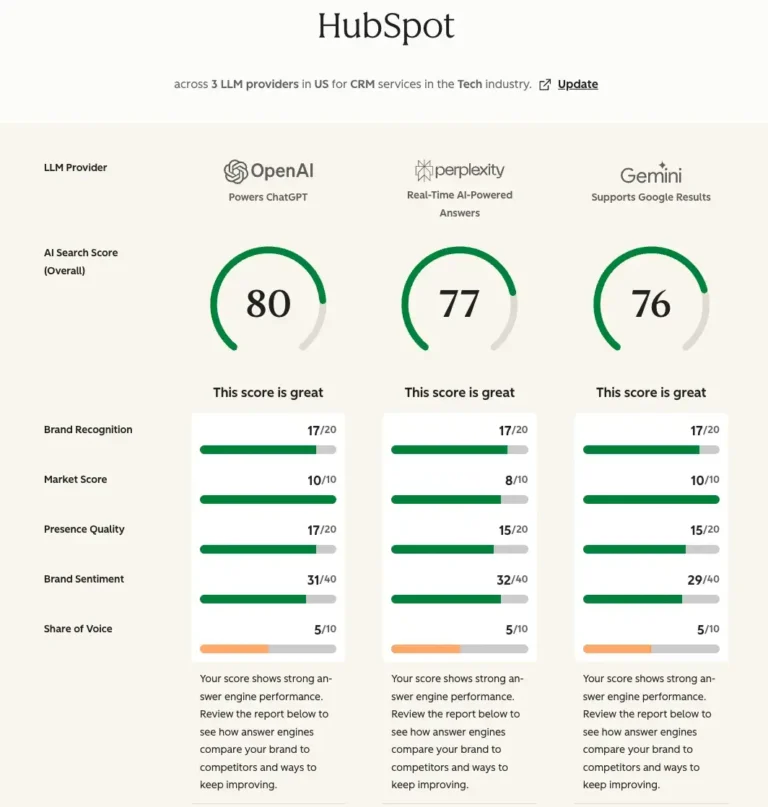
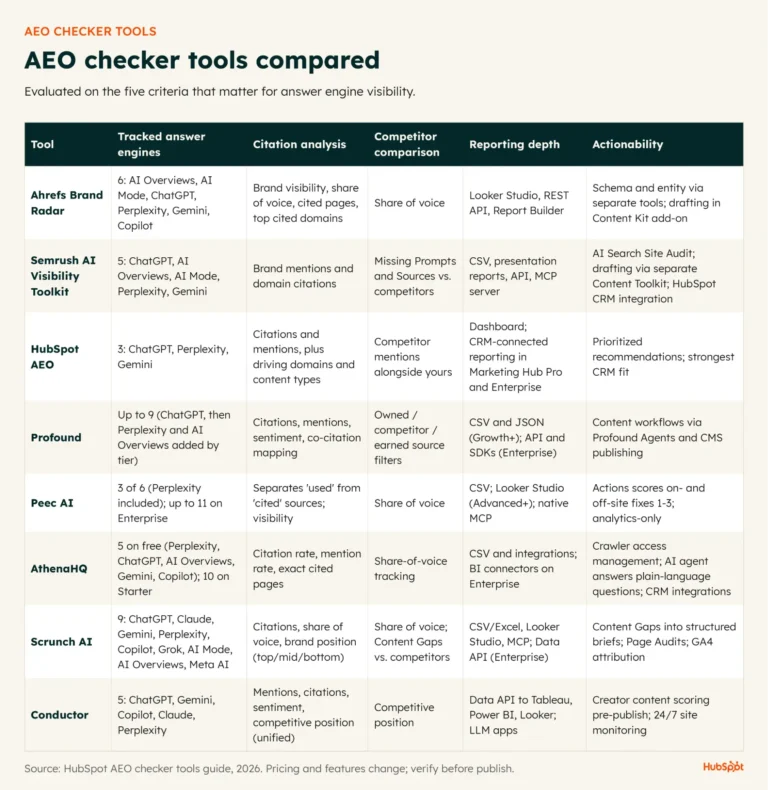
If visibility metrics remain flat, diagnosing the underlying patterns in content structure is more productive than simply publishing more content. A consistent, long-term tracking period, rather than a rigid four- to eight-week waiting period across all answer engines, is recommended. Tools like HubSpot AEO offer daily refreshes across platforms like ChatGPT, Perplexity, and Gemini, providing directional insights in the initial weeks and more reliable conclusions over time.
What Marketers Should Know About Embedding Models for AEO
Understanding the function of embedding models is distinct from building with them. For most marketing teams, the immediate priority is to apply content-focused strategies that leverage the principles of semantic understanding.
Do You Need a Vector Database to Start?
A vector database is primarily an infrastructure component for building custom semantic search or retrieval systems, such as internal knowledge bases or support assistants. It is not a prerequisite for making content discoverable by external answer engines. The initial focus for AEO content strategy should be on creating clear, relevant, and well-structured content that answers user questions effectively.
If a technical team wishes to explore content with embeddings, they can embed a representative set of pages to analyze semantic similarity. This can reveal insights into how concepts overlap and identify potential ambiguities in content. However, this analysis does not replicate the proprietary indexes and retrieval pipelines used by commercial answer engines. Qualitative assessments, such as using LLMs to compare competing content or employing visibility tracking tools, can provide valuable insights without the need for custom embedding infrastructure.
How to Avoid Over-Engineering Early
It’s easy for projects to gravitate towards infrastructure before confirming it’s the bottleneck. A strategic approach to AEO should prioritize foundational work:
- Content clarity and self-containment: Ensure each passage answers a question directly and makes sense in isolation.
- Consistent brand representation: Maintain a unified description of your brand across all touchpoints.
- Comprehensive topic coverage: Address related questions that emerge from query fan-out.
- Visibility measurement: Track how your brand and content appear in AI outputs.
Focusing on these elements before investing in custom embedding infrastructure ensures that efforts are directed towards the most impactful areas of AEO.
Frequently Asked Questions About Vector Embeddings and AEO
Do I need a vector database for AEO?
No. A vector database is infrastructure for building your own retrieval systems, not a requirement for external answer engine discoverability. Focus on clear, useful content and measurable visibility first.
How do I write entity-first statements for my brand?
Use a subject-verb-object sentence: "[Brand] is a [category] for [audience] that [differentiator]." Maintain consistency in this core description across your online presence.
What is the difference between embeddings and keywords?
Keywords rely on exact word matching, while embeddings analyze the numerical representation of meaning, allowing for semantic relevance even with different wording. Modern systems combine both.
How soon can I measure improvements in AI visibility?
There’s no universal waiting period. Establish a baseline, maintain consistent tracking methods, and analyze trends over a sufficient period to account for daily fluctuations. Tools like HubSpot AEO offer immediate tracking and daily refreshes, providing directional insights within weeks.
What Vector Embeddings Mean for Your AEO Strategy
Vector embeddings are a key mechanism behind semantic retrieval, but they are just one piece of the AEO puzzle. For marketers, the practical takeaway is to create clear, self-contained passages, ensure consistent brand messaging, comprehensively address related user queries, and diligently measure AI visibility and citation.
Tools like HubSpot AEO provide robust measurement capabilities across major AI platforms, analyzing citations, competitor presence, and prompt performance to offer actionable recommendations. As recent analyses of AI search behavior consistently point to freshness, structure, and authority as critical signals, understanding how structure and consistent meaning impact AI interpretation is vital. Brands experiencing inaccurate AI-generated descriptions should prioritize addressing this accuracy alongside visibility metrics. The ongoing evolution of AI in information retrieval demands a strategic and informed approach to content creation and optimization.
About the Author