The digital information ecosystem is undergoing a profound transformation, driven by the rapid ascent of artificial intelligence in search. As AI Overviews, ChatGPT, and Perplexity become increasingly sophisticated, their ability to directly answer user queries is reshaping how content is discovered and consumed. This seismic shift necessitates a fundamental reevaluation of marketing strategies, moving beyond traditional SEO focused on "blue links" to a new paradigm of Answer Engine Optimization (AEO). Marketers are no longer just aiming to rank; they are striving to have their content directly cited by AI-powered search interfaces.
This evolution is not a distant projection but a present reality. According to HubSpot’s 2026 State of AEO Report, a significant 58% of marketers are actively optimizing their content for these emerging answer engines. This indicates a swift transition from experimental approaches to mainstream strategic priorities. The challenge, however, lies not just in recognizing the importance of AEO but in understanding the practical methodologies required to achieve it. Fortunately, content that garners citations from AI search engines shares a common set of structural characteristics, primarily centered around clarity, organization, and machine-readability.
This analysis will delve into the content formats and structural elements that demonstrate superior performance within AI search environments. We will explore the critical role of question-led headings, direct-answer summaries, structured data implementation, and the overarching importance of a meticulously planned site architecture designed for maximum impact and discoverability by AI.
Why Content Structure is Paramount for AI Citation Rates
The fundamental shift in search is from a curated list of links to a synthesized, direct answer. Instead of presenting users with multiple options to explore, leading AI search tools like Google’s AI Overviews, ChatGPT, and Perplexity are increasingly designed to provide immediate, comprehensive responses. This means that the visibility of content is no longer solely determined by its ranking within the traditional top ten search results. Instead, it hinges on the AI’s ability to accurately extract a coherent, self-contained passage from a webpage and attribute it to the original source.
The structural integrity of a webpage is the primary mechanism that enables this extraction process. When AI models parse web content, they look for clear, logical organization that allows them to isolate specific pieces of information. Without this underlying structure, even the most authoritative and factually accurate content can be overlooked by AI systems, failing to achieve the coveted citation.
Key Structural Themes Correlating with AI Citations
The content that consistently earns citations from AI-driven search engines exhibits recurring structural patterns. These themes should form the bedrock of any AEO strategy:
- Clear Hierarchical Organization: Content that is broken down into logical sections with distinct headings and subheadings makes it easier for AI to understand the relationship between different pieces of information.
- Direct and Concise Answers: Providing immediate answers to specific questions, often at the beginning of a section or in dedicated summary formats, directly addresses the AI’s need for extractable information.
- Machine-Readable Data (Schema Markup): Implementing structured data, such as schema.org markup, provides AI engines with explicit information about the content, its context, and its origin.
- Well-Defined Entities: Consistent and clear identification of people, organizations, products, and concepts across a website helps AI build confidence in the source and attribute information accurately.
- Authoritative Signals and Trust Markers: Demonstrating credibility through author profiles, external corroboration, and verifiable information builds the trust necessary for AI to cite a source.
- Strategic Site Architecture: A well-organized website with logical internal linking ensures that AI can effectively navigate and understand the relationships between different pieces of content.
- Passage-Level Optimization: Writing individual paragraphs and sections that can stand alone and answer a specific query independently is crucial for extractability.
These themes are not merely theoretical constructs; they are practical approaches that directly influence how AI models interact with and present web content.
Schema and Entities: The Machine-Readable Layer for AEO
Beyond human-readable prose, a critical component of AEO is the implementation of schema markup and consistent entity modeling. This "machine-readable layer" provides AI search engines with explicit context about a webpage’s content and the entity behind it. This is particularly vital for bridging gaps in weak schema implementation or internal linking, which can hinder content citation even when the prose is excellent.
Schema markup acts as a set of labels, informing search engines about the nature of the content on a page. This includes identifying articles, products, events, and more. Entity modeling, on the other hand, focuses on defining and connecting the key entities (people, brands, places, concepts) mentioned within the content. By ensuring consistency in how these entities are represented across a website, marketers help AI systems build a robust understanding of the source, thereby increasing the likelihood of accurate attribution.
The schema types that are most impactful for AEO include:
- Article Schema: Helps AI understand that the content is an article, providing metadata such as author, publication date, and headline.
- Organization Schema: Identifies the publishing entity, including its name, logo, and contact information, reinforcing brand identity.
- Person Schema: Details information about authors, establishing expertise and credibility.
- FAQ Schema: Explicitly marks question-and-answer pairs, making them easily extractable for AI overviews.
- HowTo Schema: Structures step-by-step instructions, ideal for content that explains processes.
Measuring the Impact of AEO Efforts
The effectiveness of any optimization strategy hinges on measurable results. To gauge progress in AEO, tracking three key signals is essential:
- Citation Volume: The number of times content from your domain is directly cited or referenced by AI overviews and AI-powered search features.
- Citation Prominence: The position of your cited content within AI-generated summaries or answers. Higher prominence indicates greater impact.
- Brand Mentions in AI Outputs: Tracking how often your brand is mentioned or attributed in AI-generated responses, even when specific content isn’t directly cited.
These metrics provide a data-driven framework for understanding the success of AEO initiatives and for iterating on strategies to improve performance.
Deconstructing How Answer Engines Parse and Cite Content
Understanding the mechanics of how AI answer engines process and cite web content is fundamental to successful AEO. This process can be broadly understood as a pipeline: parse, score, and cite.
Before a citation appears in an AI Overview or a similar AI-generated response, the engine performs several key actions:
- Crawling and Indexing: Like traditional search engines, AI systems first need to discover and index web pages.
- Content Parsing: The AI then breaks down the content of each page into smaller, digestible units. This involves identifying headings, paragraphs, lists, and other structural elements.
- Information Extraction: The engine attempts to extract relevant information from these units that directly addresses the user’s query.
- Scoring and Ranking of Passages: Each extracted piece of information is scored based on its relevance, accuracy, and the perceived authority of the source.
- Synthesis and Citation: Finally, the AI synthesizes the highest-scoring information into a coherent answer and attributes it to the source that provided it.
This "parse-then-cite" pipeline highlights the critical need for content to be not only informative but also easily parsable and attributable.
Defining Answer Engine Optimization (AEO)
Answer Engine Optimization (AEO) is the strategic practice of structuring and formatting content to facilitate its extraction, comprehension, and citation by AI-powered answer engines. It’s about making your content not just findable but also directly usable and citable by AI.
How an Answer Engine Parses a Page
The parsing process involves AI models dissecting a webpage into its constituent parts. They identify semantic units, such as individual paragraphs, bullet points, or table rows, and evaluate their relevance to a given query. The goal is to isolate specific answers or pieces of information that can be directly incorporated into an AI-generated response.
What Makes a Passage Citable?
For a passage to be considered citable by an answer engine, it typically needs to possess several key characteristics:
- Self-Contained: The passage should make sense on its own, without requiring extensive context from surrounding text.
- Direct Answer: It should directly address a specific question or user intent.
- Clear and Concise: The language should be unambiguous and easy to understand.
- Attributable: The source of the information must be clearly identifiable.
- Accurate and High-Quality: The information itself must be reliable and meet a certain standard of quality.
Core Structural Themes for Maximizing AI Citation Potential
To optimize content for AI citation, several structural themes have proven highly effective. These themes are not mutually exclusive but rather work in conjunction to enhance a page’s "citable" qualities.
Theme 1: Question-Led Headings and Direct-Answer Summaries
Question-Led Headings are a cornerstone of AEO. They directly mirror the queries users might type into a search engine. By structuring content around explicit questions, you provide AI models with clear prompts that they can then match to relevant answers within your content. This approach increases the likelihood that your content will be considered a direct answer to a user’s search. Sequential heading structures have been shown to increase citation odds by as much as 2.8 times, according to industry reports.
Direct-Answer Summaries, often presented as a "TL;DR" (Too Long; Didn’t Read) section, are crucial for providing immediate value. These summaries should concisely state the main answer or key takeaway in one or two sentences before delving into further detail. This format is highly effective because it offers AI a readily extractable and digestible piece of information that directly addresses the query.
Formatting Q&A Blocks for Maximum Citation Potential:
Q&A blocks, which pair an explicit question with a concise answer, are among the most citable structures. To maximize their potential:
- Use clear, question-based H2 or H3 headings: For example, "What is Answer Engine Optimization?"
- Follow immediately with a direct, concise answer: This answer should be a standalone sentence or two, often prefaced with "Answer:" or placed in a distinct summary box.
- Provide supporting details in subsequent paragraphs: Elaborate on the answer, but ensure the initial summary is complete.
This structure directly maps a query to a liftable answer, making it an ideal format for AI overviews.
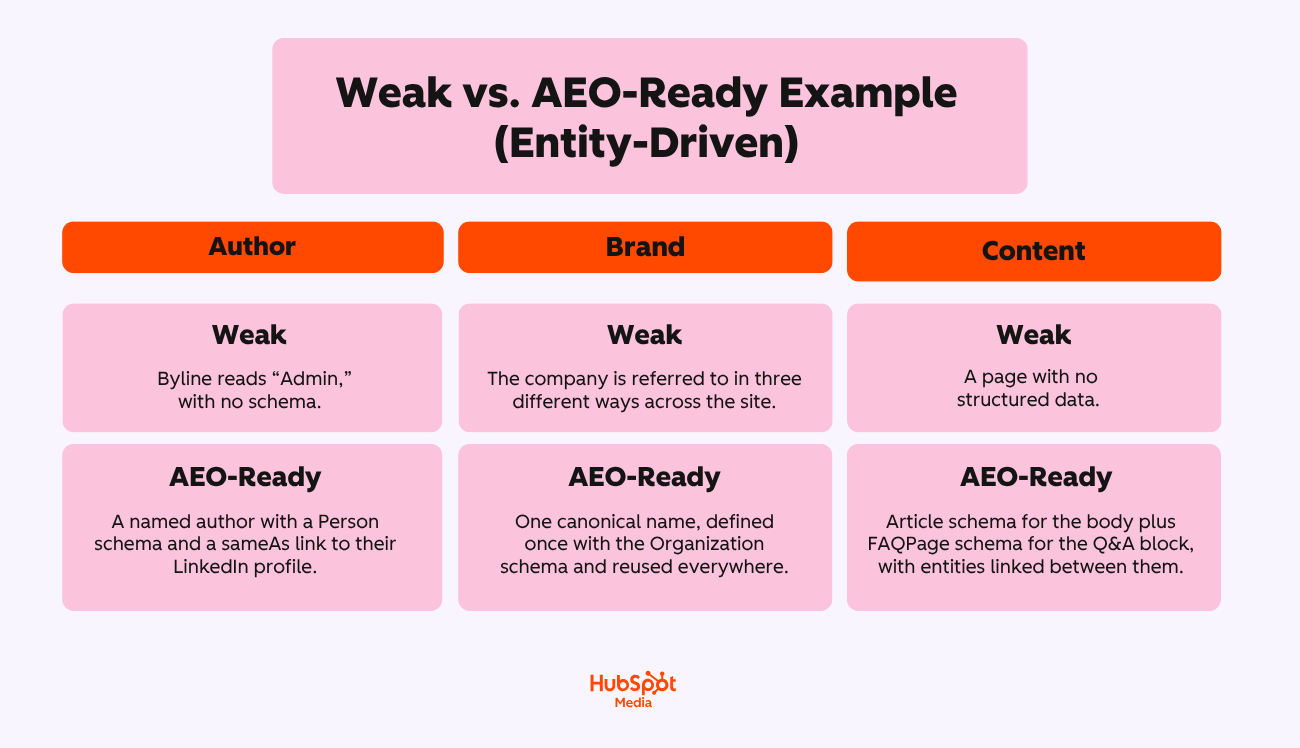
Theme 2: Semantic Schema and Entity Modeling
As previously discussed, schema markup and entity modeling provide the machine-readable layer that AI systems rely on. This structured data explicitly defines the nature of the content and the entities involved, thereby enhancing AI’s confidence in attributing information.
Key Schema Types for Content Description:
- Article Schema: Essential for blog posts and news articles, providing author, date, and headline.
- Organization Schema: Crucial for establishing brand identity and legitimacy.
- Person Schema: Vital for showcasing author expertise and building trust.
- FAQ Schema: Directly maps questions to answers, making them highly accessible to AI.
- HowTo Schema: Ideal for instructional content, structuring steps logically.
Modeling Entities for AI Recognition:

Entity modeling involves consistently defining and connecting the key people, brands, and products mentioned on your site. This creates a coherent web of information that AI can easily understand and trust. A practical sequence for entity modeling includes:
- Identify Key Entities: Determine the primary people, brands, products, and concepts relevant to your content.
- Establish Canonical Names and Descriptions: Use consistent naming conventions and provide clear, concise descriptions for each entity.
- Implement Schema Markup: Use schema.org to explicitly define these entities on your pages.
- Link Related Entities: Use internal links to connect mentions of entities, creating a network of related information.
- Ensure Consistency Across the Site: Maintain uniformity in how entities are represented throughout your website.
Theme 3: Authoritative Signals and Trust Markers
AI search engines, like human readers, prioritize trustworthy sources. Earning citations requires demonstrating authority and reliability. This is achieved through various signals:
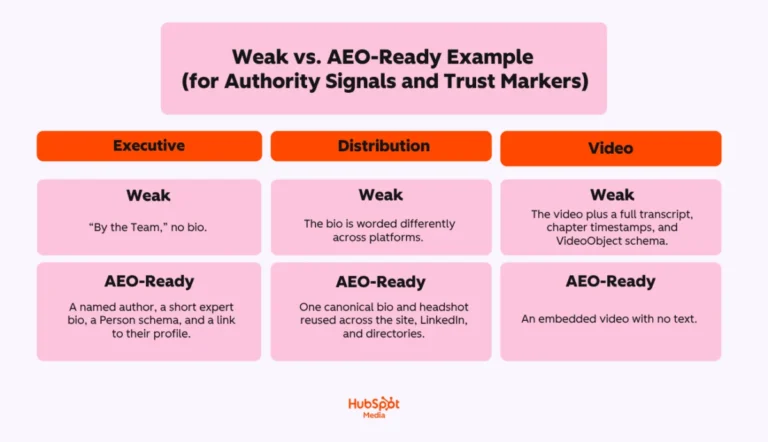
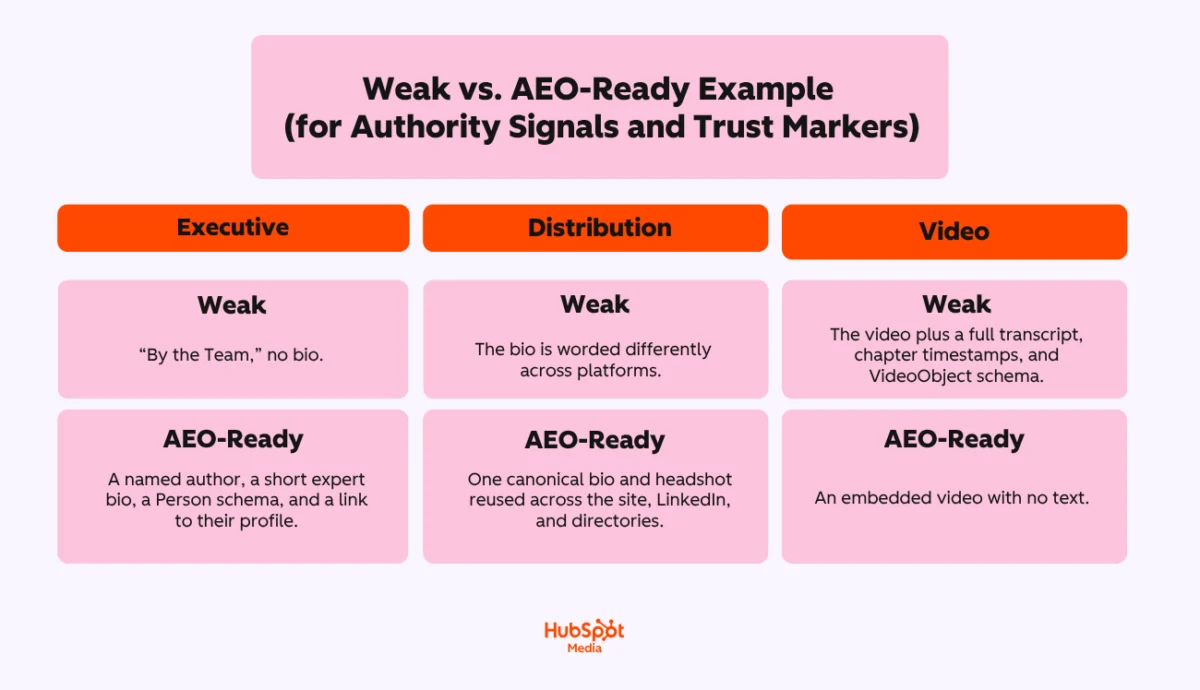
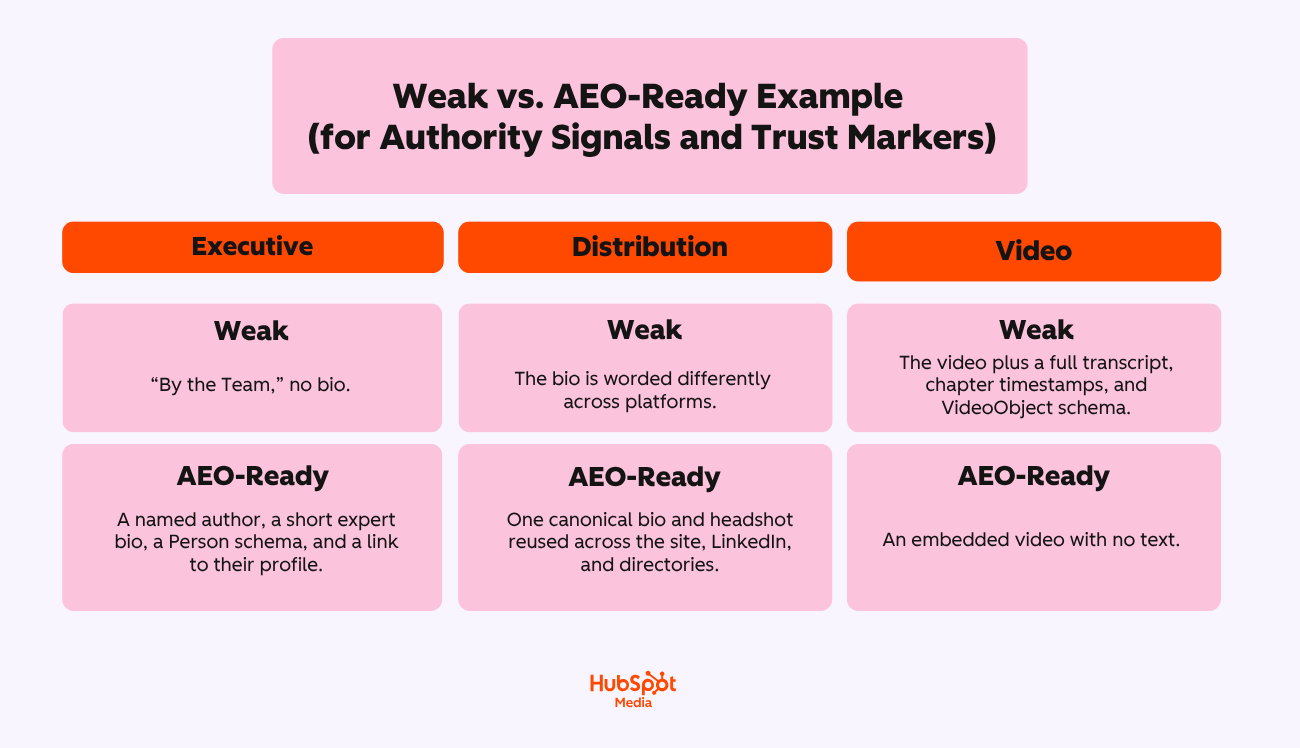
Authoritative Brand, Executive, and Product Profiles: Stable, well-described profiles for your brand, key executives, and products are essential. These profiles should be explicit about who and what they represent, providing verifiable information that AI can reference.
Distribution Across Trusted Ecosystems: The presence of your content and entities across reputable external platforms serves as a powerful trust signal. AI engines view corroboration from diverse, credible sources as evidence of reliability. This includes mentions in industry publications, reviews on trusted platforms, and participation in industry events.
Video Transcripts, Timestamps, and VideoObject Schema: Video content, often difficult for AI to parse, can be made more accessible through text-readable formats. Providing video transcripts, incorporating timestamps, and utilizing VideoObject schema markup allows AI to understand and potentially cite video content.
Weak vs. AEO-Ready Examples for Authority:
A weak approach might involve vague mentions of an author or brand without clear context or verifiable information. An AEO-ready approach, conversely, would include detailed author biographies linked to a dedicated author page, clear organizational information with contact details and legal disclaimers, and product pages with comprehensive specifications and customer reviews. This layered approach builds a robust profile of trust.
Theme 4: Strategic Internal Linking Architecture
Internal linking is the site-level manifestation of content structure. A well-planned internal linking strategy is critical for AI to effectively crawl, group, and trust related content. Weak or haphazard linking can isolate valuable content and make it difficult for AI to associate it with broader topics.
Hub-and-Spoke Structure, Glossary Pages, and Sibling Links: A "hub-and-spoke" model organizes content around a central, authoritative "hub" page that links to more specialized "spoke" pages. Glossary pages define key terms, linking to relevant content. Sibling links connect pages that are thematically related at the same hierarchical level.
Clear Anchor Text and Early Link Placement: The anchor text of an internal link should accurately describe the content of the linked page. Placing links early in the content or within prominent sections signals their importance to AI.
Internal Link to Topic Clusters: Topic clusters, where a main topic page links to numerous sub-topic pages, and vice versa, create a comprehensive coverage of a subject. This structure signals depth and authority to AI.
Theme 5: Passage-Level Optimization for Extraction
The ultimate goal of AEO is to make individual passages of content so clear and self-contained that they can be easily extracted and cited. This involves a passage-first mindset, where each segment of content is written with the intent of standing alone.
Stand-Alone Paragraphs Answering One Question: Each paragraph should ideally focus on answering a single question and be understandable without reference to preceding text. Open with the answer, then provide supporting details. Avoid pronouns that refer to earlier text, as they can break the passage when lifted out of context.
Lists, Tables, and Definition Boxes: Structured formats like lists, tables, and definition boxes are highly snippet-friendly. They present information in a clear, organized manner that AI can easily parse and extract.
Concise, Extractable Sentences: Sentence length and clarity directly impact how cleanly an engine can quote your content. Shorter, more direct sentences are generally easier for AI to process and attribute.
Aligning Structural Themes with Google’s Quality Guidelines
It’s imperative to understand that structural optimization for AI citation is effective only when underpinned by genuinely helpful and high-quality content. Google’s core principle is to prioritize user experience and provide valuable information. Attempting to "game" the system with structure alone, while neglecting content quality, is ultimately counterproductive.
The structural themes that drive AI citations – clear headings, direct answers, schema, and logical linking – amplify the inherent quality of the content. They do not replace it.
Prerequisites: Accuracy, Quality, Relevance, and User Context
Before embarking on any AEO efforts, ensure your content meets Google’s fundamental quality standards:
- Accuracy: The information presented must be factually correct and verifiable.
- Quality: Content should be comprehensive, well-researched, and offer unique insights.
- Relevance: It must directly address the user’s search intent and provide a complete answer.
- User Context: The content should be tailored to the needs and understanding of the target audience.
Transparency and Disclosure
Google permits AI-assisted content as long as it is helpful and not primarily designed to manipulate rankings. Transparency about the creation process, including disclosure of AI assistance, is crucial for maintaining reader trust. For AI-assisted drafts, an editor’s note confirming review and fact-checking by a human expert adds accountability.
Guardrails for Helpful Content: Do’s and Don’ts
Establishing clear guidelines ensures consistency and maintains quality across content creation:
Do:
- Prioritize providing original value and depth.
- Demonstrate first-hand expertise and knowledge.
- Ensure content is factually accurate and well-supported.
- Maintain consistent entity signals and attribution.
- Focus on serving the reader’s needs.
Do Not:
- Generate content primarily to manipulate search rankings.
- Create content that lacks substance or is merely a summary of other sources.
- Use AI to impersonate individuals or create misleading content.
- Obscure the source or authorship of content.
By adhering to these principles, structural optimization reinforces, rather than undermines, Google’s quality standards, forming the foundation for sustained success in AI Overviews.
Measuring Citation Performance and Structural Impact
A significant challenge in AEO is accurately measuring its impact. While implementing structural changes is feasible, demonstrating a direct correlation between these changes and an increase in AI citations can be complex. Effective measurement closes this gap, providing data-backed insights into the effectiveness of AEO strategies.
The Three Key Performance Indicators (KPIs) for AEO
To comprehensively assess AEO performance, tracking three interconnected KPIs is essential:
- Citation Volume: The raw number of times your content is cited by AI answer engines. This indicates the overall reach and discoverability of your content within AI search.
- Citation Prominence: The position and visibility of your citations within AI-generated answers. Higher prominence suggests your content is deemed more relevant and authoritative for the query.
- Structural Impact on Citations: This KPI focuses on correlating specific structural changes (e.g., implementing FAQ schema, refining headings) with changes in citation volume and prominence for targeted content. This helps identify which structural elements are most effective.
The Measurement Loop: Diagnose, Test, Measure, Iterate
AEO should be approached as an ongoing, iterative process. A robust measurement loop involves:
- Diagnosis: Identify content areas or specific pages that are underperforming in AI citations.
- Hypothesis and Testing: Formulate a hypothesis about what structural changes might improve citation rates for that content. Implement the changes.
- Measurement: Track the relevant KPIs (citation volume, prominence) over a defined period to assess the impact of the changes.
- Iteration: Based on the measurement results, refine the strategy, implement further adjustments, or apply successful tactics to other content.
This systematic approach transforms AEO from a guessing game into a data-driven discipline, ensuring continuous improvement.
Operationalizing High-Citation Content Themes
To achieve consistent success with AEO, structural themes must be systematized into a repeatable workflow. Operationalizing AEO means transforming one-off wins into a standardized process that ensures every piece of content is optimized for citation, regardless of the author.
Role-Based Checklists
Assigning clear ownership for each stage of the AEO process is crucial. A role-based checklist ensures that no critical step is overlooked:
- Content Strategists: Responsible for identifying target queries and audience intent, guiding the overall AEO strategy.
- Content Writers: Implement structural best practices during the writing and editing process, focusing on clear headings, direct answers, and passage-level optimization.
- SEO Specialists: Oversee schema markup implementation, internal linking architecture, and performance monitoring.
- Editors: Review content for adherence to AEO guidelines and overall quality.
Templates in Content Hubs
Reusable templates can embed structural best practices directly into the content creation workflow. These templates act as defaults, removing guesswork for writers and ensuring consistency across the board. Building these templates within a Content Management System (CMS) or a dedicated content platform can streamline the process.
For instance, a template might include pre-defined sections for a Q&A block, a TL;DR summary, and placeholders for schema markup. Utilizing AI-powered drafting tools can further accelerate this process by generating initial drafts of these structural elements, which are then reviewed and refined by human editors. This integration of AI and human oversight is key to optimizing passages for answer engines efficiently and effectively.
Frequently Asked Questions About Structuring Content for Answer Engine Citations
Do I need a new page for AI overviews or can I optimize existing content?
In most cases, existing content can and should be optimized for AI overviews. Creating entirely new pages is rarely necessary. This is because AI models are designed to extract information from existing web pages. The focus should be on improving the structure and clarity of your current content to make it more readily citable. This approach conserves resources and leverages your existing content library.
Which schema types help most for B2B content citations?
For B2B content, prioritizing schema that establishes credibility and structure is paramount. Key schema types include:
- Organization Schema: To clearly define your company and its role.
- Person Schema: To highlight the expertise of your authors and subject matter experts.
- Article Schema: To accurately describe the nature of your B2B content (e.g., white papers, case studies, blog posts).
- FAQ Schema: Particularly effective for addressing common B2B queries and pain points.
These schema types collectively enhance AEO by making your authority and the structure of your content explicit to AI.
How often should I refresh content to maintain citation rates?
Content refresh schedules should be tied to the dynamism of the topic rather than a fixed calendar. Topics that change rapidly require more frequent updates to maintain relevance and accuracy. When refreshing, update factual information, re-verify direct answers, and update structured data. Modifying the publication date after a substantial refresh signals freshness to search engines. Consistent refreshing is crucial for sustained AI overview performance, as stale answers are likely to be supplanted by more current sources.
Can I restrict LLMs and still perform in traditional search?
While it is possible to restrict LLMs (Large Language Models) through methods like robots.txt directives, doing so may limit your content’s visibility in AI-generated search results. The structural optimizations that enhance AI citations – clear answers, schema markup, scannable passages – also benefit traditional search rankings. Restricting LLMs might preserve some traditional SEO advantages but forfeits the significant upside of AI citation. A more common and often more effective approach is to remain open to AI crawlers and compete on content structure, as these practices rarely conflict with strong traditional search performance.
What’s the best way to align the answer engine structure with our CRM funnel?
Aligning answer engine structure with your CRM funnel involves mapping content structure to user intent at each stage of the funnel and then connecting citation data to your CRM for measurement. For instance:
- Awareness Stage: Content optimized for AI to answer broad questions related to pain points.
- Consideration Stage: Content structured to provide detailed comparisons and solutions, with direct answers to product-related queries.
- Decision Stage: Content offering case studies, testimonials, and product specifications, optimized for AI to extract key benefits and features.
By linking AI citation data to CRM metrics, you can demonstrate how content structure contributes to lead generation and revenue, ensuring that your AEO efforts drive tangible business outcomes.
Winning in the AI Search Era: A Focus on Structure
The transition to Answer Engine Optimization (AEO) might seem daunting, but its core discipline is fundamentally about structure. AI prioritizes content that is clear, direct, and well-organized. Every format that earns citations is an expression of this principle: making the best answers easy to find, extract, and attribute.
The work of AEO is manageable when approached systematically. The key is to enhance existing content by making its most valuable answers readily accessible to AI. This involves:
- Implementing Consistent Entity Modeling: Unifying brand, product, and author identities across all content.
- Leveraging Role-Based Checklists and Templates: Standardizing the AEO process for every piece of content.
- Prioritizing Passage-Level Optimization: Ensuring individual content segments are self-contained and directly answer specific queries.
By treating AEO as a repeatable workflow rather than a speculative endeavor, it becomes a sustainable competitive advantage. The most effective starting point is to assess your current position and identify areas for improvement. Engaging with tools and platforms designed for AEO can provide the necessary framework and analytics to guide your strategy and ensure your content not only answers questions but is also recognized and cited by the next generation of search engines.
About the Author