Roughly 58% of consumers now incorporate AI answer engines into their weekly product research, a figure experiencing rapid growth. As AI-powered platforms like ChatGPT, Perplexity, and Google AI Overviews emerge as primary discovery surfaces, content and SEO professionals are grappling with a fundamental question: what is the relationship between backlinks and AI Answer Engine Optimization (AEO), and is it time to fundamentally rethink the established playbook for digital authority?
The concise answer is that contextually relevant backlinks retain significant value for AEO, but they no longer represent the sole determinant of online prominence. The landscape has shifted, demanding a more nuanced understanding of how digital signals contribute to visibility in AI-driven search environments. This analysis delves into the intricate interplay between backlinks and AEO, highlights the practical distinctions between AEO and traditional Search Engine Optimization (SEO), and outlines the characteristics of a balanced authority strategy in the current digital ecosystem.
Backlinks and AEO: A Shifting Paradigm
For years, search engines have relied heavily on backlinks as a primary indicator of a website’s authority and trustworthiness. Each incoming link from a reputable domain was, in essence, a vote of confidence, weighted by the linking domain’s authority, the contextual relevance of the link, and the anchor text used. AI answer engines, while not discarding this foundational logic of off-page SEO, build upon it by incorporating a multitude of additional signals.
When an AI answer engine like ChatGPT or Google’s AI Overviews synthesizes a response, its process transcends a simple ranking of pages by backlink count. Instead, it actively identifies sources that can reliably substantiate the information presented. These sources are evaluated based on a complex interplay of factors, including the authority of the linking domain, the semantic relevance of the content, and the clarity and structure of the information presented. Consequently, a robust backlink profile, while still a necessary component, is no longer a sufficient condition for achieving visibility within AI-generated answers.
Do Links Still Move the Needle for AEO?
Backlinks undeniably continue to play a role in AEO, serving as a foundational element for any effective AI search strategy. However, the nature of these links has become far more critical than in the past. Nathaniel Miller, Head of Marketing at Ashbrook Technologies, commented in a recent interview, "The companies ranking highest across AI platforms tend to be the ones with both strong authority and strong backlink profiles. If you’re not getting qualified traffic from that link, it’s basically a logo slap. The real value is in relevance and authority – not just size."
In traditional SEO, domain authority and link volume were significant drivers of rankings. For AEO, however, the emphasis shifts towards relevance and semantic alignment between the linking source and a brand’s established topic clusters. The influence of different link types on AEO compared to classic SEO can be observed as follows:
| Link Type | Classic SEO Influence | AEO Influence |
|---|---|---|
| High-DA, low-relevance link | High | Low (weak semantic signal) |
| High-DA, high-relevance link | Very High | Very High |
| Industry publication link | High | High (especially if the publication is an AI grounding source) |
| Niche blog link with topical depth | Moderate | High (semantic adjacency reinforces entity authority) |
| Directory or aggregator link | Low-Moderate | Minimal |
| Co-citation in expert roundup | Indirect | High (positions brand alongside recognized authorities) |
Beyond backlinks, unlinked brand mentions and co-citations are emerging as equally crucial signals. A brand mention, even without a hyperlink, informs an AI system that a particular source is referencing the brand within a specific topical context. When this occurs repeatedly across credible sources, it cultivates the type of authority that influences the likelihood of citation in AI-generated responses.
Interestingly, while brands with strong backlink profiles are often cited, the AI-generated answer may not always include a direct link. Charlie Graham, founder of RivalSee, noted that approximately 85% of brands mentioned in ChatGPT responses lack a citation link. This often leads users to perform a subsequent search for the brand, effectively creating a downstream authority signal that is not captured by traditional analytics.
Practical Distinctions Between AEO and SEO
AEO can be understood as an extension of SEO, rather than a replacement. It builds upon the established foundations of SEO but adapts them to an environment where the user interface and evaluation criteria are significantly different. SEO’s primary objective is ranking in search results to drive clicks and traffic to a specific page. AEO, conversely, focuses on becoming the trusted source that an AI system will quote, paraphrase, or cite when a user poses a question.
This divergence in objectives translates into distinct structures, success metrics, and optimization priorities:
| Dimension | SEO | AEO |
|---|---|---|
| Primary Goal | Rank in search results | Earn citations in AI-generated answers |
| Content Structure Priority | Keyword placement, internal linking | Direct answers, fact statements, FAQ blocks |
| Authority Signal | Backlink profile | Backlinks + mentions + entity clarity + structure |
| Primary KPIs | Organic traffic, ranking position, CTR | AI citation frequency, brand mention share, grounding query coverage |
| Optimization Target | Individual page, keyword cluster | Brand entity, topic authority across multiple pages |
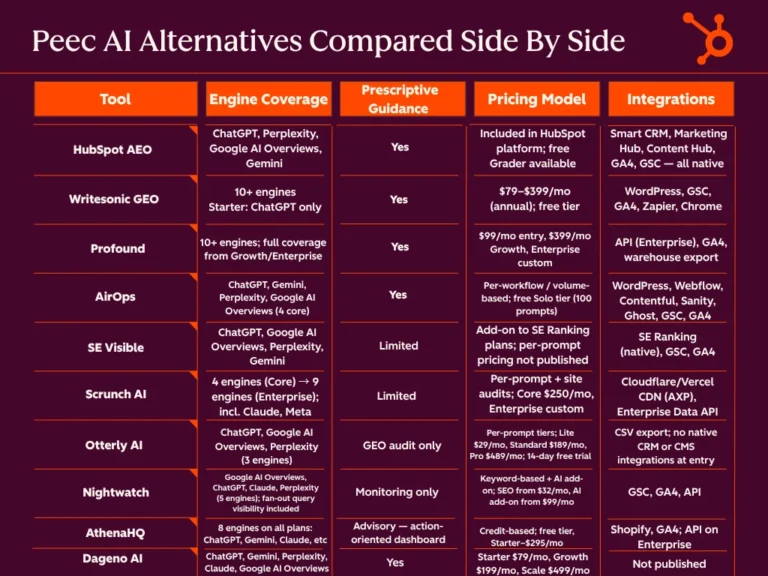
| Measurement Tools | Google Search Console, rank trackers | AI visibility tools, AI Performance in Bing Webmaster Tools, HubSpot AEO |
Organizations achieving the most significant AEO results are not abandoning SEO; rather, they are refining their SEO programs. This involves prioritizing quality over sheer volume, emphasizing clarity over keyword density, and integrating entity and mention strategies into their existing efforts.
How Answer Engines Interpret Links and Mentions
AI answer engines evaluate links, brand mentions, entity clarity, and page structure collectively. When platforms like ChatGPT, Perplexity, or Google AI Overviews formulate a response, they do not solely rely on traditional Google ranking factors. Their aim is to ground the answer in trustworthy source material from content or brands that consistently demonstrate accuracy on a given topic.
The process involves several stages:
-
Source Parsing: AI systems ingest and index vast amounts of web content, including news sites, blogs, publications, and structured data. The selection of content for parsing is influenced not only by backlinks but also by crawlability, recency, and the inherent semantic structure of the webpage.
-
Authority Weighting: Unlike traditional PageRank, AI authority weighting doesn’t primarily count links. Instead, it assesses whether a piece of content or a brand consistently and credibly appears in contexts relevant to the query. A brand cited across multiple authoritative industry publications, mentioned in expert roundups, and consistently associated with a specific topic area will possess greater AI authority than one with a strong backlink profile built through less relevant channels.
-
Signal Merging: AI systems do not analyze links, mentions, and page structure in isolation. They merge these disparate signals to form a comprehensive assessment of source reliability for a particular topic. A page with strong backlinks might still be overlooked if its content is ambiguous, outdated, or poorly organized. Conversely, a page with modest link authority but exceptional clarity—featuring clear headings, direct answers, supporting data, and consistent entity signals—can achieve citation status over technically superior competitors.
Backlinks build trust, but content structure and freshness ultimately determine whether a page is cited.
Key Signals Beyond Links for AEO
Beyond link authority, several other signals significantly influence the likelihood of AEO citation. These signals, when working in concert with backlinks, form a comprehensive authority graph:
-
Unlinked Brand Mentions: The appearance of a brand name in credible sources without a hyperlink serves as a vital signal. AI systems use these mentions to map a brand’s association with specific topic clusters, building entity authority and making the brand a clear choice for citation.
-
Co-citations: When a brand is mentioned alongside other recognized brands or sources within the same content, it creates a co-citation. This signals to AI answer engines that the brand belongs in authoritative company, positioning it alongside experts and well-regarded publications within its category. This is an often underutilized AEO tactic.
-
Entity Clarity: An AI search entity is a clearly defined and consistently described entity—be it a brand, person, or concept. AI engines prioritize citing brands with strong entity clarity, meaning they consistently use the same naming conventions, leverage structured data (like Organization or Person schema), and demonstrate a clear area of expertise across all digital channels. Entity confusion can be a significant impediment to AEO visibility.
-
Interplay with Backlinks: The most successful AEO strategies involve the synergistic interaction of these signals. A strong entity with numerous mentions but no backlinks may struggle with verification. Conversely, a robust backlink profile lacking entity clarity or consistent mentions will underperform in AI citation environments. Brands that achieve the highest AI citations typically exhibit a simultaneous strength across authoritative links, consistent mentions, strong co-citation associations, and a clearly defined entity, underpinned by high-quality content.
Structuring Content for Both Backlinks and AEO Citations
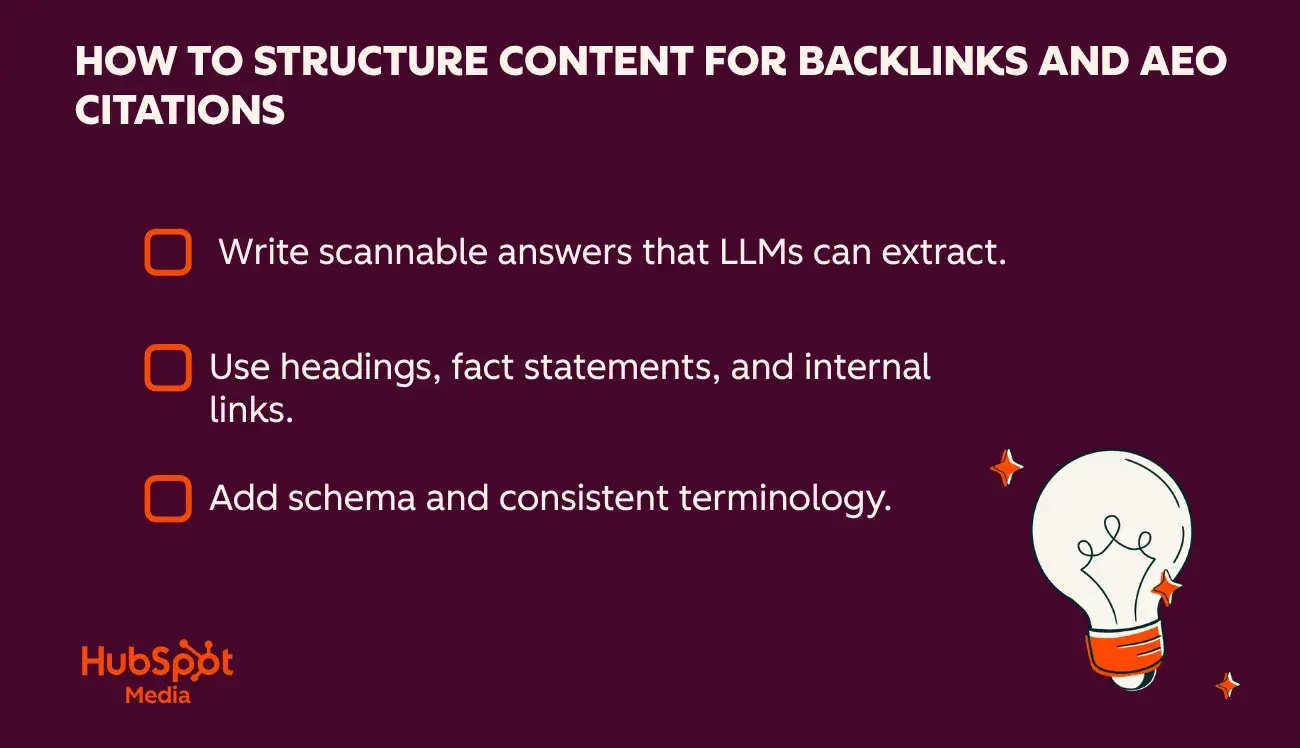
AI systems extract information from indexed content, and pages that are easily parsable, clearly organized, and directly responsive to queries are systematically more likely to be cited. The following structural approaches enhance both backlink acquisition and AEO citation potential:
-
Prioritize Scannable Answers: Content designed for easy extraction by Large Language Models (LLMs) significantly increases citation likelihood. Each major section of a page should offer a direct, self-contained answer to the question implied by its heading. Leading with the answer, followed by supporting context, data, or examples, is far more effective than burying the answer within narrative text. This means employing clear headings, concise paragraphs, and distinct fact statements.
-
Leverage Headings, Fact Statements, and Internal Links: Utilizing H2 and H3 headings to delineate topics, presenting key information as distinct fact statements, and implementing a dense internal linking structure around topic clusters signal topical depth and reinforce the "Freshness, Structure, Authority" (FSA) framework crucial for AI visibility.
-
Integrate Schema and Consistent Terminology: Schema markup, such as
Article,FAQPage, andHowToschema, clarifies page purpose and content structure for both search and AI systems. Equally important is consistent terminology; brands must adopt a canonical term for each concept and use it uniformly across all platforms to avoid entity confusion for AI engines.
Building Backlinks and AEO-Salient Mentions Across Platforms

Link building and mention building should be treated as integrated efforts, not separate initiatives. Every outreach action should aim to generate both a structural link signal and a brand mention that AI systems can index.
-
Prioritize AI-Friendly Formats: Certain content formats, such as original research, data reports, and expert commentary, are disproportionately cited by AI engines. These formats provide a compelling reason for other publishers to link to a brand as a primary source, while also generating valuable co-citation signals.
-
Earn Relevant Links and Co-citations with Original Research: Original research stands out as a highly efficient method for simultaneously acquiring backlinks and co-citations. Well-designed studies or data reports give other publishers a strong incentive to link to a brand as a primary source, and subsequent coverage often mentions the brand alongside other respected voices in the category, creating crucial co-citation signals. Digital PR, including earned media placements, expert commentary, and podcast appearances, also serves as a potent strategy for generating both link authority and authentic mentions.
-
Participate Where Authoritative Conversations Form: AI systems index content from a wide array of sources, including platforms where authoritative conversations occur. Actively participating in these channels—contributing expert commentary, publishing thought leadership, and appearing as a guest on podcasts—expands a brand’s footprint across sources that AI systems are trained to trust. This fosters relationship building, increasing the likelihood of organic requests for input and subsequent mentions on third-party sites. Platforms like Qwoted and HARO are particularly valuable for identifying these opportunities.
Measuring Backlinks and AEO Impact with a Repeatable Loop
Brands making significant strides in AEO are actively experimenting and meticulously measuring the effectiveness of their strategies. A clear feedback loop, connecting content and outreach activities to changes in authority signals and AI citations, transforms optimization from guesswork into a data-driven process. The Loop Marketing framework, emphasizing benchmarking, tying changes to activity, and reporting on what to scale, provides a structured approach.
-
Benchmark AI Visibility and Citations: Establish a baseline by assessing current AI citation frequency, identifying which pages are being cited, and analyzing the types of queries driving those citations.
-
Tie Changes to Content and Outreach Activity: Track AI visibility and cited pages in conjunction with specific content creation or outreach efforts. Disciplined logging of activities, such as publishing new content, securing guest posts, or conducting digital PR campaigns, allows for the correlation of visibility changes to concrete actions.
-
Report What to Scale and What to Stop: Regularly analyze data to identify which content and outreach strategies are yielding the most significant AI citation improvements. This allows for data-informed decisions on scaling successful tactics and discontinuing less effective ones, transforming AEO into a compounding strategy.
Frequently Asked Questions About Backlinks and AEO
-
Do unlinked mentions help answer engine optimization? Yes, unlinked brand mentions are a meaningful signal in AEO. AI systems register these associations to map brands to topic areas, building entity authority.
-
Do nofollow links matter for AEO? While less impactful for traditional PageRank, a nofollow link from a highly relevant, trusted source can still carry meaningful entity and mention signals for AI systems parsing the content. Relevance and source authority remain paramount.
-
How long does it take to see AEO impact from link building? Similar to traditional SEO, significant AEO impact from link building typically emerges within three to six months, with compounding results over 12 months. Entity and mention-based signals can sometimes surface more rapidly.
-
Should I stop classic link building in favor of AEO? No, classic link building remains integral to AEO. The approach should be to evolve link-building strategies to prioritize relevance, co-citation opportunities, and entity-reinforcing placements, rather than abandoning SEO for an AEO-only program.
Backlinks Still Have Their Place
The future of digital authority does not present a dichotomy between backlinks and AEO. They represent interconnected layers of the same authority infrastructure. Backlinks provide the foundational credibility that ensures content is indexed and trusted as a grounding source. Brand mentions, co-citations, entity clarity, and content structure collectively build the broader signal that informs AI systems about a brand’s relevance and authority.
Content teams currently achieving measurable progress in AI visibility are those that have not forsaken their SEO programs but have instead refined them to be more precise, entity-aware, and consistently structured. Tools that offer visibility into AI citation performance provide the data necessary to transition from speculative efforts to iterative, data-informed optimization.
About the Author