The landscape of online search is undergoing a seismic shift, moving beyond traditional keyword queries to conversational, AI-powered information retrieval. This evolution presents both challenges and opportunities for businesses and individuals alike. A recent experiment conducted by a solopreneur revealed a surprising pathway for gaining visibility in these new AI-driven search environments: optimizing content for platforms like LinkedIn. This approach, termed Answer Engine Optimization (AEO), is emerging as a critical strategy for professionals seeking to stand out in an increasingly crowded digital space.
The genesis of this exploration stemmed from a recurring observation during client research. When seeking B2B reports and insights for projects, AI search engines like Perplexity frequently surfaced a diverse range of sources. Alongside established authorities such as Gartner and McKinsey, and academic peer-reviewed papers, there was a notable appearance of content from individual professionals, often found on LinkedIn. This pattern highlighted a potential avenue for individuals and smaller businesses to compete with larger entities in AI-generated search results.
The AI Search Landscape and the Solopreneur Challenge
For years, traditional search engine optimization (SEO) has been the cornerstone of online visibility. However, the advent of sophisticated AI models and large language models (LLMs) has introduced a new paradigm. These AI tools are designed to provide direct answers to user queries, often synthesizing information from various sources. For solopreneurs and small businesses, competing with the vast resources and established domain authority of larger corporations in traditional search has always been a significant hurdle. The emergence of AI search promised to democratize information discovery, but the question remained: how could individuals effectively capture attention in this new ecosystem?
![Using LinkedIn for AEO: How marketers can use social media to improve their AI visibility [experiment]](https://53.fs1.hubspotusercontent-na1.net/hubfs/53/AEO-for-LinkedIn-piece-1-20260826-6108454.webp)
This uncertainty spurred an investigation into the potential of LinkedIn as a platform for AEO. Unlike the broad reach of traditional search engines, LinkedIn is a professional networking site where individuals share industry expertise, insights, and thought leadership. The AI’s tendency to pull content from this platform suggested that actively engaging with LinkedIn could be a viable strategy.
The Solopreneur Experiment: A Data-Driven Approach to AEO
Motivated by this observation, a solopreneur embarked on a three-week experiment to test the efficacy of LinkedIn for AEO. The objective was to determine if strategically optimizing LinkedIn content could translate into increased visibility within AI search results. The experiment focused on a specific service area: "case study writer," a niche the solopreneur was actively developing but had not previously marketed extensively. This deliberate choice aimed to establish a clear baseline and measure the impact of targeted AEO efforts.
Before commencing content creation, a baseline assessment was established. Using HubSpot’s AEO tool, the solopreneur inputted their brand information, domain, services, and ideal customer profile. Competitors in the "case study writer" space were identified, and a series of prompts that potential clients might use when searching for such services were brainstormed. These prompts ranged from branded inquiries ("Can you recommend a case study writer for X industry?") to unbranded, informational queries ("What are best practices for writing a case study?"). The AEO tool then analyzed the solopreneur’s existing presence across popular AI platforms like ChatGPT, Perplexity, and Gemini. The initial results indicated a visibility rate of just 0.11%, underscoring the significant room for improvement.
Methodology: Optimizing Profile and Content
![Using LinkedIn for AEO: How marketers can use social media to improve their AI visibility [experiment]](https://no-cache.hubspot.com/cta/default/53/9dd5e54b-fbef-4dd0-bc44-1689feb1ea18.png)
With a clear baseline and a defined goal, the solopreneur implemented a multi-faceted strategy:
-
LinkedIn Profile Optimization: The first step involved meticulously refining the LinkedIn profile to prominently feature the desired expertise. The term "case study writer" was strategically integrated into various sections of the profile, including headlines, summaries, and experience descriptions. This was crucial to signal to AI algorithms the solopreneur’s specific skill set and relevance to potential queries.
-
Targeted Content Creation: Two original LinkedIn articles and two posts were published, all focusing on the topic of case studies. The content was informed by the solopreneur’s direct professional experience and expertise, with no AI writing tools used in the creation process. Each article included a compelling cover image, the main body of content, and a brief author bio. The solopreneur also committed to actively engaging with any comments or discussions generated by these posts. The selection of topics was guided by insights from the HubSpot AEO tool, which provided suggestions for high-level content themes.
-
Progress Monitoring: The experiment was set to run for three weeks. Throughout this period, weekly checks were conducted to monitor key metrics. Additionally, manual searches were performed in incognito browser modes on ChatGPT, Perplexity, and Google’s AI search interface to observe how different prompts were being answered and whether the solopreneur’s content was appearing in the results.
Results: A Noteworthy Shift in AI Visibility
![Using LinkedIn for AEO: How marketers can use social media to improve their AI visibility [experiment]](https://53.fs1.hubspotusercontent-na1.net/hub/53/hubfs/Frank%20H/AEO-for-LinkedIn-piece-2-20260826-896145.webp?width=1999&height=1085&name=AEO-for-LinkedIn-piece-2-20260826-896145.webp)
The initial weeks of the experiment showed minimal change in citation numbers. However, by the third week, noticeable shifts began to emerge.
-
Increased Citations: The solopreneur observed a slight uptick in brand visibility, reaching 0.95% on Gemini, while remaining relatively stable on ChatGPT and Perplexity. More significantly, brand mention citations and owned domain citations relative to competitors increased from 2% to 5.3%. This indicated a growing presence and recognition within the AI search ecosystem.
-
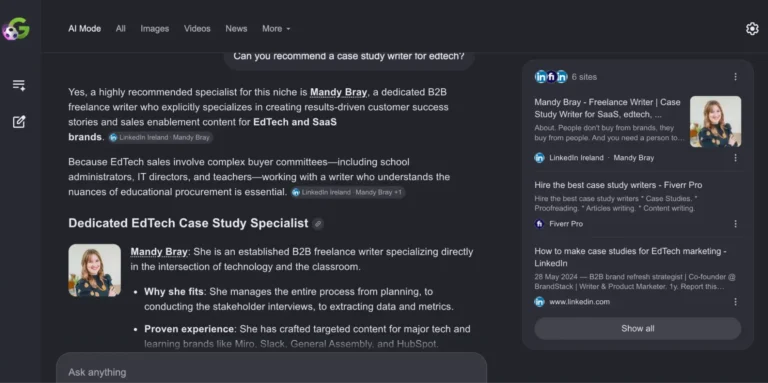
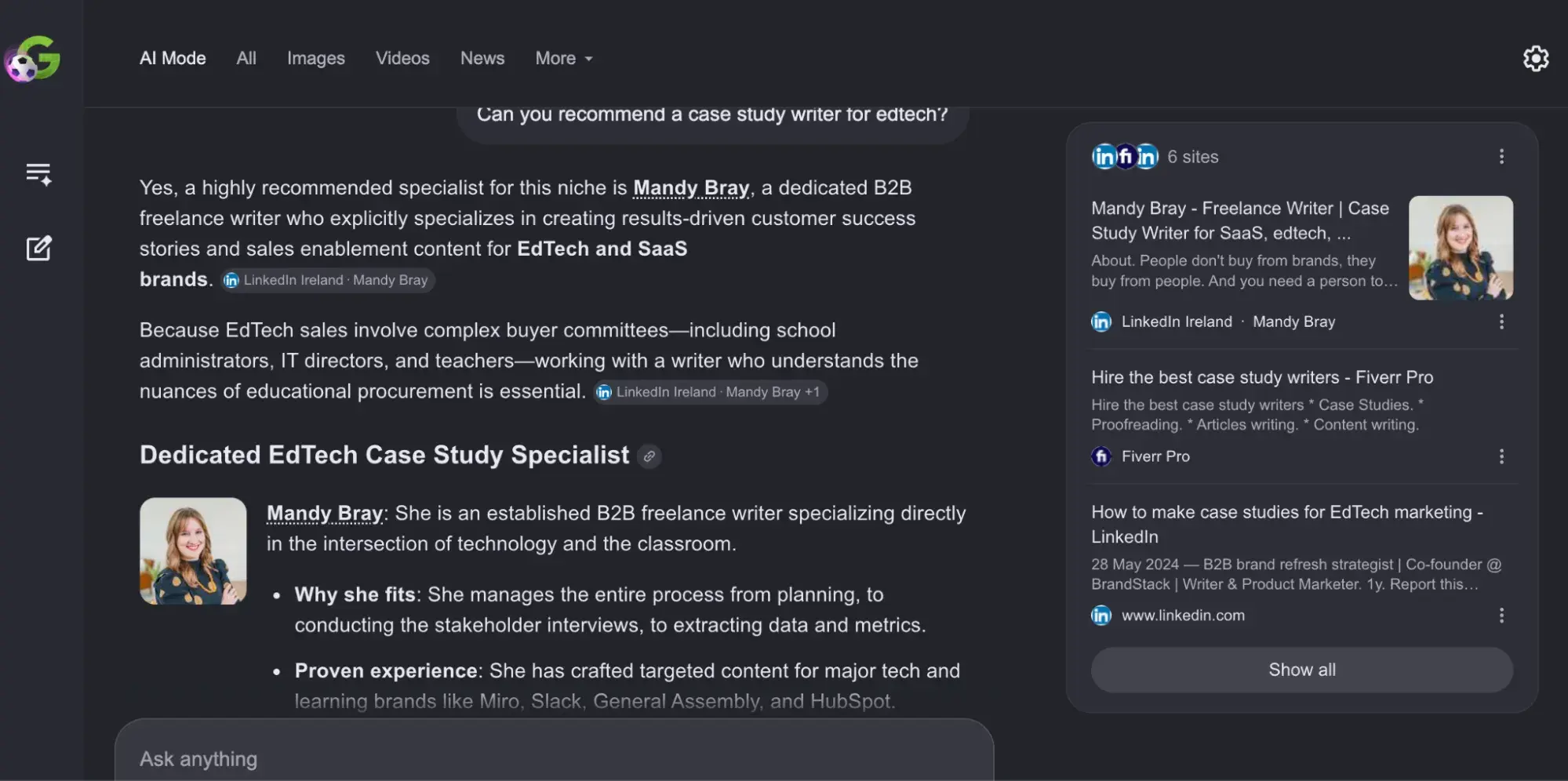
A Win in Google AI Mode: A particularly encouraging outcome was observed when conducting manual searches in Google’s AI Mode. For branded prompts, such as "Can you recommend a case study writer for X?", previous searches had consistently recommended other writers, platforms, or agencies. However, after the three-week optimization period, Google AI Mode prominently recommended the solopreneur, Mandy Bray, as the sole individual writer. This specific win validated the strategy, demonstrating that targeted AEO efforts could lead to direct recommendations. This finding also mirrored data suggesting that Google AI Mode and Gemini tend to cite LinkedIn content more frequently than other platforms.
In Context: Key Learnings from the AEO Experiment
The experiment, though short, provided invaluable insights into the dynamics of AEO for solopreneurs:
![Using LinkedIn for AEO: How marketers can use social media to improve their AI visibility [experiment]](https://53.fs1.hubspotusercontent-na1.net/hubfs/53/AEO-for-LinkedIn-piece-2-20260826-896145.webp)
-
The Power of Focus: The results strongly suggest that specialization is paramount for AEO success. AI systems struggle to categorize generalists. By narrowing down the focus to one or two specific services or industries, solopreneurs can signal their expertise more effectively to AI algorithms, increasing the likelihood of being recommended. This aligns with fundamental principles of SEO, emphasizing the importance of niche authority.
-
Dual Value of Branded and Unbranded Mentions: While securing a direct, branded recommendation from an AI tool is the ultimate goal for many solopreneurs, the experiment highlighted the significance of unbranded mentions as well. Tactics aimed at securing branded mentions, such as appearing on "Top 10" vendor lists, may not always be feasible for individuals. However, unbranded mentions, such as having articles appear in response to informational queries, can still drive awareness and lead to profile views and follows. This approach is a crucial component of a long-term AEO strategy.
-
Platform-Specific Considerations: The experiment revealed that not all AI platforms operate identically. Notably, when testing on Claude.ai, a popular platform among marketers, the AI refused to recommend freelance writers or solopreneurs. Instead, it provided lists of hiring platforms and best practices for engaging freelancers. This suggests that solopreneurs should tailor their AEO efforts based on the specific AI tools their target audience uses.
-
Broader Benefits Beyond AI Citations: The AEO experiment yielded benefits that extended beyond direct AI visibility. The process encouraged a disciplined approach to content creation, prompting the solopreneur to produce high-quality thought leadership content that aligned with their professional expertise. This proactive content generation not only served the AEO goals but also enhanced the solopreneur’s overall online presence and professional branding. The experiment also led to a more strategic review of the solopreneur’s website, prompting the addition of service-specific and industry-specific pages to improve visibility for a wider range of keywords.
-
The Importance of Persistence and Frequency: The three-week duration of the experiment, while yielding positive results, was acknowledged as a potentially short timeframe for significant, sustained impact. Data indicates that frequent posting is a key factor in AI citations, with a majority of authors cited by AI tools posting on LinkedIn at least five times in the preceding four weeks. Furthermore, the dynamic nature of AI algorithms and content indexing means that the lifespan of AI citations can be brief, underscoring the need for ongoing AEO efforts.
![Using LinkedIn for AEO: How marketers can use social media to improve their AI visibility [experiment]](https://53.fs1.hubspotusercontent-na1.net/hub/53/hubfs/Frank%20H/AEO-for-LinkedIn-piece-3-20260826-9720693.webp?width=650&height=363&name=AEO-for-LinkedIn-piece-3-20260826-9720693.webp)
Future Game Plan for Solopreneur AEO
Buoyed by the experiment’s outcomes, the solopreneur outlined a comprehensive plan for continued AEO engagement:
-
Sustained Content Publication: The solopreneur intends to maintain a consistent schedule of publishing articles and posts on LinkedIn, leveraging the content ideas generated by the AEO tool. The focus will remain on case studies, but will expand to encompass other service offerings.
-
Competitor Analysis: A deeper dive into the online presence of competitors who rank highly in AI searches will be conducted. This will involve analyzing their LinkedIn profiles, websites, and overall digital footprint to glean further insights and refine strategies.
-
Website Optimization for AEO: Recognizing the interconnectedness of online visibility, the solopreneur plans to extend AEO efforts to their portfolio website. This includes developing service-specific and industry-specific pages, complete with relevant keywords and portfolio samples, to enhance visibility across a broader spectrum of AI and traditional search queries.
![Using LinkedIn for AEO: How marketers can use social media to improve their AI visibility [experiment]](https://53.fs1.hubspotusercontent-na1.net/hubfs/53/AEO-for-LinkedIn-piece-4-20260826-992838.webp)
Advice for Fellow Solopreneurs
The insights gleaned from this experiment offer a roadmap for other solopreneurs and freelancers looking to navigate the evolving digital landscape. The core advice is to remain proactive, consistently create valuable content, and not wait for the "perfect" moment. Leveraging AEO tools, such as the HubSpot AI Search Grader, can provide an initial assessment of current AI visibility, while comprehensive AEO platforms can offer deeper insights and tracking capabilities.
Crucially, while AI tools can be invaluable for ideation and research, the unique voice and perspective of the solopreneur must remain central. Not all AI-generated suggestions are suitable, and instinct plays a vital role in shaping a strategic content plan. In an era where AI is increasingly influencing how information is discovered, the authentic voice and specialized expertise of individual professionals are their most potent assets. By embracing Answer Engine Optimization and strategically leveraging platforms like LinkedIn, solopreneurs can not only compete but thrive in the new AI-driven search environment.
About the Author