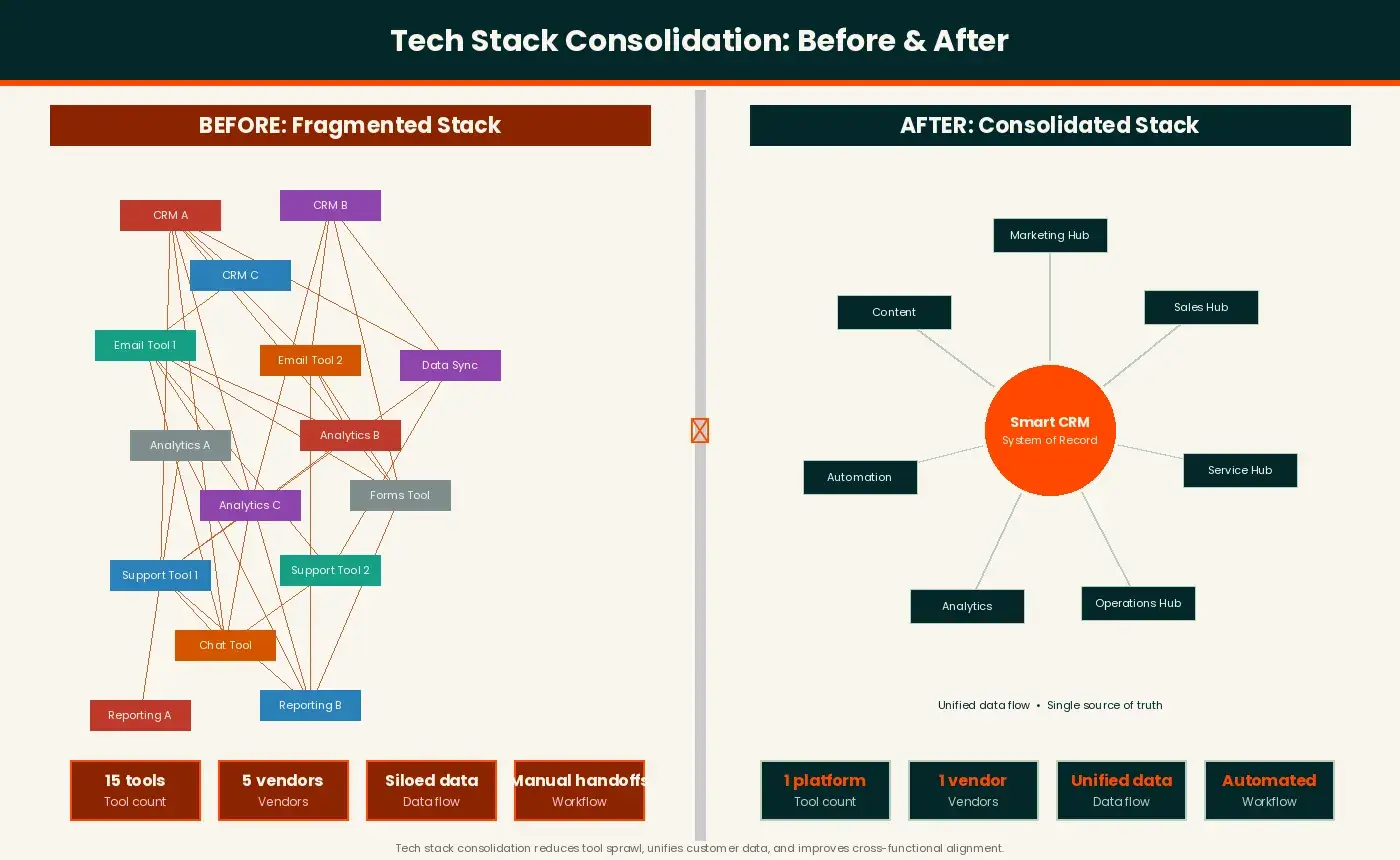
Tech stack consolidation, the strategic process of rationalizing an organization’s software tools to a smaller, more integrated set, is emerging as a critical initiative beyond mere cost reduction. The business case extends significantly, fostering unified data environments that empower customer-facing teams with consistent reporting, enable end-to-end customer journey automation, and eliminate the perpetual need to re-establish context as customers move through marketing, sales, and service interactions. At the heart of this transformation lies a robust Customer Relationship Management (CRM) system, serving as the definitive system of record. This singular platform centralizes customer data, drives workflow automation, and acts as the immutable source of truth for all departments interacting with the customer.
The concept of tech stack consolidation involves systematically retiring redundant software, standardizing operations on a core set of platforms, and optimizing integrations between the remaining tools. This approach moves beyond simply canceling subscriptions; it represents a fundamental decision-making process about which tools form the bedrock of an organization’s operational infrastructure, which augment it, and which persist due to inertia. It addresses the pervasive issue of "tool sprawl" at its root, rather than managing its symptoms through piecemeal contract reviews.
The most significant benefit of this consolidation is the unification of customer data. When a CRM system meticulously captures every customer interaction, from initial website visits through to contract renewals, teams are no longer burdened with reconciling disparate definitions of an "active customer" before critical business reviews. This leads to accelerated reporting cycles, seamless automation across the entire customer lifecycle, and a demonstrably improved customer experience, as every representative possesses the complete contextual understanding necessary for effective engagement.
While cost savings are a tangible outcome, they are often secondary to the operational efficiencies gained. Industry analysis, such as reports from Gartner, indicates that software spending continues its upward trajectory, often accompanied by an increase in the sheer number of tools deployed. The most substantial returns are realized when operational gains – stemming from enhanced data integrity, streamlined workflows, and reduced integration failures – are reinvested into core business execution and strategic growth initiatives.
Identifying the Need for Consolidation
Several indicators signal that an organization is ripe for tech stack consolidation. These include:
- Fragmented customer data: Different departments operate with distinct, often contradictory, datasets.
- Manual data reconciliation: Significant time is spent manually aligning information across various platforms.
- Redundant tool functionalities: Multiple software solutions perform similar tasks, leading to duplicated costs and confusion.
- Complex and fragile integrations: Maintaining connections between numerous disparate tools becomes a resource drain.
- Inconsistent customer experience: Customers report being asked to repeat information across different touchpoints.
- Difficulties in reporting and analytics: Generating comprehensive reports is a time-consuming and error-prone process.
- High software spend relative to perceived ROI: The cost of the software portfolio does not align with demonstrable business impact.
When three or more of these conditions are met, tech stack consolidation transcends being a mere enhancement and becomes an operational necessity. The true trigger for consolidation is not an arbitrary number of tools, but rather the point at which the complexity and friction generated by the existing stack outweigh the utility provided by its individual components.
Transforming Business Operations Through Consolidation
The impact of a consolidated tech stack reverberates across all facets of a business:
Marketing:
A streamlined marketing technology (martech) stack liberates marketing teams from the burden of data discrepancies, allowing them to focus more intensely on campaign execution and strategy. Improved attribution becomes a reality as all customer touchpoints are funneled into a single platform. Crucially, automation efforts – encompassing lead nurturing, scoring, and lifecycle stage management – can operate seamlessly across the entire funnel, creating more effective and personalized customer journeys.
Sales:
Sales representatives benefit immensely from working within a unified CRM. The need to toggle between disparate tools to understand a prospect’s history is eliminated. Pipeline management, activity logging, sequence tracking, and note-taking all reside within a single, accessible interface. This centralization also leads to more accurate forecasting, as the underlying data is comprehensive and reliable.
Service:
Customer support teams gain a 360-degree view of the customer, including purchase history, past interactions, and active deals, without leaving their primary helpdesk application. This accelerates escalation processes and significantly reduces instances where customers are compelled to re-explain their issues.
Operations, Finance, and IT:
Vendor consolidation simplifies procurement processes, reduces the overall attack surface for cybersecurity threats, and enables finance departments to more effectively reconcile software spend against actual utilization. Operational teams can dedicate more resources to strategic initiatives rather than expending effort on maintaining intricate custom integrations.

A Phased Approach to Tech Stack Consolidation
Successful tech stack consolidation is a methodical process, often beginning with a comprehensive audit of the existing software landscape. This audit should encompass all tools, including those acquired through departmental initiatives or "shadow IT" that may fall outside central procurement. For each tool, key information to document includes:
- Purpose and functionality: What problem does it solve?
- Ownership: Which department or individual is responsible?
- Cost: Annual subscription, implementation fees, and ongoing maintenance.
- Renewal date: Crucial for planning.
- Utilization metrics: How actively is the tool being used?
- Data flow and integrations: How does it interact with other systems?
- Key users and their reliance: Who depends on this tool?
Following the audit, the next critical step is to prioritize categories and identify potential "quick wins" – tasks or tools that can be consolidated with minimal disruption. These early successes build momentum and can free up budget and resources for more complex migrations.
The cornerstone of effective consolidation is defining a clear system of record and establishing robust data standards. A CRM, serving as the system of record, ensures that all customer data – contact, company, deal, and ticket information – is housed in one authoritative location. This centralization is fundamental for consistent reporting, seamless automation, and a unified view of the customer. Establishing data standards, including naming conventions for fields, definitions for lifecycle stages, and deduplication rules, is paramount. These standards ensure data quality, prevent degradation during migration, and make integrations predictable.
The subsequent phase involves a rigorous evaluation of each tool against defined criteria. This evaluation should consider:
- Alignment with strategic goals: Does the tool support current and future business objectives?
- Functionality overlap: Is its purpose already served by a more central platform?
- Integration capabilities: Can it seamlessly connect with the system of record?
- User adoption and satisfaction: Is the tool actively and effectively used?
- Cost-effectiveness: Does the value derived justify the expense?
Tools that fail to meet these criteria should be retired. The evaluation must be outcome-oriented, focusing on the business value delivered.
Migrating to the consolidated stack requires meticulous planning to minimize disruption. Before retiring any tool, thorough data migration strategies must be developed, ensuring data integrity and completeness. User training on new workflows and platforms is essential, and phased rollouts, perhaps by department or specific use case, can help identify and address issues early in the process.
Finally, enabling teams and diligently measuring adoption are critical for long-term success. Consolidation efforts can falter if users revert to familiar, albeit redundant, tools. Comprehensive training programs for each migrated function are indispensable. Adoption should be tracked not merely by login counts, but by observing key business outcomes such as data completeness, the rate of successful automation triggers, and workflow completion rates.
Navigating Common Challenges
Organizations undertaking tech stack consolidation often encounter several hurdles:
- Stakeholder Resistance: Teams may resist relinquishing tools they have integrated into their established workflows. Addressing this requires clear communication about the benefits, involving stakeholders in the decision-making process, and providing adequate training and support.
- Legacy Edge Cases: Certain specialized workflows might be uniquely supported by existing tools. In such instances, it’s crucial to assess if the functionality is truly indispensable and if a viable workaround can be implemented within the core platform.
- Integration Gaps: Assumed integrations between systems may prove more complex or costly than anticipated, requiring custom development. Thorough technical due diligence is key to identifying these potential issues early.
- Contractual Timing: Decisions to retire tools may conflict with existing vendor contracts. Strategic planning and negotiation are necessary to manage these transitions.
- "Dirty" Data: Migrating incomplete or inaccurate data into a new, consolidated system perpetuates problems. Data cleansing and standardization efforts must precede or accompany migration.
- Lack of Cross-Functional Alignment: Without buy-in from procurement, security, and finance, consolidation efforts can face significant downstream obstacles. Establishing cross-functional governance from the outset is vital.
Preventing Future Sprawl
To ensure the gains from consolidation are sustained, organizations must implement robust governance mechanisms. This includes establishing a formal intake process for all new software requests, assigning clear ownership for each tool category, conducting regular renewal-based reviews, maintaining documented standards for data and integrations, and keeping a living, up-to-date tool inventory.
Mistakes to Avoid
Common pitfalls in tech stack consolidation include:
- Prioritizing cost over functionality: While cost is a factor, the primary goal is operational efficiency and improved business outcomes.
- Skipping the audit phase: A thorough understanding of the current landscape is foundational.
- Underestimating the change management effort: User adoption is paramount and requires dedicated attention.
- Failing to define a clear system of record: Without a central data authority, fragmentation will inevitably re-emerge.
- Not involving key stakeholders early: Lack of buy-in can derail even the best-laid plans.
- Treating consolidation as a one-time project: It should be an ongoing process of strategic technology management.
A 90-Day Plan for Initial Consolidation
A structured 90-day plan can lay the groundwork for successful tech stack consolidation:
Days 1-30: Audit and Align

- Week 1: Initiate data collection for the tool inventory from finance, IT, and department heads.
- Weeks 1-2: Augment the inventory with utilization data, renewal dates, and documented data flows and ownership.
- Weeks 2-3: Map inter-system data flows and integration dependencies with IT and Operations.
- Week 3: Present initial findings to leadership and align on strategic consolidation goals.
- Week 4: Define a candidate system of record and establish initial data standards in collaboration with Marketing and Sales.
Days 31-60: Prioritize and Plan
- Week 5: Score all tools against defined "keep/retire" criteria and identify immediate quick wins.
- Week 6: Finalize the system of record selection and validate critical integrations.
- Week 7: Develop a detailed migration plan for the identified quick-win tools, including runbooks.
- Week 8: Communicate the consolidation plan to affected teams and establish go-live timelines.
Days 61-90: Execute Pilot and Govern
- Week 9: Conduct a pilot migration for the first quick-win tool, thoroughly documenting the process and outcomes.
- Week 10: Deliver comprehensive training to affected teams on new workflows and the replacement tools.
- Week 11: Officially retire the first redundant tool and begin tracking adoption metrics.
- Week 12: Implement governance structures, including the intake form, category ownership, and the review cadence.
Beyond Day 90, consolidation transitions into a continuous process of evaluation and optimization, with quarterly reviews designed to proactively prevent the recurrence of sprawl.
Addressing Frequently Asked Questions
How long does tech stack consolidation take?
The duration varies significantly, typically ranging from three to twelve months, depending on the complexity of the stack, the volume of data requiring migration, and the number of integrations involved. A comprehensive CRM migration can itself take a full quarter. Larger organizations may implement consolidation in phases over 12-18 months.
How can vendor lock-in be avoided?
Prioritize platforms with open APIs and established partner ecosystems. Opt for systems that utilize open data formats and negotiate data portability clauses into enterprise contracts. Maintaining a flexible integration layer between the core system of record and ancillary tools ensures each component remains replaceable.
Do smaller teams benefit from consolidation?
Absolutely. For smaller teams, the proportional overhead of managing multiple tools can be particularly burdensome. Consolidation offers immediate time savings and cleaner data. For these teams, leveraging platforms that natively integrate multiple functionalities can eliminate the integration challenges altogether.
What metrics confirm consolidation success?
Success should be measured across four key areas:
- Cost: Track overall software spend and cost per user.
- Data Quality: Monitor record completeness, duplicate counts, and adherence to data standards.
- Adoption: Measure active user engagement and feature utilization.
- Business Outcomes: Evaluate improvements in conversion rates, sales cycle velocity, and customer satisfaction scores.
Baselines should be established before migration, with regular follow-ups at 30, 60, and 90 days post-implementation.
How are edge-case tools handled?
If an edge-case tool serves a genuine, actively utilized workflow and integrates cleanly with the system of record, it may be retained as a deliberate exception. However, if the "edge case" represents low utilization or a niche use case that can be addressed within the core platform, prioritizing a workaround within the central system is often more efficient than maintaining a separate vendor relationship.
The strategic imperative of tech stack consolidation is clear. By embracing this disciplined approach, organizations can unlock significant operational efficiencies, foster a more unified and data-driven culture, and ultimately enhance their ability to serve customers and achieve sustained growth in an increasingly complex digital landscape.
About the Author