The burgeoning field of AI-Enabled Optimization (AEO) presents a complex cost landscape for businesses aiming to secure visibility within artificial intelligence-driven search and content generation. While a precise universal price tag remains elusive, industry analysis reveals a broad spectrum of investment, ranging from approximately $30 per month for self-managed monitoring tools to upwards of $15,000 per month for comprehensive, full-service agency programs. The actual expenditure hinges significantly on the scope of services rendered, with costs escalating in direct proportion to the complexity and breadth of AEO activities undertaken. This guide aims to dissect the multifaceted pricing structures of AEO, offering a clear breakdown by approach, budget tier, and the realistic investment required for initial pilot programs, thereby empowering organizations to align their spending with their strategic objectives and internal capabilities.
Understanding the AEO Cost Spectrum: From Budget Tools to Premium Agencies
The financial commitment to AEO varies dramatically based on the chosen service model. At the lower end, businesses can leverage monitoring tools that track their brand’s presence in AI-generated answers for a modest monthly fee. For instance, HubSpot’s AEO tool is available for approximately $50 per month, offering a foundational level of visibility tracking. This contrasts sharply with the upper echelon, where full-service agencies provide end-to-end AEO solutions. Companies like RevenueZen, for example, offer premium packages, such as their "Total Market" offering, which can reach $15,000 per month, encompassing a holistic approach to AI visibility and authority building. Custom agency packages can command even higher figures. The fundamental determinant of cost is the extent to which a business outsources the AEO workflow, from simple visibility monitoring to intricate strategy development, content creation, and off-site authority enhancement.
Before delving into AEO-specific costs, it is prudent for organizations to establish a broader understanding of their overall AI budget. A comprehensive overview of AI expenditure, encompassing various model types and tool functionalities, can provide crucial context for allocating resources effectively towards AEO initiatives. This strategic financial planning ensures that AEO investments are integrated within a larger, cohesive artificial intelligence strategy.
Deconstructing AEO Pricing: Three Primary Approaches
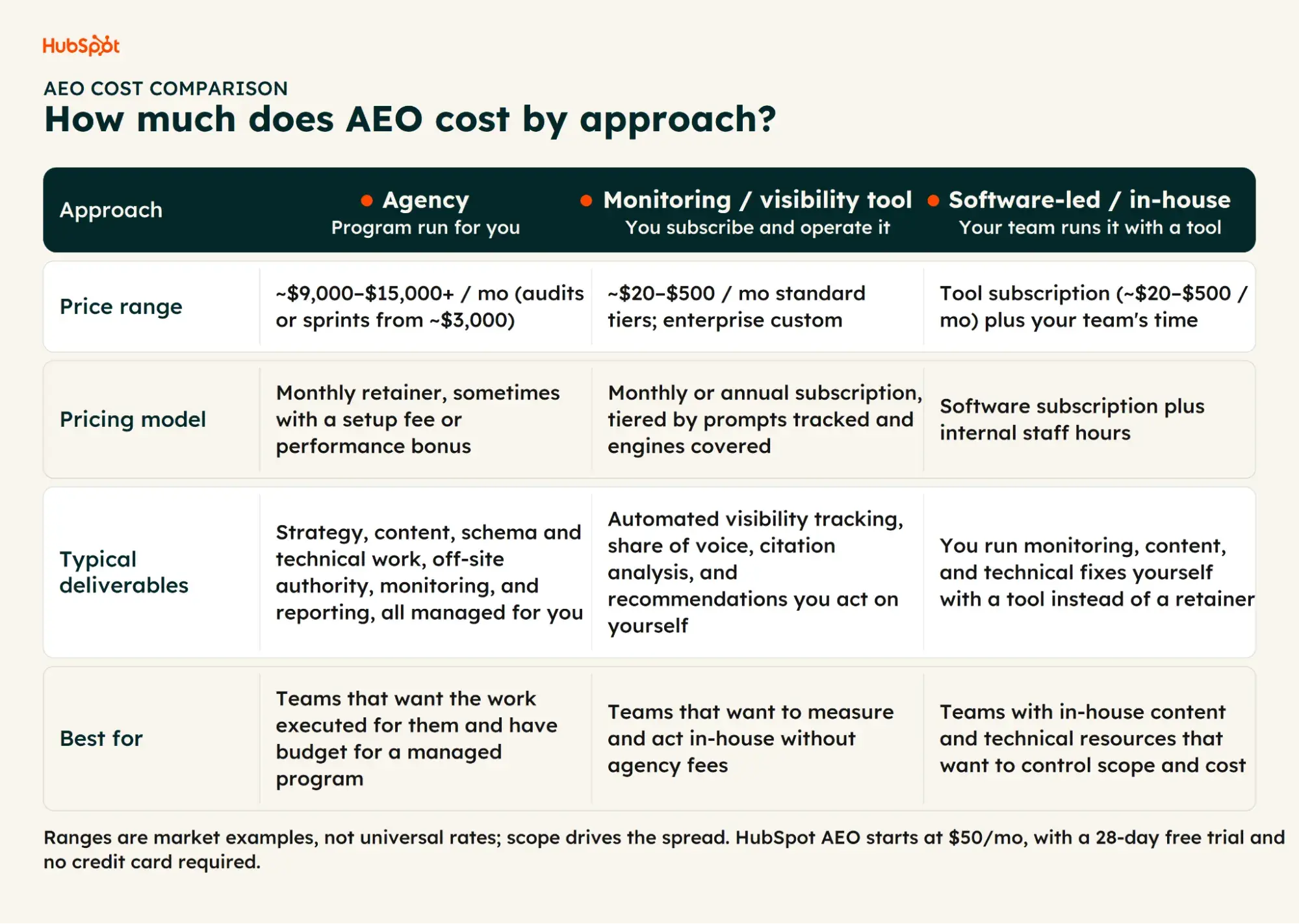
Most organizations contemplating AEO investments typically consider one of three primary operational models. Each model offers a distinct balance of cost, control, and execution, catering to different organizational needs and resource availabilities.
1. Agency-Led AEO Programs:
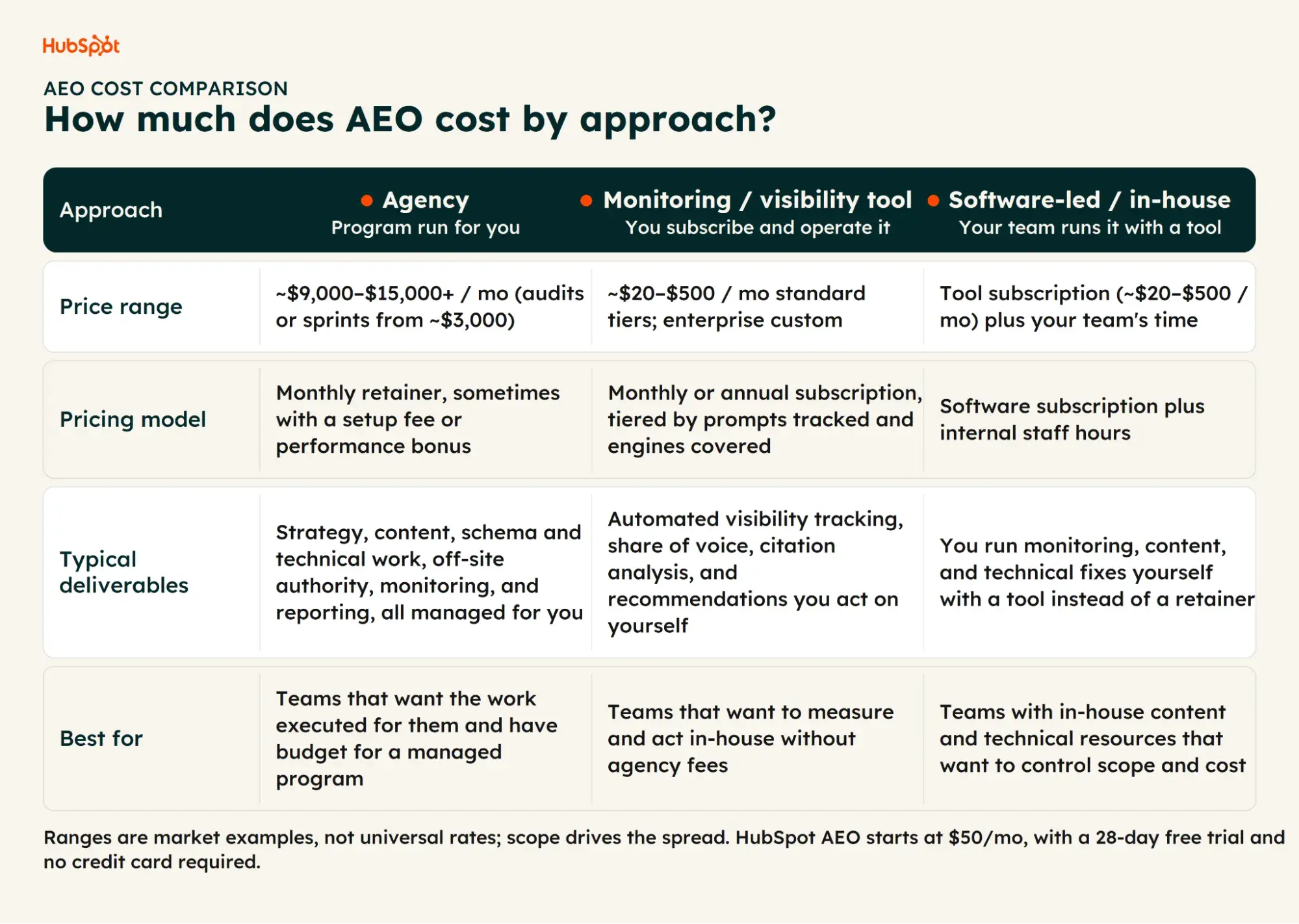
- Typical Monthly Cost: One-time audits or project sprints can range from approximately $3,000, while ongoing, comprehensive programs typically fall between $9,000 and $15,000 per month, with potential for higher investments in highly customized or extensive engagements.
- Payment Structure: This model predominantly utilizes monthly retainers. Some agencies may also incorporate a one-time audit or setup fee, or opt for a hybrid model that combines a retainer with performance-based incentives.
- Scope of Services: Agency programs are designed for a hands-off approach, encompassing strategic planning, content production and optimization, technical SEO elements like schema markup, off-site authority building through link acquisition and brand mentions, continuous monitoring, and detailed reporting. The entire AEO process is managed by the agency.
- Ideal For: Businesses that prefer a fully managed service, lack in-house AEO expertise, or have the budget to delegate all AEO-related tasks to external specialists.
2. Monitoring and Visibility Tools:
- Typical Monthly Cost: Standard, self-serve tiers generally range from $29 to $489 per month. Pricing is often metered based on the number of prompts analyzed and the AI engines covered. Enterprise-level plans are typically custom-quoted.
- Payment Structure: These are usually offered as monthly or annual subscriptions, with pricing tiers determined by usage metrics such as the volume of tracked prompts and the number of AI search engines monitored.
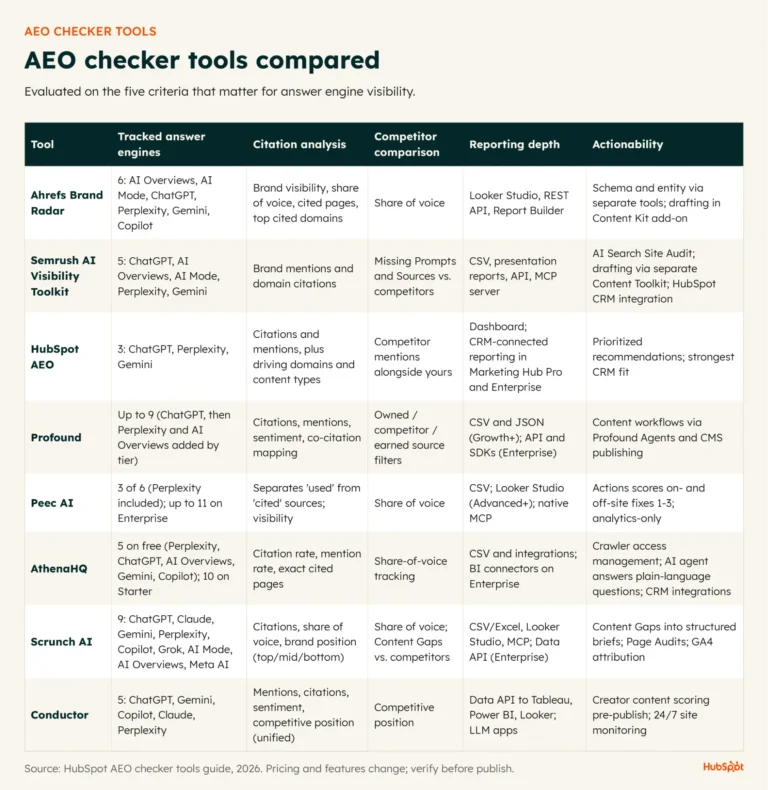
- Scope of Services: These tools primarily focus on automated tracking of brand presence within AI-generated answers, providing insights into competitive share of voice, citation analysis, and actionable recommendations that the user’s team must implement. Examples include HubSpot AEO ($50/mo for 3 engines), Profound (starting at $99/mo for limited engines, with multi-engine plans at $399/mo), and Peec AI (from $95/mo).
- Ideal For: Organizations that wish to measure and understand their AI visibility and implement optimizations internally, thereby avoiding ongoing agency fees.
3. Software-Led or In-House AEO Execution:
- Typical Monthly Cost: This model involves the cost of the chosen software subscription (as detailed above) combined with the internal labor costs of the marketing team.
- Payment Structure: This approach involves a software subscription fee alongside the investment in internal staff hours dedicated to AEO tasks.
- Scope of Services: Here, the organization leverages monitoring tools to conduct visibility tracking, content optimization, and technical AEO work in-house. For example, HubSpot’s AEO is integrated into its Marketing Hub Professional and Enterprise tiers, or can be purchased as a standalone product, allowing teams to manage AEO directly.
- Ideal For: Businesses possessing in-house content creation and technical expertise who prefer to maintain direct control over their AEO strategy and execution, thereby managing scope and costs more granularly.
The considerable price disparity between these options is not merely a reflection of vendor markups but is fundamentally driven by the scope of work being commissioned. The subsequent sections will delve deeper into the specific factors that contribute to these cost variations.

The Drivers Behind AEO Pricing Variability
The wide range in AEO pricing is primarily dictated by the extent of services an organization procures and the volume of existing content that requires optimization. Several key factors contribute significantly to this cost differential:
- Scope of Services: As previously noted, the more comprehensive the AEO strategy, the higher the cost. This includes the depth of AI engine coverage, the volume of keyword or brand mention tracking, and the extent of content auditing and optimization.
- Content Volume and Complexity: A larger existing content library or content that is highly technical or requires significant restructuring for AI optimization will naturally incur higher production and refinement costs.
- Competitor Landscape: Operating in a highly competitive AI visibility landscape often necessitates more aggressive and resource-intensive strategies to gain traction, thereby increasing costs.
- Technical Requirements: Implementing advanced schema markup, structured data, and ensuring technical SEO best practices for AI consumption can add complexity and thus cost to the AEO process.
- Off-Site Authority Building: Activities such as securing brand mentions, earning citations from authoritative sources, and managing online reputation contribute significantly to off-site authority, which is a key driver of AEO success but also a substantial investment.
Understanding these cost drivers is crucial for evaluating AEO proposals and ensuring that the chosen pricing model accurately reflects the anticipated deliverables and required effort.
AEO Pricing Models: A Closer Look
The AEO market offers several distinct pricing models, each with its own implications for what a client ultimately receives. Familiarity with these models is essential for accurately comparing quotes and understanding the value proposition of different AEO providers.
- Retainer-Based Models: These are the most common for agency services, involving a fixed monthly fee for a defined set of services. The scope of work under a retainer can vary significantly, from ongoing content optimization to comprehensive AI strategy and execution.
- Project-Based or Audits: For initial assessments or specific AEO initiatives, businesses may opt for one-time project fees. This often involves an in-depth audit of current AI visibility, competitive analysis, and strategic recommendations.
- Subscription-Based Software: As discussed, monitoring and analytics tools are typically offered on a subscription basis, with tiered pricing based on usage and features.
- Performance-Based Pricing: While less common in the nascent AEO field, some agencies may offer hybrid models that include a base retainer with bonuses tied to achieving specific performance metrics, such as increases in AI-generated answer citations or share of voice. However, the variability and inherent complexity of AI answer generation make fixed performance-based models challenging to implement reliably.
Budget Tiers for AEO: What Your Investment Can Buy
The pricing models translate into distinct budget tiers, each offering a varying degree of AEO support and execution. The primary differentiator across these tiers is the extent to which external support is leveraged for content, off-site authority, and reporting.
- Lean Tier (Under $500/month): At this level, the investment is primarily focused on AEO monitoring and visibility tools. This tier is suitable for organizations that want to measure their AI presence and identify opportunities but will execute the necessary optimizations in-house. The cost covers software subscriptions and potentially a one-time diagnostic audit.
- Mid-Tier ( $1,000 – $5,000/month): This tier often involves a combination of monitoring software and some level of outsourced support. This might include hiring freelance content creators or a specialized consultant for technical AEO tasks. It allows for a more proactive approach to content optimization and technical implementation without committing to a full-service agency.
- Comprehensive Tier ($9,000 – $15,000+/month): This tier represents a full-service agency engagement. It covers strategic planning, end-to-end content production, off-site authority building, technical SEO, and ongoing monitoring and reporting. This is for organizations that seek a complete, managed AEO solution.
Regardless of the chosen tier, it is crucial to understand that AEO is not a replacement for Search Engine Optimization (SEO) but rather a complementary discipline. Effective AEO strategies often build upon a strong SEO foundation, and a robust SEO strategy is essential for maximizing the potential of AEO efforts.
AEO vs. SEO: Understanding the Synergy and Distinction
The advent of AEO necessitates a clear understanding of its relationship with traditional SEO. While both disciplines aim to enhance online visibility, they operate in distinct yet interconnected arenas.
SEO focuses on optimizing web pages to rank higher in traditional search engine results pages (SERPs) and drive organic traffic through link clicks. Key metrics include keyword rankings, click-through rates (CTR), and impressions. SEO targets users actively browsing through lists of links.
AEO, conversely, aims to secure a brand’s inclusion and prominence within AI-generated answers and summaries. The success of AEO is measured by metrics such as brand mentions, share of voice within AI responses, and the number and quality of citations. AEO requires content that not only satisfies human readers but also provides direct, factual answers that AI models can confidently extract and present. SEO writers craft content for skimmers; AEO writers must provide definitive, quotable information.
The synergy between SEO and AEO is significant. High-ranking pages in traditional search results often serve as authoritative sources that AI models cite. Consequently, neglecting SEO can inadvertently undermine AEO efforts, as it reduces the pool of high-quality content available for AI citation. Cutting SEO budgets to fund AEO initiatives could therefore prove counterproductive.

The need for both disciplines is underscored by evolving user behavior. While AI referral traffic has seen substantial growth, with some reports indicating a tripling in AI-driven referrals within a year, it still constitutes a relatively small fraction of overall referral traffic. This overlap highlights the continued importance of traditional search while acknowledging the rising influence of AI-powered information retrieval. It is also within this evolving landscape that some providers may blur the lines between genuine AEO services and standard SEO offerings, a point of caution for potential buyers.
Navigating AEO Pricing Red Flags
Given the novelty of AEO, the market is still establishing standardized pricing and service level agreements. This can lead to potential pitfalls for businesses entering the space. Awareness of common red flags is essential to avoid suboptimal investments:
- Vague Deliverables: Proposals that promise "full optimization" or "guaranteed top rankings" without clearly defining the specific, measurable deliverables are suspect. A robust AEO statement of work should clearly outline the number of AI engines tracked, the prompts monitored, content production targets, and reporting frequencies.
- Bundling Standard SEO as AEO: Some providers may present traditional SEO services as AEO solutions, capitalizing on the buzz around AI. Genuine AEO requires a different strategic approach than standard on-page and off-page SEO.
- Lack of Transparency in Pricing: Unclear cost breakdowns or hidden fees can obscure the true investment required. Transparent pricing that details costs associated with tools, labor, and any third-party expenses is crucial.
- Unrealistic Timelines: AEO, particularly content and off-site authority building, is a long-term strategy. Promises of rapid, dramatic results within a few weeks for complex tasks should be met with skepticism.
- Limited Engine Coverage: AEO providers should clearly state which AI engines they monitor (e.g., ChatGPT, Gemini, Perplexity) and the extent of that coverage. Limited engine focus might not provide a comprehensive view of a brand’s AI visibility.
Budgeting for a Successful AEO Pilot Program (60-90 Days)
To ascertain the efficacy of AEO for their specific brand before committing significant resources, organizations should consider a targeted 60-90 day pilot program. This approach allows for data-driven decision-making and builds a compelling business case for broader AEO adoption.
1. Lean Initialization: Anchor the pilot on a monitoring subscription, typically costing between $30 and $50 per month. Supplement this with a one-time diagnostic audit if budget allows. For the initial pilot phase, it is advisable to defer extensive content production and off-site authority building, as these are long-term investments that may not yield conclusive results within a short timeframe.
2. Prioritized In-House Execution: For smaller teams with limited resources, a prioritized approach is recommended:
- Monitoring and Analysis: Utilize AEO tools to establish a baseline of brand mentions, competitive share of voice, and citation patterns across key AI engines.
- Technical SEO Audit for AI: Identify and address any technical SEO gaps that might hinder AI visibility, such as schema markup or structured data implementation.
- Content Gap Analysis: Identify topics and queries where competitors are being cited but your brand is not.
3. Measurable Outcomes: The pilot must focus on core AEO metrics: brand mentions, competitive share of voice, and citation frequency. Establish a clear baseline in the first week and track trends rigorously over the 60-90 day period. It is important to note that AI answer engines are non-deterministic, meaning results can vary between prompts, so tracking trends rather than single data points is crucial for accurate assessment.
4. Cost-Effective Tools: Leveraging free trials can significantly reduce pilot costs. For instance, HubSpot AEO offers a 28-day free trial covering 25 prompts across ChatGPT, Gemini, and Perplexity without requiring credit card information. This can effectively cover the monitoring aspect of a short pilot at no charge. A comprehensive three-month optimization pilot using HubSpot AEO, at its $50 monthly rate (or $45/month billed annually), could cost as little as $100 out-of-pocket, providing continuous insights into brand mentions and citation trends without a substantial upfront investment.
Upon successful completion of a pilot, AEO should be integrated into recurring SEO budget planning rather than being treated as a perpetual experimental initiative.
Integrating HubSpot AEO into the Cost Conversation
When an AEO pilot demonstrates positive results and the organization decides to scale its efforts, the ongoing challenge shifts to sustained measurement and demonstrating marketing ROI. This is where a software-led approach, such as HubSpot AEO, plays a pivotal role.
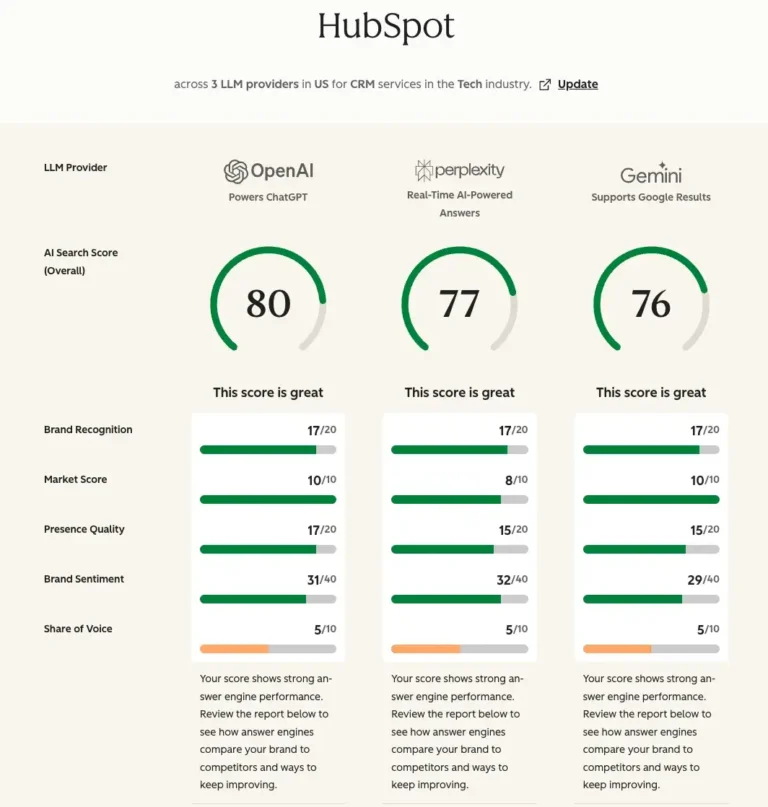
HubSpot AEO is designed to track brand visibility across major AI platforms like ChatGPT, Gemini, and Perplexity. It identifies instances where competitors are cited instead of your brand and analyzes the domains and content types that AI engines frequently reference within your industry. This analysis generates a prioritized list of actionable recommendations. This measurement-centric methodology mirrors HubSpot’s internal approach to AI-search optimization, the details of which are documented in their CRM AI-search case study.
HubSpot AEO is available as a standalone product for $50 per month, providing visibility tracking, citation analysis, competitive benchmarking, and actionable recommendations. For existing users of HubSpot Marketing Hub Professional or Enterprise, AEO is included at no additional cost, seamlessly integrating its recommendations with CRM data and content management tools.
Frequently Asked Questions About AEO Cost
Is AEO different from SEO and do I need both?
Yes, AEO is distinct from SEO. While SEO optimizes web pages for traditional search engine rankings, AEO focuses on securing brand mentions and citations within AI-generated answers. They share a foundation of credible content, but diverge in their primary objective and measurement. Most organizations benefit from investing in both, as strong SEO rankings often contribute to AI citations, and a decline in one can negatively impact the other.
Can I do AEO myself with just monitoring tools?
Partially. Monitoring tools are invaluable for tracking AI visibility and identifying opportunities. However, they do not execute the necessary optimizations. Content creation, schema implementation, and off-site authority building remain tasks that your team must either handle internally or outsource. Tools like HubSpot AEO provide analysis and recommendations, but the execution still lies with the user.
How long until I see results from AEO?
Early indicators of AEO success can typically be observed within the first 60 to 90 days of a focused pilot. This period may reveal improvements in visibility and share of voice. However, the compounding effects of content and off-site authority building take longer to materialize. Due to the inherent variability in AI answer generation, it is crucial to track trends over time rather than relying on isolated data points.
What should be included in an AEO statement of work?
A comprehensive AEO statement of work (SOW) should detail specific deliverables rather than vague promises. Key components include the number of AI engines and prompts to be tracked, content production or revision targets, technical SEO tasks such as schema and entity optimization, any off-site authority building scope, and the frequency of reporting. Many agencies require a minimum commitment period, often three months, which should be clearly stipulated.
How do I budget for AEO if I’m a small team?
For small teams, a lean approach is recommended. Begin with monitoring subscriptions, which can range from a low monthly cost to approximately $50. A one-time audit can also be beneficial. Focus on identifying and addressing low-cost, high-impact gaps in AI visibility before investing heavily in large-scale content production or off-site campaigns. Establishing a baseline and prioritizing immediate opportunities is key. HubSpot AEO’s free trial offers a cost-effective way to initiate monitoring and analysis.
About the Author