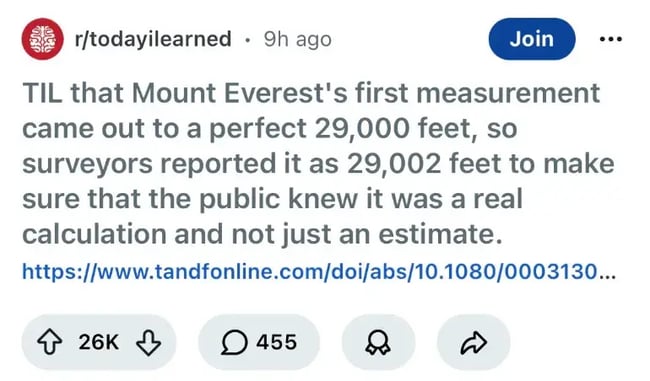
The exact elevation of Mount Everest, the world’s tallest peak, was not initially declared as a neat, round figure. Instead, the British Royal Geographical Society, following the monumental task of its first comprehensive measurement, announced the height of the majestic mountain as 29,002 feet. This seemingly minor deviation from a perfect 29,000 feet was not an error, but a deliberate choice rooted in a profound understanding of human perception, a principle later validated by extensive psychological research. The surveyors, meticulously calculating the colossal stature of the Himalayas’ crown jewel, understood that a precise, even oddly specific, measurement lent an air of irrefutable accuracy. A rounded number, while simpler, could inadvertently suggest an approximation, a less rigorous assessment. This historical decision by the Great Trigonometrical Survey of India in the mid-19th century, particularly the decade of the 1850s, foreshadowed a psychological phenomenon that would be scientifically explored and confirmed decades later, impacting everything from charitable giving to high-stakes negotiations.
The Genesis of the Precise Measurement: A 19th Century Endeavor
The mid-19th century marked a pivotal era in the exploration and cartography of the Indian subcontinent. The Great Trigonometrical Survey of India, a project of immense scale and ambition, undertook the formidable task of mapping the vast and challenging terrain. Among its most significant objectives was the accurate determination of the height of the highest peaks in the Himalayas. This endeavor was not merely an exercise in cartographic precision; it was a testament to imperial ambition, scientific curiosity, and the burgeoning understanding of geodesy – the science of measuring and representing the Earth’s shape and size.
The survey, initiated in 1802 under the command of Lieutenant-Colonel William Lambton, continued for over half a century, pushing the boundaries of surveying technology and human endurance. By the 1840s, the focus had turned towards the formidable Himalayan range. The peak that would eventually be known as Mount Everest, then referred to by its local names such as Sagarmatha in Nepali and Chomolungma in Tibetan, presented a unique challenge. Its sheer scale and remote location demanded innovative approaches and unwavering dedication from the surveyors.
The process of measuring such a colossal mountain was a complex undertaking. It involved establishing a vast network of triangulation points, extending from the plains of India to the high-altitude regions. These observations, taken over vast distances, relied on sophisticated instruments like theodolites, which allowed for precise angle measurements. The calculations involved were complex, accounting for factors such as atmospheric refraction, curvature of the Earth, and the gravitational pull of the mountains themselves.
It was in 1852 that Radhanath Sikdar, an Indian mathematician and surveyor working for the survey, is credited with identifying Peak XV (the survey’s designation for Everest) as the highest mountain in the world. The subsequent years were dedicated to meticulously verifying and calculating its precise elevation. The data gathered was then subjected to rigorous analysis by the leading scientific minds of the time, primarily within the British Royal Geographical Society.
When the findings were eventually published, the figure of 29,002 feet emerged. This number, rather than a round 29,000 feet, was the product of the scientific process, reflecting the best available data and calculations. The decision to present this precise figure, rather than rounding it for simplicity, was a tacit acknowledgment of the scientific rigor involved and a desire to convey the highest degree of accuracy. This early instance of leveraging numerical specificity to enhance perceived credibility would resonate through the annals of human interaction.

The "Pique Technique": Disrupting Mindless Compliance
The psychological underpinnings of why specific numbers are more persuasive than rounded ones were not scientifically explored until the late 20th century. A seminal study published in the Journal of Applied Social Psychology in 1994, conducted by researchers Michael D. Santos, Craig Leve, and Anthony R. Pratkanis from the University of California, Santa Cruz, provided compelling evidence for what they termed the "pique technique."
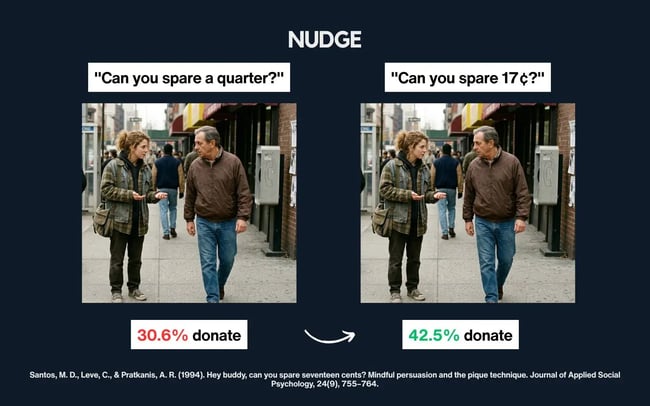
This technique posits that people are more likely to comply with a request if their typical, automatic "mindless refusal" is disrupted by an unusual or specific appeal. In their experiment, the researchers sought to test this hypothesis by observing how people responded to requests for monetary donations. Three female actors approached 289 adults, posing a simple question: "Can you spare 17 cents?" or "Can you spare 37 cents?" The control group, conversely, was asked a more conventional question: "Can you spare a quarter?" or "Can you spare any change?"
The results were striking. Those who were asked for the precise, unconventional amounts of 17 or 37 cents were significantly more likely to donate change than those who were asked for a round quarter or simply "any change." This outcome suggested that the specificity of the request acted as a cognitive trigger. Instead of automatically dismissing the request based on habit or a general unwillingness to give, the unusual monetary figures prompted recipients to pause and consider the request more deliberately. The oddity of "17 cents" or "37 cents" signaled that the request was not a rote one, implying a more genuine need or a more thoughtful consideration on the part of the asker.
This finding was significant because it demonstrated that precision, even in small, seemingly inconsequential amounts, could overcome ingrained behavioral patterns. It suggested that the human mind processes precise figures differently from round numbers, attributing a higher degree of authenticity and justification to the former. The researchers inferred that the perceived randomness of a precise figure made it seem less arbitrary, implying a thoughtful rationale behind the specific request.
Extending Precision: The "37 Seconds" Experiment
Building on the success of the 1994 study, researchers later investigated whether the pique technique, and the persuasive power of precise numbers, extended beyond monetary transactions to other forms of requests, specifically those involving time. In 2015, Professor Nicolas Guéguen, a behavioral scientist at the University of Southern Brittany in France, led a study that directly explored this question.
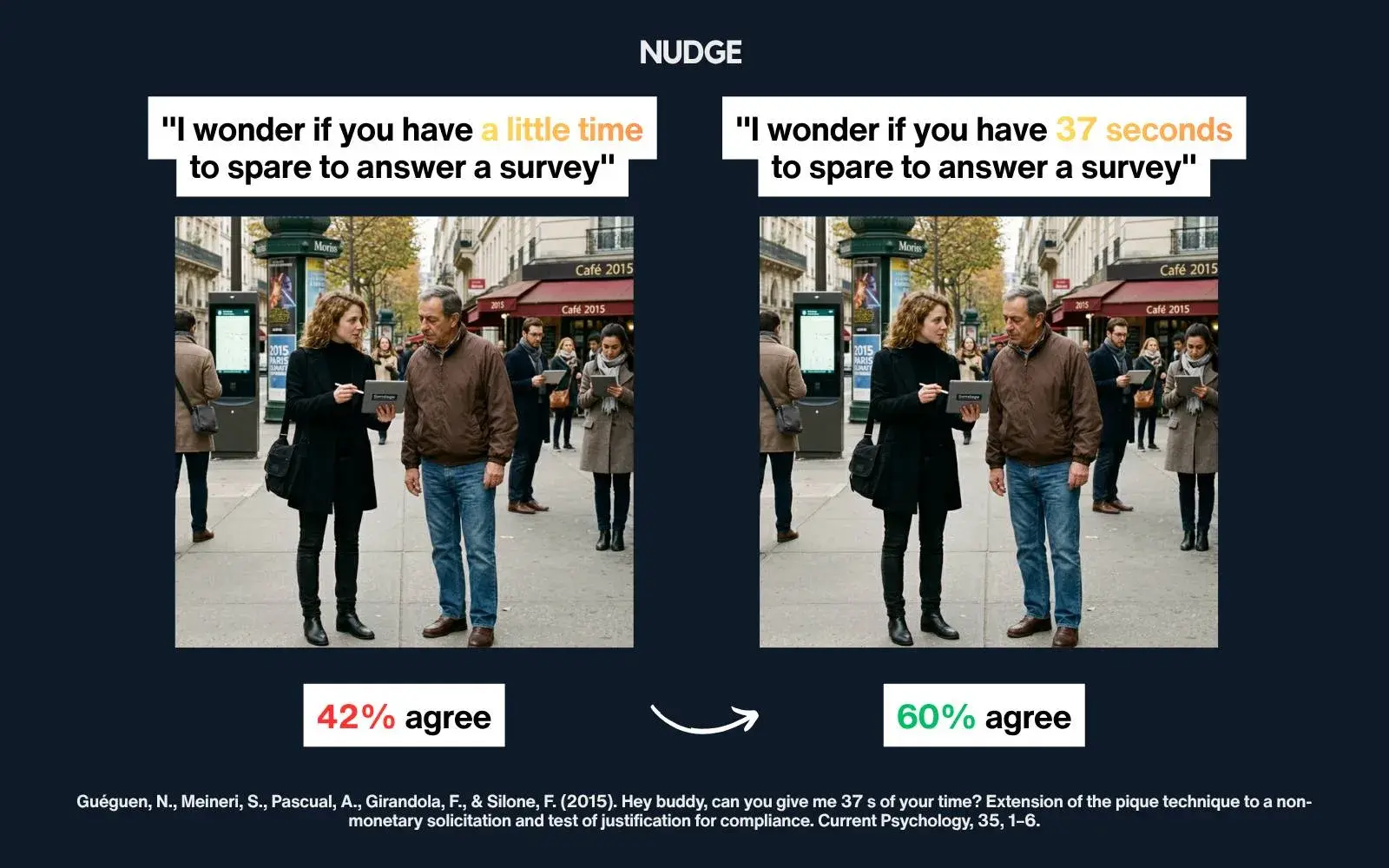
Guéguen and his team recruited four female actors, uniformly dressed in black to ensure a consistent presentation, to solicit participation in a survey from passersby. A total of 300 individuals (150 men and 150 women) were approached. The critical variable was the framing of the request for their time. One group of 150 individuals was asked, "I wonder if you have a little time to spare to answer a survey." The other 150 individuals were asked, "I wonder if you have 37 seconds to spare to answer a survey."
The findings mirrored those of the earlier monetary study. Of the 150 people asked for "a little time," only 63 agreed to participate. However, when the request specified "37 seconds," a remarkable 90 individuals complied. This represented a substantial increase in compliance, with the precise time request boosting participation by an impressive 42.9%.

This experiment reinforced the notion that precision in requests, regardless of the commodity being sought (money or time), significantly enhances the likelihood of compliance. The "37 seconds" request, much like "17 cents," acted as a cognitive disruptor. It prevented the automatic "no" response by presenting a seemingly well-defined and quantifiable commitment. The recipient was prompted to mentally calculate whether 37 seconds was a feasible or reasonable amount of time, rather than resorting to a generalized refusal of an ill-defined "little time." The implication is that a precise commitment, even a small one, feels more considered and less burdensome than a vague one, leading to a greater willingness to engage.
Precision in Negotiation: The Car Sale Scenario
The principle of precision influencing trust and compliance extends into more complex transactional environments, such as negotiations. A 2013 study published in the Journal of Experimental Social Psychology by four researchers investigated the impact of precise pricing on negotiation outcomes.
In one of their experiments, hundreds of participants were tasked with negotiating the hypothetical sale of a second-hand car. The buyers were divided into two groups. One group was instructed to initiate the negotiation with a rounded starting price of $2,000. The other group was instructed to use a precise starting price, either $1,865 or $2,135. The researchers aimed to determine if these precise starting prices would influence the counter-offers made by the sellers and, consequently, the final selling price.
The results indicated a clear correlation between the precision of the initial offer and the negotiation dynamics. When buyers presented a precise starting price, sellers tended to make smaller adjustments in their counter-offers. Conversely, when buyers began with a rounded price of $2,000, sellers were more inclined to make larger concessions. The use of precise numbers, such as $1,865 or $2,135, lent an air of legitimacy and justification to the price. It suggested that the buyer had conducted thorough research or had a specific valuation in mind, making the offer appear more reasoned and less arbitrary. This, in turn, led to a greater perceived fairness and ultimately influenced the final selling price, often resulting in higher outcomes for the party using the precise figure.
This finding has significant implications for sales and marketing. It suggests that presenting prices with specific, even seemingly arbitrary, decimal points or unusual figures can enhance credibility and potentially lead to more favorable outcomes. The perception is that a rounded number is a convenient simplification, while a precise number is the result of careful calculation and a true reflection of value.
The Underlying Psychology: Why Specificity Earns Trust
The recurring theme across these studies is that humans possess a natural inclination to associate rounded numbers with approximations, estimations, or even fabricated figures. The lack of specificity can trigger a subconscious skepticism, leading us to question the reliability of the information. In contrast, precise numbers, even if they appear oddly specific, convey a sense of thoroughness, diligence, and authenticity.
When a surveyor meticulously measures Mount Everest and arrives at 29,002 feet, the added two feet, while seemingly minor, signals that this is not a casual estimate. It suggests that the measurement process was detailed and that the result is a product of careful scientific observation. This imbues the figure with a greater degree of trustworthiness. Similarly, asking for "17 cents" implies a very specific need or a precise calculation of a required amount, making it harder to dismiss than a general request for "change." The same logic applies to requesting "37 seconds"; it implies a well-defined task that will not unduly consume one’s time.
This phenomenon is deeply ingrained in our cognitive processes. We often associate precision with accuracy and detail, qualities that are fundamental to credibility. In a world saturated with information, both accurate and misleading, our brains are wired to seek signals of trustworthiness. Specific numerical data, particularly when it deviates from easily rounded figures, serves as one such signal. It suggests that the source has invested effort in obtaining and presenting accurate information, thereby earning our trust and increasing our willingness to comply with requests or accept claims at face value.
Implications for Marketing and Communication
The insights derived from these studies have profound implications for marketers, communicators, and anyone seeking to persuade or inform an audience. While marketers often round numbers to create a sense of simplicity and polish in their messaging, this approach may inadvertently undermine their credibility.
Consider pricing strategies. Instead of marketing a product at $100, a price of $99.97 might be more effective in certain contexts. This precise figure, while only a small deviation, can make the price seem more carefully considered and less arbitrary, potentially leading to increased sales. Similarly, when communicating statistics or claims, using specific, granular data rather than broad generalizations can significantly enhance the perceived accuracy and trustworthiness of the message.
For instance, instead of stating that a product improves efficiency by "up to 20%," a more precise claim, if supported by data, such as "increases efficiency by 18.7%," can resonate more strongly with consumers. This level of detail suggests that the claim is backed by rigorous testing and analysis, rather than being a marketing exaggeration.
The principle extends to time-sensitive offers or commitments. Instead of offering a "limited-time discount," specifying the exact duration, such as "discount ends in 48 hours," can create a greater sense of urgency and authenticity. The specific timeframe makes the offer feel more concrete and less like a generic marketing tactic.
Furthermore, in customer service interactions, specific responses can be more reassuring. If a customer inquires about a delivery time, providing a precise window, such as "your package is expected to arrive between 2:15 PM and 2:45 PM," is often perceived as more reliable than a vague "sometime this afternoon."
Broader Impact and Future Research
The "precise number effect," as it can be termed, is a subtle yet powerful aspect of human psychology that influences decision-making across various domains. From the monumental task of measuring the world’s highest peak to the everyday interactions of asking for change or negotiating a price, the way numbers are presented can significantly alter perception and behavior.
The initial decision by the surveyors of Mount Everest to record its height as 29,002 feet, rather than a round 29,000, stands as an early, practical application of this principle. It demonstrated an intuitive understanding that specificity fosters believability. The subsequent scientific validation of this phenomenon through studies on the pique technique and negotiation outcomes further solidifies its importance.
Future research could explore the nuances of this effect across different cultures and demographics. Are there cultural variations in how precise numbers are perceived? Do certain age groups or educational backgrounds respond differently to specific versus rounded figures? Additionally, the application of this principle in digital environments, such as online advertising and e-commerce, warrants further investigation. How can marketers effectively leverage precise numbers in the digital space to build trust and drive engagement?
In conclusion, the enduring legacy of Mount Everest’s measurement, marked by its precise 29,002 feet, serves as a potent reminder that in the realm of communication and persuasion, specificity often speaks louder than simplicity. By embracing precision, individuals and organizations can cultivate greater trust, enhance credibility, and ultimately achieve more impactful outcomes. The two extra feet on Everest are not just a testament to a surveyor’s diligence; they are a symbol of the profound psychological power of numerical accuracy.
About the Author