The digital marketing and search engine optimization (SEO) world is undergoing a seismic shift with the rise of artificial intelligence-powered search engines. As consumers increasingly turn to platforms like ChatGPT, Perplexity, and Google’s AI Overviews for direct answers, the traditional metrics of SEO are becoming insufficient. Visibility that once translated into website clicks and organic traffic can now vanish into synthesized responses, unseen by the user. This emergent challenge has given rise to a new discipline: Answer Engine Optimization (AEO), and with it, the critical need for AEO checkers. These tools are designed to gauge a brand’s presence within AI-generated answers, identifying when a brand is mentioned, when its content is cited, and crucially, where AI systems may be misrepresenting or overlooking a brand.
The core function of an AEO checker is to provide businesses with insights into their performance within these new answer engines. Unlike traditional SEO tools that focus on ranking for keywords in a list of search results, AEO checkers analyze the accuracy and frequency of brand mentions and content citations within AI-generated responses. This involves understanding which queries lead to AI overviews, whether a brand’s domain appears as a source, and what specific claims the AI makes about the brand. The data gathered by these tools can then inform strategic adjustments to content, website structure, and schema markup, aiming to improve a brand’s visibility and accuracy in AI-driven search interactions.
Understanding the mechanics of AEO requires a brief look at the evolution of search. For years, search engines like Google primarily presented users with a list of links, requiring them to click through to find answers. SEO strategies were largely built around optimizing content to rank high on these link lists. However, the introduction of sophisticated language models and AI capabilities has enabled search engines to synthesize information from multiple sources and present a single, comprehensive answer directly within the search results page. Google’s integration of "AI Overviews" in May 2024, for instance, marks a significant step in this direction, prioritizing synthesized answers for many queries. This shift means that even a top-ranking website might not be seen if its information is incorporated into an AI overview without a direct citation or mention that users recognize.
What is Answer Engine Optimization (AEO)?
Answer Engine Optimization (AEO) is the strategic practice of enhancing a brand’s presence and accuracy within AI-generated answers provided by conversational AI platforms and AI-powered search interfaces. These "answer engines," including ChatGPT, Perplexity, and Gemini, along with features like Google’s AI Overviews, aim to directly address user queries by synthesizing information from a multitude of online sources. Instead of presenting a list of hyperlinks, they offer a singular, often detailed, response.
![AEO checker tools that measure answer engine visibility [2026]](https://53.fs1.hubspotusercontent-na1.net/hubfs/53/aeo-checker-1-20260903-3858273.webp)
The fundamental goal of AEO is to ensure that when an AI engine processes a query relevant to a brand, it either accurately mentions the brand or cites its content as a source. This is distinct from, yet complementary to, traditional Search Engine Optimization (SEO). While SEO focuses on securing a high ranking in a list of search engine results pages (SERPs), AEO targets the visibility within the AI-generated answer itself. Strong SEO practices, such as clear website structure, authoritative content, and robust crawlability, remain foundational for AEO, as AI engines rely on these signals to determine which sources are trustworthy and relevant.
The shift in user behavior is palpable. Studies indicate a growing trend of users accepting AI-generated answers without further investigation, a phenomenon often referred to as "zero-click searches" in this context. This means that valuable brand visibility, once captured by organic rankings, can now be absorbed into an AI response, leaving the brand unseen and uncredited. AEO seeks to reclaim this visibility by ensuring that brands are not only discoverable by AI crawlers but are also prominently and accurately represented in the synthesized answers they produce.
The Role and Functionality of an AEO Checker
An AEO checker serves as a diagnostic tool, meticulously measuring a brand’s visibility across various answer engines. Its primary function is to translate raw data into actionable insights, guiding businesses on how to improve their AI-driven search performance. These checkers typically assess several key aspects:
- Brand Mentions: They identify instances where a brand’s name is explicitly mentioned within AI-generated answers.
- Content Citations: They track when AI engines cite a brand’s website or specific content as a source for the information provided in an answer.
- Competitor Analysis: They highlight instances where competitors are cited or mentioned, revealing competitive gaps.
- Accuracy of Information: Some advanced checkers can also flag inaccuracies or misleading claims made by AI about a brand.
- Query Performance: They analyze which specific search queries trigger AI overviews and how a brand performs for those queries.
Based on this comprehensive analysis, an AEO checker prioritizes areas for improvement. This could involve suggesting content updates to address specific questions, recommending schema markup enhancements to make content more understandable to AI, or identifying entities and factual claims that need reinforcement. The ultimate aim is to provide a clear roadmap for optimizing a brand’s presence in the evolving AI search landscape.
Manual Checks: Navigating Google AI Overviews
For businesses looking to understand their presence in Google’s AI Overviews (AIOs), a manual approach can be a starting point, particularly for those with a limited set of critical queries. This process involves actively querying Google and observing the results. It’s important to note that Google’s AIOs are not triggered for every search query. They appear when Google’s algorithms determine that a synthesized summary would be additive and provide a more direct answer than traditional links. This selective triggering means that AIOs can vary significantly from one search session to another.
![AEO checker tools that measure answer engine visibility [2026]](https://no-cache.hubspot.com/cta/default/53/9dd5e54b-fbef-4dd0-bc44-1689feb1ea18.png)
Step 1: Defining Priority Queries
The first step in a manual AIO check is to identify and list the queries that are most important to the brand. This typically includes:
- Brand name: Direct searches for the company’s name.
- Branded product terms: Searches for specific products or services offered by the brand.
- Informational queries: Questions that potential customers frequently ask and that the brand aims to answer through its content.
These queries should then be executed in a signed-out or incognito browser session to ensure unbiased results, free from personalized search history. For each query, three key pieces of information should be recorded:
- AI Overview Appearance: Does an AI Overview appear for this query?
- Brand’s Domain Presence: If an AI Overview appears, is the brand’s domain listed among the inline source links?
- Specific Claim: What exact claim or piece of information does the AI Overview make?
Step 2: Interpreting the Results
The interpretation phase involves comparing the data collected. Queries that trigger an AIO and successfully cite the brand’s domain are positive indicators. Conversely, queries where an AIO appears but cites competitors instead of the brand represent a "content gap" – an area where the brand is currently losing visibility. Given the dynamic nature of AIOs, a single instance of absence should be treated as a prompt for re-testing rather than definitive proof of lost placement.
Step 3: Building a Reporting Framework
For effective tracking and advocacy, a robust reporting system is crucial. This involves taking screenshots of each relevant result, clearly documenting the query, the date of the search, and the geographical location (as search results can vary by region). This provides a defensible record of performance over time. It’s important to recognize that Google Search Console, while a vital SEO tool, does not currently isolate AIO activity within its standard performance reports. AIO data is often aggregated into the general "Web" search type. While Google has begun rolling out dedicated generative AI performance reports, these initially focused on impressions and were not universally available.
Pro Tip: While manual checks are useful for initial exploration, they are not scalable for businesses with extensive query lists. The inherent volatility of AIOs makes manual sampling unreliable at volume. Automated AEO checkers are essential for continuous monitoring and efficient data capture.
![AEO checker tools that measure answer engine visibility [2026]](https://53.fs1.hubspotusercontent-na1.net/hubfs/53/aeo-checker-2-20260903-852936.webp)
Manual Checks: Examining ChatGPT and Perplexity Citations
Beyond Google’s AI Overviews, other prominent AI platforms like ChatGPT and Perplexity also provide synthesized answers, often with explicit citations. Checking brand visibility on these platforms requires a similar manual approach, focusing on how these engines integrate source material.
Perplexity, by default, attaches citations to virtually every answer it provides, directly linking to the source material. It also features a dedicated panel on the right side of the interface that lists all sources consulted for a given response. This makes identifying cited content relatively straightforward.
ChatGPT, when it utilizes web search capabilities to answer a query, also displays inline citations. Furthermore, it typically provides a "Sources" panel beneath the generated response, listing the websites that informed the answer.
Step 1: Conducting Practical Citation Checks
Using the same set of branded and informational queries defined earlier, users should check two critical elements for both ChatGPT and Perplexity:
- Domain Citation: Does the brand’s domain appear among the cited sources?
- Brand Mention: Is the brand’s name explicitly mentioned within the answer text itself?
A citation and a direct mention are distinct achievements, and tracking both provides a more complete picture of visibility.
![AEO checker tools that measure answer engine visibility [2026]](https://53.fs1.hubspotusercontent-na1.net/hubfs/53/aeo-checker-3-20260903-8904553.webp)
Step 2: Phrasing Prompts for Optimal Retrieval
For ChatGPT, the engine’s web search functionality is not always activated by default. It typically searches the web when a question clearly benefits from current information or when the user explicitly selects the web search option. To ensure that the AI accesses live sources that can be inspected, prompts should be direct and focus on current information. For example, queries like "best [category] tools for [use case]" or "latest trends in [industry]" are more likely to trigger live web searches.
Step 3: Logging Results and Translating Gaps into Actionable Tasks
The sources consulted by AI engines can vary significantly from one query to the next. Therefore, it is crucial to run each prompt multiple times across fresh sessions to capture this variability. For each run, meticulous records should be kept, including:
- The AI engine used (ChatGPT, Perplexity).
- The exact prompt submitted.
- The date of the search.
- Whether the brand was cited or mentioned.
- Which competitors appeared in the results.
This log will help identify inconsistencies, such as a brand being cited in one session but not the next, or being cited by Perplexity but not by ChatGPT for the same query. Each instance where the brand is absent and a competitor is present represents a clear task: either the content related to that question needs optimization, or its structure requires refinement. After making these improvements and republishing the content, the queries should be re-run to assess the impact.
AEO Checker Buyer Criteria: Selecting the Right Tool
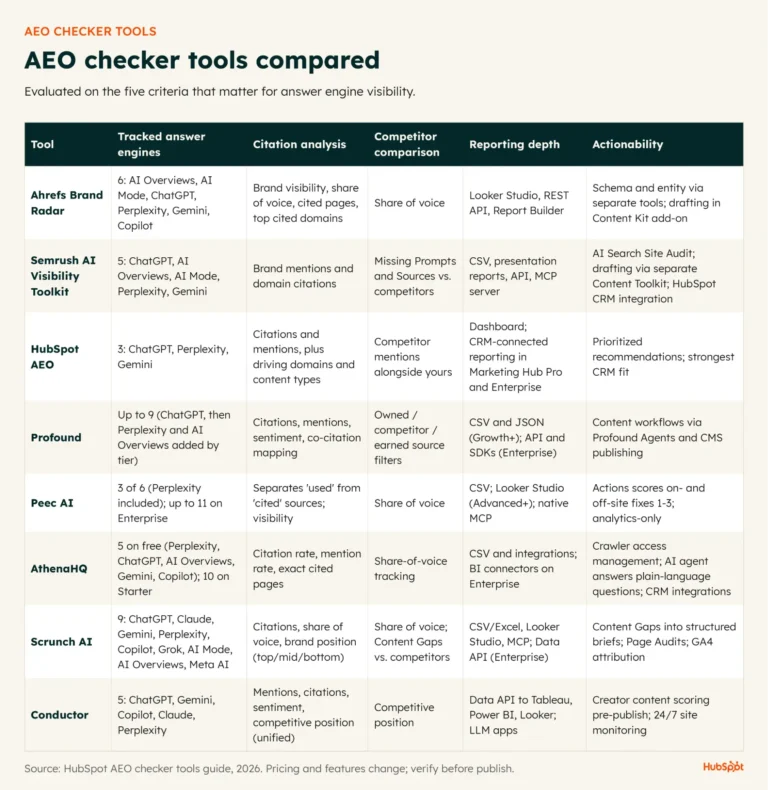
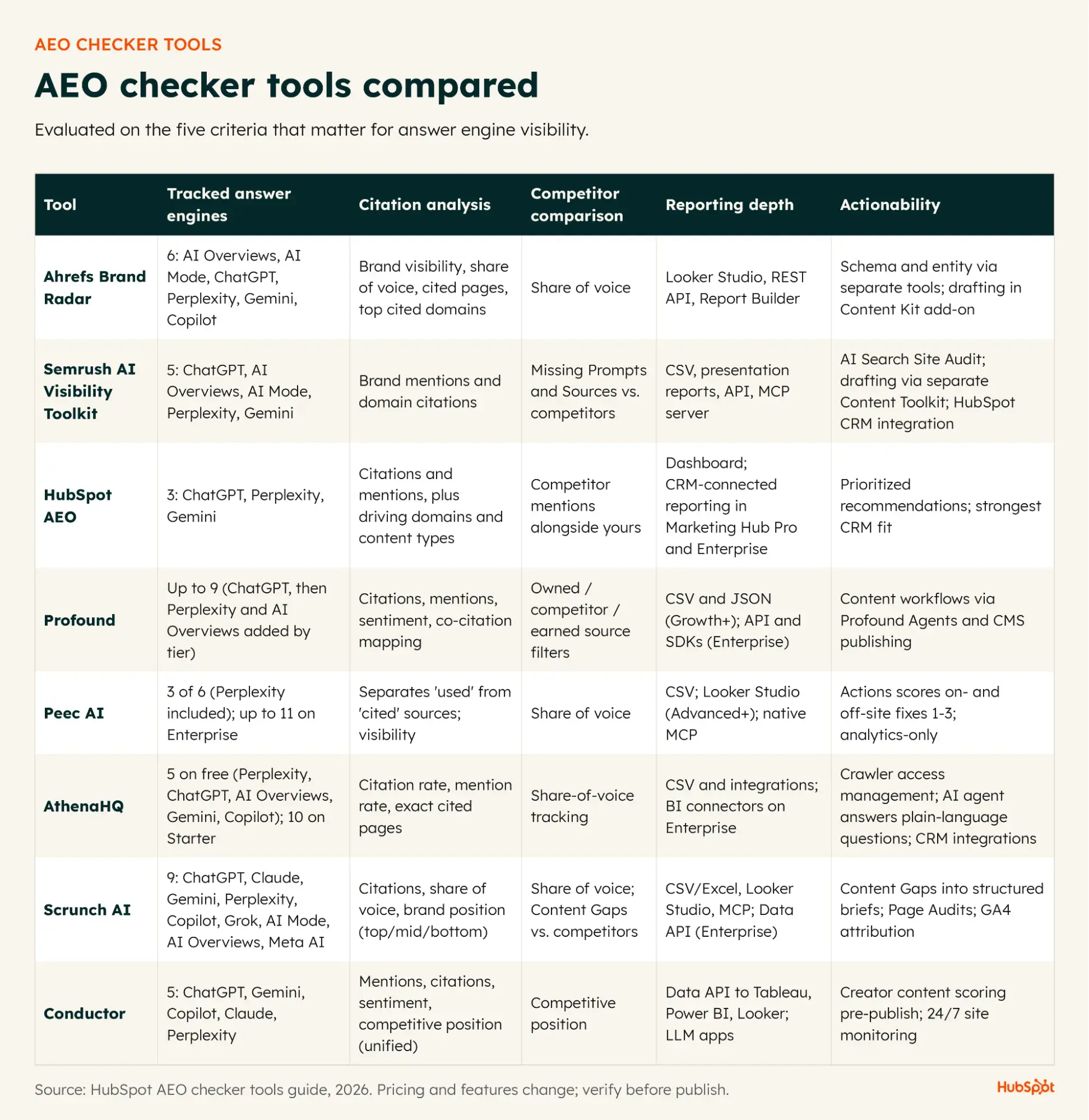
While manual checks provide foundational understanding, they are not a sustainable strategy for businesses aiming for consistent AI visibility. As the volume of queries and the dynamic nature of AI responses grow, the need for automated AEO checking software becomes paramount. When evaluating AEO checking tools, several criteria are essential:
- Engine Coverage: The tool should support monitoring across the most relevant AI answer engines, including Google AI Overviews, ChatGPT, Perplexity, and Gemini. Comprehensive coverage ensures a holistic view of a brand’s AI presence.
- Automated Monitoring: The software must offer continuous and automated tracking of AI visibility, eliminating the need for repetitive manual checks. This includes daily or weekly refreshes to capture the frequent shifts in AI response generation.
- Citation and Mention Tracking: The ability to track both direct content citations (links back to the brand’s domain) and brand mentions (where the brand name is used without a link) is critical.
- Competitor Benchmarking: The tool should provide insights into how competitors are performing within AI answers, enabling comparative analysis and identification of competitive opportunities.
- Actionable Recommendations: Beyond data reporting, the best tools offer concrete, prioritized recommendations for improvement, such as content optimization suggestions, schema markup enhancements, or entity-level improvements.
- Data Visualization and Reporting: Clear dashboards, intuitive visualizations, and customizable reporting features are necessary for stakeholders to easily understand the data and track progress over time.
- Integration Capabilities: For businesses using integrated marketing platforms, the ability to connect AEO data with CRM or other marketing tools can provide a more unified view of customer engagement and pipeline impact.
- Scalability and Customization: The tool should be able to handle a large volume of queries and offer customization options to align with specific business goals and target audiences.
AEO Metrics That Matter for Performance Tracking
Once an AEO checker is in place and actively monitoring a brand’s performance, focusing on specific metrics is key to understanding the effectiveness of optimization efforts. These metrics, when tracked over time, reveal trends and highlight areas of success or concern:
![AEO checker tools that measure answer engine visibility [2026]](https://53.fs1.hubspotusercontent-na1.net/hubfs/53/aeo-checker-4-20260903-6212698.webp)
- Visibility Score: This is a composite metric that quantifies a brand’s overall presence across AI engines. An increasing visibility score over weeks indicates positive progress.
- Citation Coverage: This metric measures the percentage of relevant queries for which a brand’s content is cited as a source. A rising citation coverage suggests improved content discoverability by AI.
- Mention Frequency: This tracks how often a brand’s name is mentioned in AI-generated answers. An increase here indicates better brand recognition and integration into AI knowledge bases.
- Share of Voice (SOV): This metric compares a brand’s visibility (mentions and citations) against its competitors within AI answers for specific queries or categories. A growing SOV is a strong indicator of competitive advantage.
- Top Performing Queries: Identifying which queries consistently result in positive AI visibility helps in understanding what content and topics resonate with AI engines.
- Content Gap Identification: Quantifying the number of queries where competitors are cited but the brand is not, highlights areas requiring immediate attention.
It is crucial to interpret these metrics as trends rather than isolated data points. A single reading may not be indicative of a larger shift. The direction and consistency of change over weeks and months are what truly matter. Furthermore, while direct attribution of zero-click traffic is impossible, metrics like AI-referred sessions (when available) and a lift in branded search can serve as proxies for the indirect influence of strong AI visibility.
From Measurement to Action: Integrating AEO into Workflows
The true value of an AEO checker lies not just in its diagnostic capabilities but in its ability to seamlessly integrate into the content creation and optimization workflow. Many AEO tools stop at identifying issues, leaving businesses to manually export data, brief content teams, and implement changes. However, advanced platforms are bridging this gap, enabling a more unified process from measurement to action.
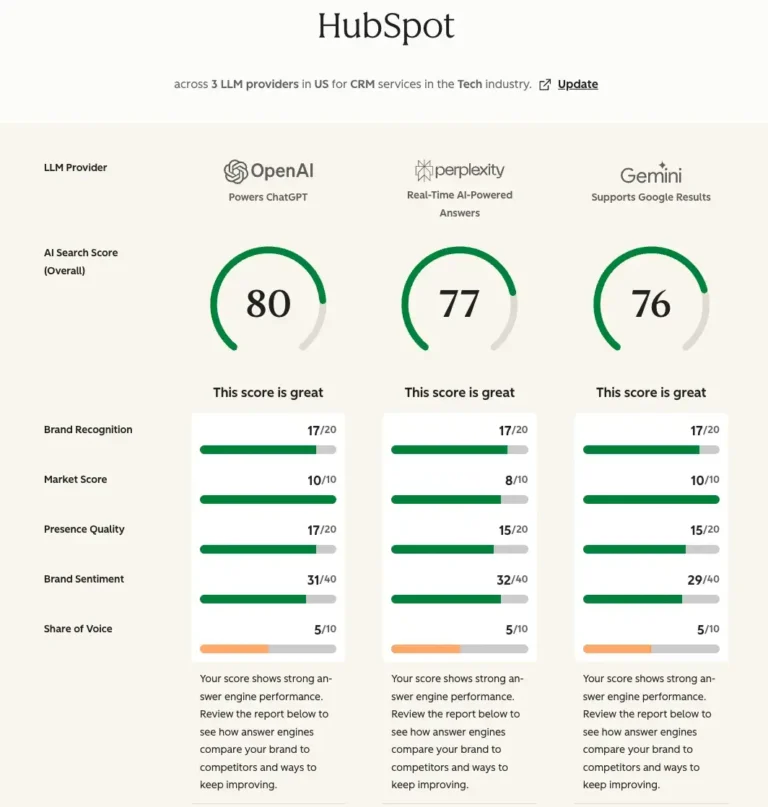
For instance, HubSpot’s AEO tools, integrated within Marketing Hub Professional and Enterprise, offer a more streamlined approach. Beyond tracking visibility across ChatGPT, Perplexity, and Gemini, these tools provide prioritized recommendations for content creation, updates, and outreach. In higher tiers of Marketing Hub, features like "Content Agent" can leverage CRM data to generate first drafts of blog posts based on AEO recommendations, directly within the HubSpot platform. This significantly reduces the friction between identifying a content gap and addressing it.
The draft content then lands in HubSpot’s content editor, allowing for team review and refinement before publishing through Content Hub or Marketing Hub. This integrated workflow ensures that AEO insights directly inform content strategy and execution.
A significant consideration in this new era of search is the "zero-click" phenomenon. While AI engines may resolve user queries without sending traffic to websites, strong AI visibility can still influence brand perception and, indirectly, future search behavior. When AI traffic does click through, platforms like HubSpot can attribute these sessions as originating from AI tools, linking them to contacts and deals within the CRM. This allows for a more holistic view of the customer journey, even when direct pipeline attribution is challenging. Therefore, visibility scores and referral revenue should be viewed as complementary indicators of a brand’s success in the evolving search landscape.
![AEO checker tools that measure answer engine visibility [2026]](https://53.fs1.hubspotusercontent-na1.net/hubfs/53/aeo-checker-5-20260903-8938354.webp)
Frequently Asked Questions About AEO Checkers
As businesses adapt to the growing influence of AI in search, several common questions arise regarding AEO and the tools used to manage it.
How Often Should You Run an AEO Check?
The frequency of AEO checks depends on the methodology used. For manual spot-checks, it’s advisable to sample multiple sessions per query due to the inherent variability in AI responses. Automated checkers, however, can provide more consistent data. Daily or weekly refreshes are recommended to capture the rapid shifts in AI-generated content, while monthly snapshots might obscure important short-term volatility.
Is AEO the Same as AI Search Optimization?
While the terms are often used interchangeably, "Answer Engine Optimization" (AEO) is more precise. It specifically refers to the practice of improving a brand’s presence within the AI-generated answers provided by tools like ChatGPT, Perplexity, and Gemini. "AI search optimization" is a broader term that could encompass other AI-related search functionalities. Standardizing on "AEO" ensures clarity in communication and strategy.
Can You Reliably Track Citations in ChatGPT and Perplexity?
Yes, with important caveats. Both ChatGPT and Perplexity can surface the sources that inform their answers, making individual responses readable and auditable. However, the dynamic nature of these engines means that results can change between search sessions. Reliability is achieved through repetition: running each prompt multiple times across fresh sessions and analyzing the patterns of citations and mentions, rather than relying on a single snapshot.
Do AEO Checkers Replace Traditional SEO Tools?
No, AEO checkers and traditional SEO tools serve distinct but complementary purposes. SEO tools focus on keyword rankings, backlink profiles, and overall website authority, which are crucial for discoverability. AEO checkers, on the other hand, measure how that discoverability translates into visibility within AI-generated answers. Strong SEO foundations remain essential for AI engines to crawl and trust content. Therefore, businesses should utilize both SEO and AEO tools in tandem to maintain a comprehensive search strategy.
About the Author